

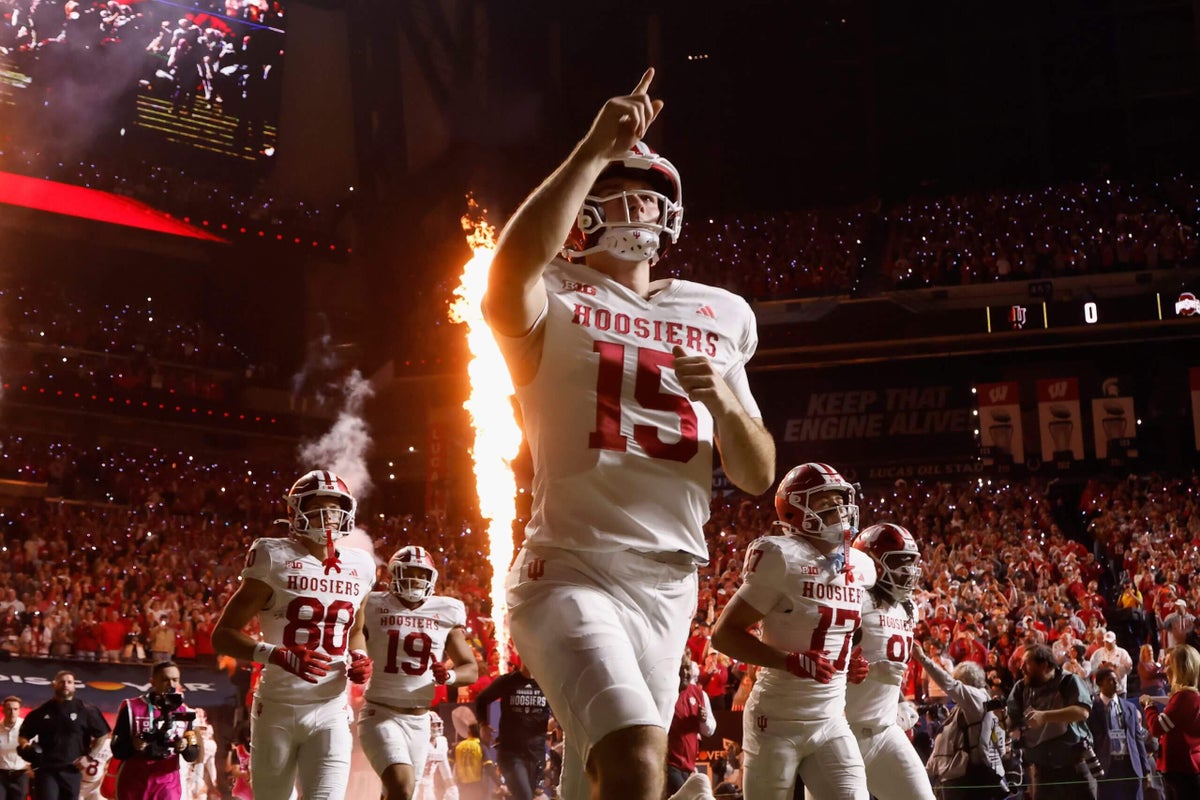
Conference championship weekend saved its drama for the very end, as Indiana fought off Ohio State for the Big Ten title while Duke helped pave the way for College Football Playoff chaos by upsetting Virginia.
For NFL teams, though, the real focus will be on what’s next. Which underclassmen will declare for the 2026 NFL Draft in the coming days? How will some of the most prominent prospects in the upcoming draft class perform when faced with win-or-go-home stakes?
We’ll soon find out. For now, draft experts Dane Brugler and Nick Baumgardner break down what we saw during Friday and Saturday’s action.
1. Fernando Mendoza took a huge shot, threw a tough pick and struggled to find space against Ohio State’s defense early, only to deliver a clutch dagger late. What else does he need to show NFL scouts?
Dane Brugler: “This is the guy you have teams trading up to No. 1 to get in your mock?”
I received more than a handful of comments like this on social media after the first quarter of the Big Ten Championship Game. Want to guess how many I received after the final three quarters?
Things rarely go as planned in football, and the best quarterbacks keep their calm and become even more focused in those pressing moments. Mendoza has put that mental toughness on display multiple times this season. He threw a fourth-quarter pick six against Oregon that tied the score, then answered immediately with a 12-play drive that ended with a go-ahead touchdown pass. It wasn’t always pretty against Iowa, but Mendoza made several NFL-level throws that led to another late, game-winning touchdown. And his final drive against Penn State cemented Mendoza’s legendary status in Indiana history.
In the Big Ten title game, against the No. 1 defense in the country, Indiana had a hard time early — not because of any major faults by its quarterback. Mendoza continued to battle and made several key throws to secure the win. Though box-score scouts might not be impressed, anyone who watched the game gets why Mendoza is so well-liked by NFL teams.
I don’t think there are many unanswered questions (on the field) when it comes to Mendoza’s evaluation. NFL teams certainly will welcome more high-profile games, against tough opponents, to see how far Mendoza and his competitive poise can extend Indiana’s Cinderella season.
EVERY ONE of Fernando Mendoza’s completed passes in the @bigten championship 🎯 pic.twitter.com/Zhk0v2vLm4
— FOX College Football (@CFBONFOX) December 7, 2025
Baumgardner: Mendoza’s a great quick-game processor who can take defenses apart on first and second downs based on pre-snap reads and legit arm talent. However, I still question his ability to be a truly decisive processor on third down (especially third-and-long), and we saw some of that again against Ohio State.
Mendoza’s numbers are all pretty good, but context is important — Indiana’s offense takes incredibly good care of him. As with Ohio State’s Julian Sayin, Mendoza’s play caller and head coach are an elite battery, and his run game keeps him out of dangerous situations more than most college passers. When he’s faced with difficult third-and-long spots, and defenses start mixing coverage, he can get hesitant. I love Dane’s Jared Goff comparison for Mendoza, but right now, Mendoza reminds me of where Goff was before he gained confidence ripping the ball into tight windows on critical downs.
This is kind of a nitpick, as Mendoza hangs in there better than most. But we’re talking about a potential No. 1 pick, so the discussion’s different. Still, as with Cam Ward last season, Mendoza improved from wire to wire this season, and there’s no reason to think that can’t continue in the NFL.
2. Dane posted after Alabama’s loss that Ty Simpson “needs more time in college” — something we’ve talked about before. Can Simpson flip his draft momentum back with an impressive performance or two in the playoff?
Brugler: Never say never. Simpson going on the road and playing lights out against a stingy Brent Venables’ defense in the first round of the Playoff would certainly be a statement. With the way November played out, though, the chances of that happening seem slim. And it isn’t just the quarterback that could hold Alabama back, but also a sloppy offensive line, marginal run game and inconsistencies from the pass catchers.
Simpson does a lot well. His ability to quickly eliminate things and get through his reads while using his athleticism and negotiating the rush can be impressive. He also has just 13 career starts, which shows when the defense gives him different looks and changes the picture to affect his timing and placement.
Whether to go pro or not is an individual decision with a ton of variables, so none of us can say what will be the main driver here. Objectively, though, Simpson needs more development and experience, and it is a good bet that most of his inconsistencies will continue to improve with another year in college.
Many will bring up his age (Simpson turns 23 later this month), but NFL teams don’t care about age nearly as much as fans think when it comes to quarterbacks. Michael Penix Jr. and Bo Nix were both 24 years old when they were drafted in the top 12 two years ago. Can you be a productive starter over the next 10 years? That’s all NFL teams want to know.
The other wrinkle: Alabama has five-star super recruit Keelon Russell ready to take over as the quarterback. Will the coaching staff be fully committed to Simpson if he returns?
Baumgardner: When we talk about the difference between players such as Mendoza and Simpson, it’s almost always an experience (or a data) thing. With Mendoza, you can be more comfortable right now that he won’t do something on third down that’ll truly hurt the team. If he bails too early and throws the ball away, so be it. More often than not, Mendoza isn’t making a careless throw in those spots.
Simpson has done that a few times this year, though. It’s not exactly a debilitating habit, but it’s hard to say it’s not a problem because we only have one year of data. Think back to 2023 and remember how first-year starter Carson Beck played at Georgia. Had he declared for the draft that year, I’d bet a dollar he’d have been selected near the bottom of the first round or top of the second — right where the Titans took Will Levis. We had one season of mostly very good data on Beck at that point. As time wore on, the picture changed.
We had questions about C.J. Stroud that year, too. Stroud had more experience, but he also went into the postseason and played the game of his life against Georgia. Should Simpson do that against a real defense or two in the Playoff, I’ll bet another dollar he changes some minds. Easier said than done.
3. It’s time for fans to get to know Tulane and James Madison. Are there any draft-eligible prospects of note on either roster?
Baumgardner: If you could get like 10 more pounds on 5-foot-7, 190-pound James Madison running back Wayne Knight (not to be confused with the guy who played Newman on “Seinfeld”), you might have something. I’d expect Knight to be back in school somewhere next season after a huge 2025. He’s the Dukes’ leading rusher (1,258 yards, 9 TD) and leads the team in catches (37 for 373 yards). Despite his size, he’s extremely quick in the hole with great contact balance.
Another guy to watch in the future: James Madison second-year edge Sahir West (6-4, 270), who has added roughly 50 pounds since high school. He still moves like a much lighter player and has solid length. He can also slide down and play three tech. West has seven sacks with 38 pressures this season and a 15.8 percent win rate. He’ll be a highly paid college player somewhere next year and on the draft radar down the road.
Brugler: Honestly, there isn’t a senior on either team who is considered a draft lock, but there are a few potential priority free agents worth checking out. Tulane defensive lineman Kameron Hamilton (6-3 3/8, 279) is a little bit of an end/tackle tweener, but he found a role from day one. He’ll be an NFL practice-squad candidate in his first season, and I won’t be surprised if he eventually finds his way onto a roster.
Tulane quarterback Jake Retzlaff, a transfer from BYU, is undersized (6-0, 200) and tends to stare down his reads, but he has an NFL-quality arm with enough mobility to extend. He is a potential camp arm.
For James Madison, safety Jacob Thomas is a good-sized athlete with solid instincts against both run and pass. The former walk-on will get his chance in an NFL camp.
4. Since defenses mostly ruled Saturday: Which defensive prospects helped their causes on championship weekend?
Baumgardner: The longer Texas Tech plays, the more linebacker Jacob Rodriguez is going to grow on people. He’s a terror. He leads all Power 4 linebackers with 65 stops this season and has more than 100 combined over the last two years. He was everywhere against BYU in Saturday’s title game, too. Rodriguez could be bigger, but his effort and potential in coverage make up for an awful lot.
Same with Texas Tech edge David Bailey, who had another sack with four more pressures Saturday. For the season, he leads the FBS with 74 pressures and 14 sacks. He is the most polished pure pass rusher in this draft class.
Brugler: Georgia cornerback Daylen Everette was a “stock down” prospect much of the year for NFL area scouts, but he picked a good time to play his best. He finished the SEC title game with an interception (which he returned 30 yards) and another pass breakup, adding to his big-game resume (two interceptions in the SEC Championship Game last year). Everette (6-1, 195) has good size and uses his length to stay attached early in man-to-man. He can get lost at times when late to read route combinations, and his tackling must improve, but Saturday was a reminder of what he looks like at his best.
Make the pick ➡️ Get the spike pads pic.twitter.com/oRE8xQ4Pu5
— SEC Network (@SECNetwork) December 6, 2025
Mikail Kamara was the guy to watch on Indiana’s defensive line coming into the year, but Kent State transfer Stephen Daley might have surpassed him as the better NFL prospect. The senior was disruptive in the MAC and has translated his game well to the Big Ten. Whether he was lined up on the edge or inside, Daley’s strength, hand usage and motor really jumped out against Ohio State.
5. What other draft takeaways do you have off Friday’s and Saturday’s action?
Brugler: Georgia tight end Lawson Luckie saw only one target against Alabama, which he turned into an 18-yard reception, but his run blocking was the main takeaway from the SEC title game. With physical hands and point-of-attack strength, Luckie consistently won the edge to open holes and allow the Georgia running backs to attack the second level of the defense.
This is a strong tight end draft class, with Kenyon Sadiq at the top and a deep pool of seniors in Rounds 3-7. If Luckie declares, an already loaded position in the 2026 NFL Draft gets even stronger.
Baumgardner: His team got hammered, 34-7, but it’s hard to argue with the effort put forth by BYU running back LJ Martin. The 6-2, 220-pounder had 76 yards on 19 carries Saturday, with seven catches for another 27 yards. Martin has made at least four catches in four of his last five games and now has a career-high 36 for the year, plus 1,299 rushing yards and 12 scores. He’s really tough after contact, with good vision and quick feet. Martin’s work as a receiver has been his biggest improvement this year.
He’s a true junior, so he could certainly return to school, but he’s already had 483 rushing attempts for 2,537 yards at BYU. I’d be curious to see how he tests, as I think he has Day 2 potential.