

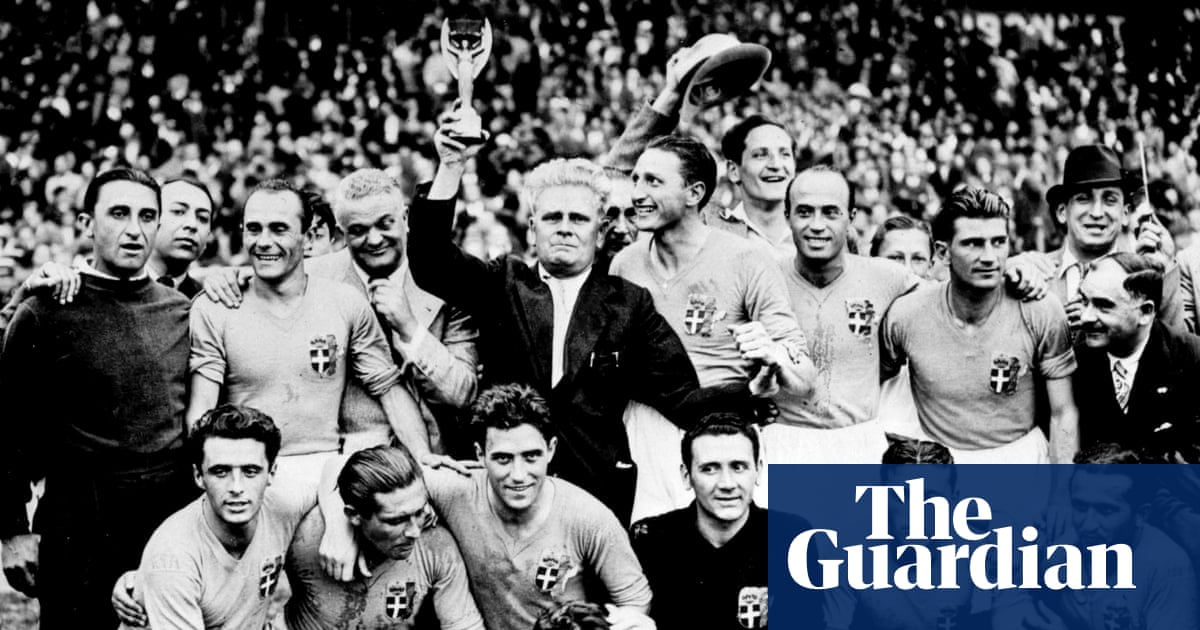
Vittorio Pozzo, the only manager to win two men’s World Cups, in 1934 and 1938, is often celebrated as the competition’s greatest manager. But long before he masterminded the Azzurri’s twin triumphs, Pozzo was a young officer enduring the brutal realities of the first world war. Pozzo’s experiences in the trenches from 1915 to 1918, by his own admission, forged the discipline, resilience and leadership that defined his coaching philosophy.
Born in Turin in 1886, Pozzo fell in love with football while watching Manchester United in his youth. By 1911 he was back in Italy, helping found Torino FC and managing the club’s early teams. When Italy entered the war in May 1915, the 29-year-old volunteered immediately as a lieutenant in the 1st Alpini Regiment, elite mountain troops specialised in high-altitude combat.
Pozzo was thrust into the Dolomites along the Isonzo River front, a jagged hellscape of sheer cliffs, glaciers and perpetual fog. “The mountains were not romantic; they were murderers,” Pozzo wrote in his autobiography, La Mia Vita. His unit’s first major engagement was the First Battle of the Isonzo in June and July 1915, part of Italy’s ill-fated push to seize Trieste and Trento. Pozzo described the initial charge as soldiers scrambling up razor-sharp limestone under Austrian machine-gun fire, with bodies tumbling into abysses. The subsequent casualties were staggering; Italy lost more than 15,000 men in that battle alone.
Pozzo’s war was a vertical nightmare. Alpini troops dug trenches into ice-covered peaks at altitudes up to 3,000 metres, where temperatures plunged to -30C. “We lived like moles in the snow,” he recalled in letters home, preserved in Turin’s military archives. Shelters were carved from rock or snow caves; wooden planks served as beds, often shared with rats and lice. Food was scarce – hard bread, tinned meat, and watery soup – leading to widespread scurvy and frostbite. Pozzo lost toes to gangrene in 1916 but refused evacuation, insisting on leading his platoon.
Daily life revolved around patrols, mining enemy positions and repelling assaults. The Austrians held the high ground, raining down hand grenades rolled down slopes like bowling balls. Pozzo participated in the gruelling Sixth Battle of the Isonzo in August 1916, where Italy captured Gorizia after hand-to-hand fighting in tunnels blasted through mountains. Gas attacks were rare in the Alps due to winds but avalanches – natural or artillery-induced – claimed thousands of lives. One night in December 1916, known as “White Friday,” avalanches killed up to 10,000 soldiers on both sides; Pozzo’s unit narrowly escaped when their trench collapsed, burying comrades alive.
As an officer, Pozzo commanded 50–100 men, many peasants from Piedmont like himself. He emphasised camaraderie, organising impromptu kickabouts with rag balls during rare lulls. “In the trenches I learned that a team is only as strong as its weakest link,” he said after the war.
For Pozzo, the war’s turning point came on 24 October 1917, at the Battle of Caporetto (now Kobarid, Slovenia). A combined Austro-German offensive shattered Italian lines with innovative stormtrooper tactics and poison gas. Pozzo’s regiment was on the front at Tolmin when the barrage hit, more than 2,000 guns firing in a matter of hours. “It was apocalypse,” Pozzo later told journalists. His unit retreated in chaos amid mud-slicked paths, abandoning equipment. Italy lost 300,000 men (many surrendered) and the front collapsed 100km back to the Piave River.
Pozzo, promoted to captain, helped rally stragglers. He was wounded by shrapnel in the leg during the retreat but evaded capture. He also served in the counteroffensive at the Second Battle of the Piave in June 1918 and in the decisive Vittorio Veneto offensive four month later, which broke Austrian forces and ended the war for Italy on 4 November. By Armistice, Pozzo had earned two silver medals for military valour as well as a bronze one, citations praising his “exemplary courage under fire”.
Demobilized in 1919, Pozzo returned home physically and mentally scarred. He suffered nightmares and with post-traumatic stress disorder (PTSD) but managed to channel that into coaching. Appointed Italy’s national team manager in 1912 and again in 1929, he built the 1930s squads around metodo tactics –disciplined, defensive, and unbreakable – like the Alpini lines he once held.
Pozzo rarely spoke publicly about the war but in a 1934 interview with La Gazzetta dello Sport, he said: “The trenches taught me that victory comes from suffering shared, not individual brilliance.” His players noted his stern demeanour and emphasis on endurance training, echoes of mountain marches. More than a million Italians died in the war; Pozzo survived to lift two World Cups, dying in 1968 at the age of 82.
In essence, Pozzo’s trench odyssey wasn’t just about survival; it was the crucible that tempered a football immortal. Without the Alps’ unforgiving forge, there might never have been the Azzurri’s golden era.
Lionel Scaloni and Didier Deschamps are World Cup-winning managers vying to emulate Pozzo and they are treading where many have tried and failed, including Alf Ramsey, Mario Zagallo, Carlos Bilardo, Luiz Felipe Scolari, Marcello Lippi, Vicente del Bosque and Joachim Löw. As things stand, Pozzo remains a solitary figure on a seemingly immovable pedestal, one who was inspired by the experience of past traumas.
Architects of Glory by Geoff Brown and Jon Reeves will published by Sona Books in May 2026.