

You can’t make an omelette without breaking a few eggs. That has increasingly become NBA teams’ mindset when it comes to chasing extra possessions and the potential costs of doing so.
Let’s back up a bit. With a bit more than a quarter of the season complete and most teams on mini-hiatus for the next 10 days while the NBA Cup plays out, it’s a good time to exhale and take a look at some league-wide trends.
One notable shift that stands out is that fouls and free-throw attempts have both sharply increased from a year ago. While this can change over the course of a season as both players and officials react to each other — most notably in the “no paint fouls” era in the second half of the 2023-24 season — I suspect this one is likely to stick around, because it’s driven by bigger stylistic changes that we’re seeing league-wide.
First, the data on fouls. League-wide free-throw attempts per field-goal attempt are up by 14.8 percent from a year ago; league-wide fouls per 100 possessions are up 13.4 percent. That comes in the wake of a flat half-decade-long trendline in the post-COVID-19 era:
NBA Foul Trends By Season
|
YEAR
|
FTR
|
PF/G
|
|---|---|---|
|
2025-26 |
0.279 |
21.1 |
|
2024-25 |
0.243 |
18.6 |
|
2023-24 |
0.244 |
18.7 |
|
2022-23 |
0.266 |
20.0 |
|
2021-22 |
0.248 |
19.6 |
|
2020-21 |
0.247 |
19.3 |
|
2019-20 |
0.260 |
20.8 |
|
2018-19 |
0.259 |
20.9 |
FTR = free-throw attempts per field-goal attempt
PF/G = Fouls per team per game
The 2022-23 season stands out as something of an outlier, and 2023-24 was trending the same way before an abrupt reduction in fouls and free throws after the All-Star break. Still, even those seasons pale beside what we’ve seen in 2025-26. To have double-digit percent increases in foul rates in one season is a fairly extreme shift.
Pedants will note that pace is also up this year, which would affect personal fouls per game, but it’s only a 1.2 percent difference, and the foul rate has increased more than 10 times that amount. That isn’t the cause here.
What is? The first instinct is to blame the refs somehow, but that quickly leads to dead ends. I’ve been in a lot of arenas in the last month, and nobody is really talking about changes in the officiating this year. (As opposed to, say, March 2024, when everyone was talking about it). To my own eyes, I haven’t seen play types officiated differently than previous years. And anecdotally, post-game officiating rants have been an uncommon sight.
A more possible boogeyman would be the Oklahoma City Thunder, who nearly set a record for defensive efficiency last season while finishing 26th in opponent free-throw rate. The team that finished just behind them in the defensive stats, the Orlando Magic, was 29th in opponent free throws.
What those two teams mastered was “possession-ball,” something I wrote about earlier this year as teams have leaned into it more. Both Oklahoma City and Orlando forced heaps of turnovers and controlled the boards, limiting opponent field-goal attempts.
The flip-side of that is the Houston Rockets’ approach, which is to go nuts on the offensive glass and attempt to win the possession battle that way. This is basically a new paradigm in the league, replacing the previous 2010s orthodoxy of limiting rebounding attempts to avoid surrendering transition. This more aggressive approach has increased offensive rebound rates across the league. (Well, except in Milwaukee.)
Meanwhile, teams have also leaned into using ball pressure to generate more turnovers — again, I discussed this at length earlier in the season. That’s a direct response to both the ridiculous efficiency some modern offenses have achieved if they’re just allowed to play pop-a-shot … and, ironically, to the increased physicality allowed on the perimeter since the middle of the 2023-24 season.
Perhaps as a reaction to the success of teams like Thunder, Magic and Rockets, both offensive rebounds and turnovers are way up this year. The league-wide offensive rebound rate this season is 26.2 percent, and the league-wide turnover rate is 13.0 percent. The rebound rate has seen an 8 percent jump just in the last two years and an 18 percent jump from the league’s low ebb of a 22.2 percent rebound rate in 2020-21. Meanwhile, the turnover rate of 13 percent hasn’t been exceeded in the last decade and is a 7.4 percent jump from last season.
Some individual teams have been wild outliers: Oklahoma City and the Phoenix Suns are turning teams over on more than 15 percent of their possessions, while Houston has an unthinkable 38 percent offensive rebound rate.
So, back to our omelette: Possession-ball isn’t possible without fouls, and often fouls on both sides. Increasing offensive rebound attacks also increases the number of contested rebounds, which adds to the number of loose-ball fouls in both directions. One sight that’s been especially common, however, is a ref on the baseline blowing their whistle, raising both arms and then pointing their fingers at the floor, in an exaggerated “stays here” motion after the defense fouls an opposing offensive rebounder.
For instance: Just try uprooting Steven Adams without getting a whistle. Watch as Denver’s Bruce Brown leans in with his full body weight and two arms, doing his best Sisyphus impersonation to roll this human boulder out of the way:
This happens nearly every game with Adams, whose 25.4 percent offensive rebound rate leads the league among players with at least 300 minutes played; the dude is drawing fouls and earning free throws without even touching the ball.
Of course, that’s only part of it. Putbacks, as a shot type, also tend to generate a lot more shooting fouls than jumpers, putting even more pressure on the league-wide foul rate.
The same applies to a lesser extent with ball pressure. Not only does it increase the risk of fouls 50 feet from the basket (in theory, at least, although the league has been reluctant to call all but the most egregious hand-checks), it also increases the possibility of offensive fouls from frazzled dribblers.
Which takes us to the next question: Are foul rates about to escalate even more? It’s a copycat league, and the copying seems to be working. As much as teams such as the Rockets have rediscovered the value of crashing the glass to their offenses, many are seeing the foul-turnover tradeoff seems to favor the defense.
It’s not just the Thunder. The Detroit Pistons, for example, have the league’s third-best defense despite the worst opponent free-throw rate; they are third, however, in opponent turnover rate at 14.6 percent and second in offensive rebound rate at 31.5 percent. Phoenix has been less extreme, but it’s another surprise team that has benefited in a big way from owning the possession war despite a high foul rate. (The Thunder, I will note, have dialed back the fouling quite a bit in 2025-26; they’re now just awesome at everything).
Again, we’ve seen the ebbs of flows of league-wide trends pivot before; the NBA could decide to call the game differently, or other factors we can’t even conceive of yet could convince teams to tilt their focus in a different direction. Nonetheless, the possessions-and-fouls shift is one of the most notable stylistic changes we’ve seen in the league this season. Now the question, for the last three quarters of the season, is whether the trend only accelerates from here.
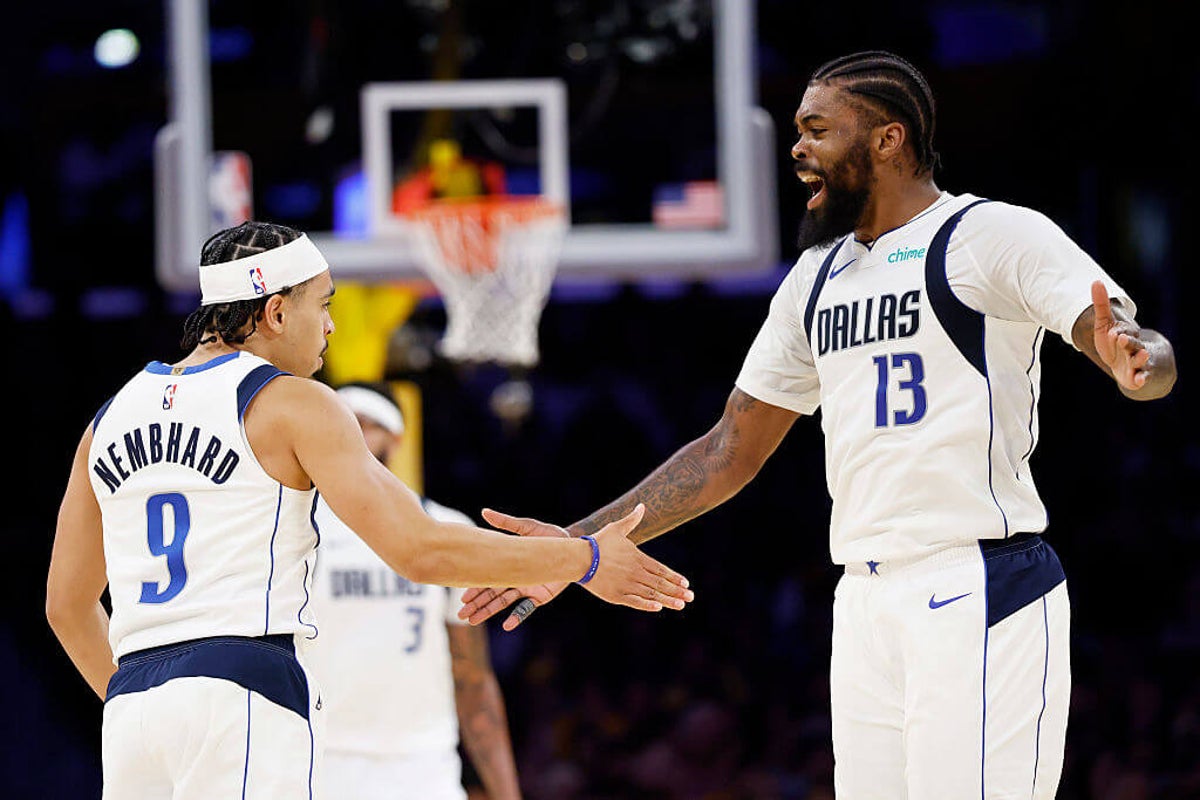
Rookie of the Week: Ryan Nembhard, PG, Dallas
Break up the Mavs! Dallas has won four of five, with the only blemish coming against the Oklahoma City Fully Operational Death Star, and those wins include victories over the Nuggets and Rockets. In a related story, Nembhard took over as the Mavs’ starting point guard six games ago, and he has immediately helped everything click for what had been among the league’s most constipated offenses.
To wit, Dallas had cleared the 110-point mark just nine times in its first 19 games but has done so in all six games Nembhard started. He scored 28 points on 12-of-14 shooting and added 10 assists in a shocking win at Denver, and then came back two days later to put up 15 and 13 as the Mavs beat the Miami Heat.
Nembhard, who measured 5 feet 11 without shoes at the NBA Draft Combine, went undrafted because of concerns about both his size and shooting; he’s five inches shorter than his brother, Indiana Pacers’ guard Andrew Nembhard, and thus has to play a different style of game.
Nonetheless, there are some parallels that track here: undervalued guards out of Gonzaga with tremendous instincts and basketball IQs to offset unremarkable physical tools.
For instance, watch this steal from Saturday’s win against Houston, when Nembhard is on top of Jabari Smith Jr.’s spin move to snatch the ball away from him with two hands. His quick hit-ahead pass after the steal then springs D’Angelo Russell for a transition layup:
Nembhard has also been good at avoiding mismatches of his own where possible. While his height is sometimes an unfixable disadvantage — you don’t often see Reed Sheppard play over the top of an opponent like he did a couple times against Nembhard — his IQ helps him stay out of trouble.
For instance, this next clip looks like a nothing play, but that’s NBA defense — the absence of mistakes is half the battle, and the technique for a rookie in his 12th game is notable. Nembhard not only avoids the temptation to switch on to the bigger Amen Thompson as his man (Sheppard) sets the screen, but he also hugs up on Sheppard so that the primary defender (Naji Marshall) can navigate under the screen without losing a step in traffic.
What might have been a deadly pick-and-pop, or a mismatch post-up, or a blow-by with Marshall caught in traffic, instead ends up as … nothing. Houston is forced to reset and turn to Plan B against a dwindling shot clock.
What makes this all work, however, is that Nembhard has been better than advertised at the offensive end. He has a penchant for one-handed layups on the run to take away shot-blockers and has softened the shooting questions so far by hitting 15 of 28 from 3. The shooting piece is still something to monitor — he was a reluctant and not-very-accurate shooter at both Creighton and Gonzaga, shooting 34.7 percent for his college career and only attempting 94 in 35 games in his senior year — and played much more as a passer than a scorer.
More importantly, those passing instincts haven’t gone away. Watch this lob to Anthony Davis when he throws it in the air for the spin-out before Davis has even started spinning; notice that he spies the far corner defender isn’t looking at the play, so he has time to put some air under it.
However, where the Mavs have really benefited is from the fact that defenses haven’t been able to cheat off Nembhard as a scorer. Stay tuned — we’ve got a small sample of games and minutes so far — but Nembhard is at 65.8 percent true shooting on non-trivial usage.
If he can keep that up, it’s amazing what it does for the rest of the Mavs lineup. This team had been starving all year for a real point guard, and is now able to play much faster than it did when it tried huge lineups at the start of the year.
With Davis also forced by other injuries to play his real position (center), the Mavs finally look coherent. Cooper Flagg can play off the ball and looks a thousand times more comfortable, P.J. Washington can play his natural four spot, Brandon Williams can come off the bench and hunt buckets without looking to get other guys involved, and playing Russell becomes optional.
Let’s not get too carried away — Dallas is still 9-16 with the league’s 30th-ranked offense. But the mere fact of having a real point guard can go a long way toward helping the Mavs evaluate the rest of their roster, ahead of what’s likely to be a very active post-Nico Harrison trade deadline. Finding him in the undrafted scrap heap was tremendous work by Harrison’s staff.
Cap Geekery: Two-way days
With the unofficial start to trade season (Dec. 15) and the start of the G League Showcase (Dec. 18) both just a few days away, I wanted to talk a little about a topic that will become increasingly relevant to a few teams and may precipitate some other roster decisions: players on two-way contracts running out of eligibility days.
To review, a player on a two-way can be active for only 50 games. (It doesn’t matter if he plays, if he puts a uniform on that night — it counts.) Already, several players are on pace to eclipse the limit long before the season ends, and a few of them have taken on fairly important roles for their teams. According to Spotrac’s Keith Smith, a dozen players have used at least 20 games already, which his notable since teams are barely past the 20-game mark overall.
Most of them aren’t just waving a towel at the end of the bench, either. Players such as Golden State’s Pat Spencer, Philadelphia’s Jabari Walker, Denver’s Spencer Jones, New Orleans’ Bryce McGowens, Cleveland’s Nae’Qwan Tomlin and Detroit’s Daniss Jenkins have carved out either rotation or rotation-adjacent places in their team’s playing time hierarchies, and thus would be difficult to just throw back to the G League once they run out of games of eligibility; all of them have played at least 20. Others, such as Nembhard and Philadelphia’s Dom Barlow, who has started 11 games through Sunday, seem equally unlikely to stay under 50 until the end of the season.
Teams can convert a two-way to a roster contract at any time, or (more often) sign the player to a multi-year minimum deal to lock in his rights for the future, so that part isn’t the problem.
The issue is managing the roster and aprons to allow those two-way conversions to happen. That issue seems particularly acute in Philadelphia, where Barlow narrowly leads all two-ways in minutes through Sunday, and Walker leads them all in games played. It’s not just that they’re playing — they’ve been good, too. While we’re here, check out Barlow switching onto Luka Dončić on Sunday night, taking a bump and then staying down through four shot fakes before forcing a wild miss:
The Sixers have one open roster spot, but we’re talking about two players here. Additionally, they are just $1.06 million below the first apron; while they are not hard-capped, they would likely greatly prefer to stay under the apron until the Feb. 6 trade deadline so as not to diminish their trade flexibility. While it seems they could eventually move on from little-used vets like Eric Gordon or Kyle Lowry to create the extra roster spot, the first apron likely incentivizes them to drag their feet until the trade deadline has passed if at all possible.
Ditto for Golden State with Spencer. The Warriors have a full roster, and the most obvious player to waive to accommodate a roster spot for Spencer is Seth Curry, which would be awwwwwkard to say the least, given the other player named Curry the Warriors employ. Golden State could also make a trade to open a spot or waive another secondary player, such as reserve big man Trayce Jackson-Davis, but Steve Kerr has used his whole roster this season. Beyond that, the Warriors are only $264,372 from the second apron and can’t go over it (they are hard-capped because of signing Al Horford with the taxpayer midlevel exception); a contract for Spencer can’t fit into that space until long after he’s used up his 50 games.
Detroit has an easier path with Jenkins, who has been awesome so far; its roster is full, but at least a couple players are fungible. Ditto for McGowens in New Orleans — it will not shock you to learn that the 3-21 Pelicans aren’t exactly lacking in the “cuttable players” department — and the Pels are far enough below the tax line that signing him shouldn’t overly constrain their trade-deadline flexibility.
However, Denver and Cleveland are in tighter spots. The Nuggets are only $110,528 below the tax line, meaning they will go into the luxury tax — and keep the repeater in play in future years — if they sign Jones any time before April without a corresponding move to trade another salary. Meanwhile, Cleveland’s current tax bill and penalties are so exorbitant that Tomlin would essentially cost nearly 10 times his nominal salary — even, say, a $500,000 rest-of-season contract signed when he runs out of days could actually ding them for another $4.4 million.
And finally, there’s Nembhard. The Mavs are only $1.3 million from the second apron and can’t go over it, and they also have a full roster. Even waiving a player (such as the out-for-the-season Dante Exum) would put them in jeopardy of exceeding the apron if they do it too early, as well as hamper their trade flexibility at what is expected to be an active deadline for Dallas. Their situation likely could be resolved by trading Exum and his $2.2 million salary to another team, but the Mavs would have to incentivize the deal with picks or cash.