

While NFL coaches and executives have talked and talked about the pursuit of sustained success, the New York Jets have led the league in sustained failure. They own the longest playoff drought in North American sports for a very specific reason.
They have not identified, acquired and developed a quarterback who can consistently win games over the long haul.
A painful truth that brings us to Fernando Mendoza of Indiana, the favorite to win the Heisman Trophy on Saturday night. He is the co-star of this revised “Hoosiers” script along with his head coach, Curt Cignetti, who is playing the role of Norman Dale with the same conviction as the late, great Gene Hackman.
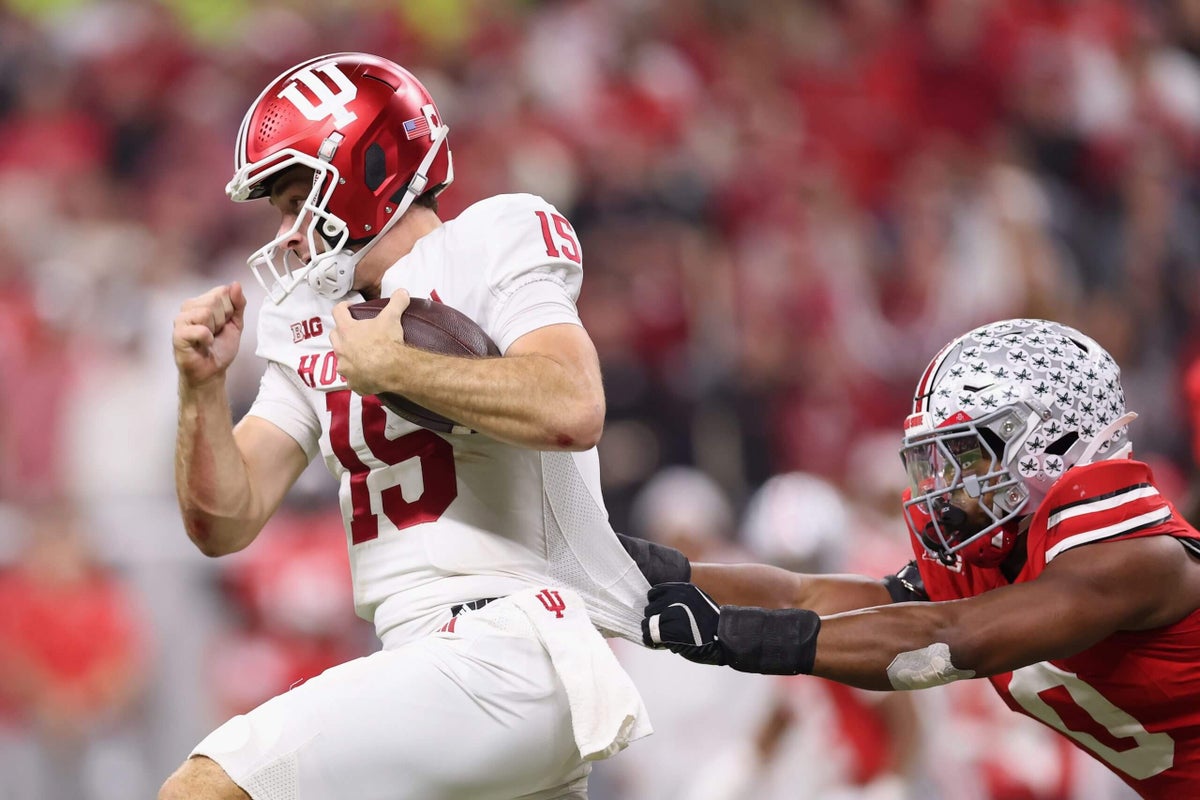
Mendoza will lead Indiana into the College Football Playoff with a 13-0 record, a No. 1 overall seed and a Big Ten title game victory over previously unbeaten and top-ranked Ohio State, the defending national champ, tucked firmly in his hip pocket. The Jets have scouted him in person multiple times. Surely they have seen what any right-minded observer could see.
Namely, a 6-5 quarterback with the skill, toughness, intelligence and can-do personality worthy of being the first pick of the 2026 draft.
If the Jets are hot on Mendoza, and they should be, they will have two obstacles to clear to get their man:
1. They’ll need to trade valuable assets to climb the board and move into striking position.
2. They’ll need to defy their recent history of trying and failing to find the next Joe Namath near the top of the draft.
Both hurdles are manageable, and the Jets would be wise to work around them. They should use the draft capital acquired in the Sauce Gardner and Quinnen Williams trades (not all of it) to land Mendoza, because the evidence suggests he’s worth it.
The Jets last made the postseason in 2010, and since the start of a 15-year run of futility in 2011, they have started three quarterbacks who were picked in the top five of their drafts — Mark Sanchez (No. 5, 2009), Sam Darnold (No. 3, 2018) and Zach Wilson (No. 2, 2021) — and one who was picked early in the second round in Geno Smith (No. 39, 2013).
Sanchez was the only member of this group who made at least 40 regular-season starts for the Jets (62); he also reached back-to-back AFC Championship Games in his first two years despite throwing more interceptions (33) than touchdown passes (29) during those regular seasons. Darnold and Smith have experienced varying degrees of success with other teams.
Of course, rookie general manager Darren Mougey and rookie head coach Aaron Glenn had nothing to do with those players. They don’t wear the scars of past Jets disasters, though Glenn was a cornerback on the franchise’s worst team, the 1-15 Jets of 1996, and they both have to own their roles in this year’s 3-10 record.
After cutting Aaron Rodgers, the Jets gave Justin Fields a guaranteed $30 million and paid the price for it. Fields was a bridge quarterback who only reconnected the Jets to the fact that they need to finally find a major difference-maker at the most important position on the field.
The schedule might help that hunt, as the Jets are expected to lose at least three of their final four games — at Jacksonville and at Buffalo, and again at home against New England. Even if they beat New Orleans, a 4-13 final record could move the Jets a bit higher in the draft order than they are right now (seventh).
Either way, they will need to trade at least two of their five first-round picks over the next two drafts as part of a wider package to move up for Mendoza. The last Jets GM to build winning postseason teams, ESPN analyst Mike Tannenbaum, said it is too soon to say how many picks they should be willing to surrender in a Mendoza move. But as the founder of The 33rd Team, a football think tank and consulting group, Tannenbaum advised Jets owner Woody Johnson in his hirings of Mougey and Glenn and has insight into their roster-construction philosophy.
And he likes the Indiana quarterback. A lot.
“I think he’s QB1,” Tannenbaum said. “He has size, a very good arm and accuracy, and he throws with really good anticipation. He’s a good athlete, not a high-end athlete. I see so much of Matt Ryan in him as far as the type of player and person he is. With his character, I think he will be a good top-of-the-line NFL starter for the next 10 years.”
Ryan, a league MVP and four-time Pro Bowler, led Atlanta to six playoff appearances and a 25-point lead in a Super Bowl in his first 10 years. The Jets would sign for that in blood right now.
“If Mendoza stays healthy,” Tannenbaum said, “every time you drive to the stadium you’ll have a chance to win.”
The Jets felt that way about past quarterbacks who didn’t honor the expectation, who couldn’t carry the burdens of a franchise that hasn’t appeared in a Super Bowl since Richard Nixon’s days as president-elect. But Mendoza has something different going for him. He already proved he could elevate a program that was never supposed to be the best of the best, leading Indiana to its first Rose Bowl bid since Lyndon Johnson’s days as president.
The Hoosiers entered this season with the most all-time defeats (715) in Division I. They had never been No. 1 in the country, and they hadn’t won a postseason game since their 1991 Copper Bowl victory over Baylor.
Yes, the Hoosiers did go 11-2 last year before Mendoza transferred in from Cal. But being the 10th seed and going one-and-done in the College Football Playoff is one thing, and running the table and expecting to win it all is quite another.
Mendoza is the reason an old-school basketball power is a new-school football power that would feel devastated over a loss in the Playoff.
“It’s one of the all-time great sports stories,” Tannenbaum said. “It starts with the head coach and the quarterback. You need a certain mental toughness and resilience to play quarterback, and Mendoza has that. Bill Parcells said you need to be a battlefield commander out there, and whatever that requires, Mendoza has.”
You saw it on that drive to beat Penn State, when Mendoza recovered from a first-play sack to ultimately absorb hits from two blitzers as he threw the jump-pass that turned into Omar Cooper Jr.’s absurd touchdown catch. You saw it after the crushing shot Mendoza took to open the Ohio State game, the passes he made under pressure to get Indiana to 13-0. You saw it after that fourth-quarter pick six at Oregon, where the Hoosiers quarterback responded with a monster touchdown drive in a hostile environment.
Fernando Mendoza was slow to get up after taking a massive hit here pic.twitter.com/hNU9KhbgZW
— FOX College Football (@CFBONFOX) December 7, 2025
It’s hard to believe this grandson of Cuban immigrants was once a two-star recruit from Miami headed to Yale because he had no major college offers, at least until Cal came out of left field. Mendoza draws his strength from his mother and best friend, Elsa, who has multiple sclerosis, and from his religious faith. As you can see and hear from his on-field interviews, he is as passionate about the game as his football idol, Tom Brady, is.
A lot can change between now and draft day. Against all odds, the Jets’ new starter, the undrafted Brady Cook, might light it up over the next four weeks. Or maybe Joe Burrow becomes available in a trade.
But assuming those things don’t happen, hey, the Jets got two first-round picks for Gardner, and a star quarterback-to-be is worth at least that much. The evidence is there.
Fernandomania is a phenomenon worth chasing in New York.