

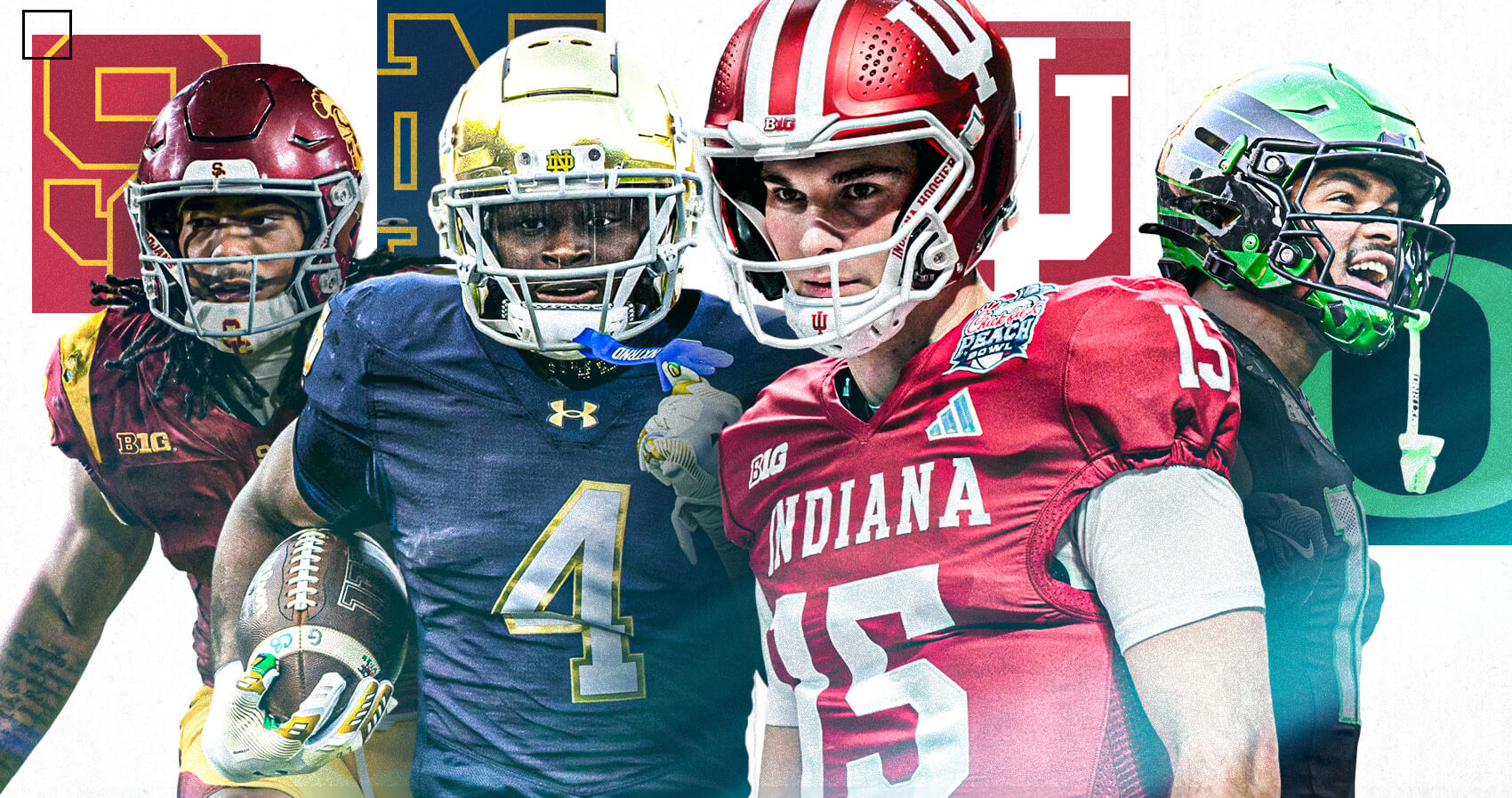
And so it begins!
The goal of this article is to give you a taste of the 2026 NFL Draft prospects and some high-level thoughts entering a season of dynasty debate.
Everyone and their mama has so many opinions about what matters and what doesn’t for NFL Draft prospects. On the Fantasy Footballers Dynasty Podcast, we are willing to admit this part of the off-season is a starting place: we don’t know what we don’t know! We try to enter into prospecting with an open mind as we move from production profiles to film evaluation and then how it translates to your rookie drafts. We preach a holistic approach so if someone asks if we are on team “watch the tape” or team spreadsheets, we give a resounding: YES!
Dynasty Season
We cling on to so many different pieces of information (a tweet, a chart, what we heard someone say one time on podcast) that it is easy to get lost in a sea of information. It is the classic paralysis by analysis or, in dynasty circles, it is a dump truck’s worth of data about to level your entire fantasy football world.
Are you ready to navigate these waters or are you still catching your breath like me during the NFL playoffs?
Our Fantasy Footballers Dynasty Pass (which releases on Super Bowl Sunday) will give you the full menu of prospect information:
- Production Profiles
- Dominator Ratings
- Team Opportunity Reports
- Rookie Mock Drafts
- Risers & Fallers
It also has three major updates as a living & breathing tool to help you analyze these prospects and crush your rookie drafts.

For each of the main offensive fantasy positions, I’ve highlighted the names, the metrics that matter, and questions that remain entering the pre-draft process.
Each position is organized by their recent MockDraftDatabase Big Board rank (January 5th), which gives us a consensus of where these players are being mocked for the NFL Draft.
Top-100 Offensive Prospects: Where Were They Ranked Back in September?
I try to take “snapshots” of consensus Big Board ranks (Sept, mid-Nov, early Jan) to visualize player movement using @_mockdrafts
🔖Bookmark for later because this will change over coming months. pic.twitter.com/YdZmTAnH84
— Kyle Borgognoni (@kyle_borg) January 5, 2026
Keep in mind, this is different than a ranking for fantasy football purposes. There is SOOOO much more to navigate for these prospects. Let this article be an initial look and survey. I still have to update all of our statistics through the College Football Final (Miami vs Indiana) and we are waiting on a number of prospects to declare or return to college and get that NIL money!
Editors Note: For more on each rookie, Andy, Mike, and Jason’s exclusive rookie rankings and production profiles are found only in the Dynasty Pass, part of the UDK+ for 2026.
Quarterbacks
The Names

The Metrics That Matter
Of all the positions, I find that QB is a nuanced dance learning how to blend what we’ve seen on the field, what a QBs tendencies are, and what we can project for an NFL offense. If you need a refresher, consider the mountain of 1st round QB failures in the NFL and there isn’t just one be-all statistic or reason why they don’t work out.
For QBs, my method for watching film is simple: get out a pen and pad of paper. Watch each pass attempt taking note of the down and distance and simply write down what I see. For a QB, I focus on accuracy, aDOT, footwork, locating 2nd reads, and how they stand in the pocket under pressure. I usually take 7-8 of a prospect’s highest-profile games including bowl games and big-time opponents on the road. You can go back and read rookie profiles on top-notch NFL signal-callers (Joe Burrow, Jayden Daniels, Justin Herbert and even Jordan Love), guys who have recovered from stumbling (Trevor Lawrence and C.J. Stroud) and some ones I was quite blunt about (Zach Wilson, Will Levis, and Shedeur Sanders). That was a fun stroll down memory lane looking back and some of these write-ups I did over the last decade of doing this.
Intermediate Accuracy
I’ve talked about this way too much over the years on the Dynasty Podcast. We praise QBs who can do this by sheer strength, like how Justin Herbert was blessed with a Howitzer. Or how Josh Allen steps into throws and achieves unreal velocity on throws outside the numbers. We need chunk gains at the NFL level if you want to move the chains. Arm strength is an enigmatic physical trait when it comes to grading QBs.
Some might’ve gushed over the eye-popping arm of Josh Allen coming out of Wyoming. On the opposite end of the spectrum, there are guys like former Marshall QB Chad Pennington who made his mark in the NFL as an accurate, albeit dink-and-dunk artist always throwing ducks when it went 30+ yards downfield. Regardless, QBs rarely make more than four-to-five 20+ yard throws in a game; honestly, who cares if someone can throw it 75 yards in the air when the NFL game is won in the short-to-intermediate zones most of the time. If you want, go back and look at how we evaluated Cam Ward on last year’s podcast:
Among the top QBs in this group, here are the guys with the highest passer rating in the intermediate (11-19 yards) area of the field:
- 118.7- Fernando Mendoza (Indiana)
- 118.0- Trindad Chambliss (Ole Miss)
- 113.8- Ty Simpson (Alabama)
- 113.6- Dante Moore (Oregon)
- 101.5- Carson Beck (Miami)
Pressure-to-Sack Ratio
There has been a lot of discourse in recent years about this subject but the main headline: Sacks are a Quarterback Stat. Offensive line play is obviously a big part of the equation but sack avoidance is part of creating positive plays for your offense and not turnover or turnover on downs plays. I highly recommend this article from Kevin Cole on sack avoidance with prospects and Eric Eager’s on who controls pressure rates.
Take Caleb Williams for example. What was the biggest difference between his rookie campaign and this year? He saw a massive improvement in the sack department going from a 30% pressure to sack ratio (only Will Levis was worse) as a rookie to 3rd best in the NFL this year at just 10%.
Any Pressure-to-Sack Ratio (P2S%) over 20% in college is concerning. For context, Quinn Ewers (22.8%) and Shedeur Sanders (20.4%) paced last year’s groups and NFL teams seemed less than stellar on Draft Day. This year’s bunch is fairly tempered in this statistic according to PFF:

Scramble Rate
College stats are going to fail us if you only end up box-score watching. College QBs are credited for negative rushing yards on sacks taken which skews some of the overall numbers.
However, we can certainly meet in the middle of looking at the statistics, scramble rates, and film to confirm what we truly want for fantasy: a gamebreaker. Jayden Daniels averaged 4.8 scrambles per game per PFF. He posted the highest scramble rate (31.7%) of any college QB in their final season with 250+ dropbacks over the last decade. The “Daniels scramble” was a perfect blend of his skillset plus how NFL defenses are adjusted in 2024 with more two-high safety looks. A scramble is the most valuable QB rush attempt between the 20s worth more than two times as many fantasy points as a designed run in 2023. QBs with 20+ scramble attempts averaged over 7 yards per carry last year for context. Even Drake Maye had things in profile that should’ve led you to him being a dual threat for fantasy. He led all FBS QBs in PFF grade on throws between the hashes (a good marker for reading NFL defenses) and he was willing to scramble (5.6% of his non-pressured dropbacks) to the point where you can foresee extending plays and adding goal-line runs as part of his future. He became one of 7 rookie QBs to average 35+ rushing yards per game since 2000.
I looked at every 1st round QB drafted since 1995 (75+ different guys) and then narrowed that list to every QB that saw at least a 10 percent rush share in their best rushing season, a total of 36. That was the threshold I found where college rushing production dictated that they were likely to carry over into the NFL. You can also see the emphasis on dual-threat QBs over the last two decades where the “pro-style” drop-back passer of yesteryear slowly faded as a 1st round must at the position. However, the true fantasy difference-makers needed to see 18+ % of their team’s rushing yardage in their best season.
You can see where Fernando Mendoza slides in this year as a runner compared to other QBs drafted since 2005:

I wrote a couple of years ago about Rookie QBs & What History Can Tell Us when Kyler Murray came into the league. The main findings were since 1990, every rookie QB that crossed 80 rushing attempts has not only been a fantasy force but maintained a top-10 QB per game pace. To give perspective, 80 rushing attempts is 4.7 per game in this new 17-game era. I backed this up in Jayden Daniels’ Range of Outcomes & Recent Dynasty History and it is a good reminder of how rushing breaks our game.
Here are how the top QB prospects stack up in terms of scramble rate noting that these games* do NOT include the College Football Playoff final in the data set.

Note About Film Evaluation
“What am I not seeing?” is a question I ask often when evaluating prospects on film. It is easy to splice together highlight reel takes and forget that we are looking at college football players; in other words, the majority of players the prospect faced will never be playing on an NFL field and likely will be vying to sell you life insurance or go to high school coaching.
I think the hardest part of evaluating a college QB is trying to determine if they don’t do something because they can’t or they weren’t asked to.
— Quincy Avery (@QuincyAvery) January 10, 2026
We cannot only glean from film watching based on what our eyeballs are showing us. For example, I came across this video compilation below of Dante Moore throws which definitely show the best of his 2025 season. Use this in conjuncture with the question of “what am I not seeing?” in this video. (Note: I think James Foster does great work and would definitely recommend following him for NFL Draft coverage.)
Dante Moore dots pic.twitter.com/R0kk4FbuiL
— James Foster (@NoFlagsFilm) December 28, 2025
This is a puzzle in which none of us have all the pieces to assemble a final product. Not even NFL scouts and franchises with billions of dollars are able to see the whole picture of what a prospect can be at the next level considering there is an emotional and psychological component for this type of limelight and profession. The offensive system, the coaching, the skill position players all factor in as well. (See Zach Wilson. Remember Jamarcus Russell. Never forget Mitch Trubisky.)
QB Questions That Still Need Answering:
- If the Raiders take someone other than Mendoza, are they relegated from the league?
- How many NFL teams are in the market for a rookie QB?
- Is Mendoza’s fantasy ceiling lower than we’d like for a No. 1 overall QB pick?
- Does Dante Moore have the same bugaboo as Caleb Williams: holding onto the ball too long?
- Does Ty Simpson’s lack of college starts hurt him?
- Is Trinidad Chambliss part of the mix? Or will this play out in court?
- Is Moore a true dual threat for fantasy purposes or is his rushing more just a bonus?
- Which teams are the best fit for Garrett Nussmeier?
- Does Drew Allar’s intermediate accuracy turn off some teams?
- Which QBs will climb in the pre-draft process?
Running Backs
The Names

The Metrics That Matter
Dominator Rating aka TDs & Yards
The stickiest of stats for RBs is not a super complicated thought: they scored and gain yards. Touchdowns translate incredibly well to the NFL. Who knew?!
Beyond raw counting stats, we often refer to a RB’s Dominator Rating in the Dynasty Pass as a measure of a player’s impact for a college offense.A running back’s dominator rating (DR) is calculated based on games played and gives double weight to yards compared to touchdowns. A DR greater than 15% indicates a potential breakout season but anything over 30% is what we are looking for in college. The higher the better because it shows an absolute workhorse role.
We compare those marks to what a fantasy RB1 in the NFL accomplished in college. It is essentially reverse engineering what made difference-making RBs great. Here is 2025’s class for a comparison of how their metrics stacked up:

Yards per Team Play
Yards per Team play is another metric that our own Marvin Elequin highlights a lot in his offseason analysis. While there are a few exceptions, players who dominate in college usually produce at the NFL level. In fact, we consistently see higher hit rates when we control the sample size for draft capital and production. This factors in usage but also efficiency relative to each team’s offense. Anything above 1.5 yards is relatively strong but every offense needs context.
For example, here is Ashton Jeanty‘s compared to other recent game-breakers in fantasy football:

Pass-Catching Work
This isn’t rocket science but we know how valuable targets are for fantasy. Depending on half or full PPR settings, a target is generally work 2.25-2.5x a rush attempt in today’s NFL. Targets are gold for fantasy. For example, an RB who sees only 125 rush attempts but adds 70 targets has the same expected fantasy points as the bell-cow with 300 carries.
I’ve done a far amount of studies over the years on Vacated Targets and the RB position, as well as The Myth of 3rd Downs and the RB Position. We get it… pass-catching work is nice.
Here are the RBs in this year’s class with 30+ receptions in 2025:
- 46- Emmett Johnson (Nebraska)
- 43- J’Mari Taylor (Virginia)
- 34- Darius Taylor (Minnesota)
- 31- Jonah Coleman (Washington)
J’Mari Taylor | RB | UVA
Compact runner that runs behind his pads. Good lateral wiggle but looks to plant & get upfield off each cut. Good eyes for cutback lanes & adept at pressing LoS and altering gap last second.
Sets a strong base in pass pro & + hands as an outlet tgt. pic.twitter.com/SToFyrnBjD
— Matt Lane (@Matty_KCSN) January 7, 2026
RB Questions That Still Need Answering:
- Is Jeremyiah Love a lock for the top-15 in the draft? Or are we projecting team needs versus actual NFL drafting?
- How much passing work will Love see at the next level?
- Who is the consolation prize for non-Love managers? Is it Emmett Johnson?
- Is Mike Washington Jr. a late bloomer or just a big dude?
- Is teammate Jadarian Price’s vision 2nd only to Love in this class?
- Which Penn State RB does the NFL prefer?
- Which RB might be overlooked based on size but runs with authority ala Bucky Irving?
- Is Darius Taylor another classic example of RBs peaking too early?
- Is Demond Claiborne a sleeper in this class?
- Which NFL teams have the clearest path for a rookie RB to contribute right away?
Wide Receivers
The Names

Comparing Talent & Opportunity
While we might have some first-round locks in our mind, we must remind ourselves that the WR position is somewhat immune to the landing spot. There is an awesome article (“What Matters More for Rookies: Skill or Landing Spot?“) by one of our former writers if you want a full dive on the subject. We found that skill was TWICE as strong as the situation. Looking back at last year’s prospects, our film + talent evaluation mattered more than landing spot.
Because the WR position is dependent on a QB’s efficiency, “available targets” can be overrated. Your evaluation and the metrics that matter for WRs come into play even more than perceived opportunity.
The Metrics That Matter
Per-Route
It can be hard to zero in on a couple of metrics and proclaim, “These are the ones worth paying attention to!” There are deeper studies out there (highly recommend Ryan Heath’s chart on stable & predictive stats) but for the sake of this article, we will focus on routes-based data.
We talk all the time about how targets are earned; they show skill. Routes give context because they mix in opportunity (or lack thereof) for a WR. It is worth noting that route data is not widely available and is often found behind paywalls. Why? It is data and sites like PFF or FantasyPoints have put in a ton of time and hard work collecting this data. Do them a favor and subscribe or at least acknowledge that tracking every single route in every single game in the NFL takes time and a desire for accuracy. I mostly use the route data available from Pro Football Focus for college evaluation.
Yards per Route Run (YPRR) gives a well-rounded figure to work with as we are able to simply divide the total receiving yards by the number of routes they run on the field. It is less prone to outlier skewed stats (Yards per Target, Yards per Reception) but it’s not perfect. YPRR needs roughly 11 games or 180+ routes to start to stabilize for WRs. Targets per Route Run (TPRR) is another metric we discuss frequently on the Fantasy Footballers podcast. It measures how involved a player is and weeds out cardio kings such as Marquez Valdes-Scantling who might be the best-conditioned players on the field but shots in the dark for fantasy. TPRR closely follows target share but it gives us an even deeper look at team opportunity. When this player is running route, how often does their QB look their way? You might’ve seen the highlight of a long 60-yard TD the week before but when you peel back the curtain, MVS might’ve been targeted just 10% of the time, an atrociously low figure. I wrote a primer on this stat back in 2021 and one of our writers (AJ Passman) does a weekly article in-season.
We care about WRs who earn targets in college because if you can’t do it there, how are you going to turn it on in the NFL? That was the worry with Matthew Golden last year. He sported the lowest TPRR (17.7%) of any 1st round WR since 2014 coming in.

I wrote a massive article entitled Dynasty WR Thresholds That Matter if you want a full discussion on this topic. Since 2015, WRs in their final* year of college averaged:
- Round 1: 28.1% TPRR, 3.16 YPRR
- Round 2-3: 27.8% TPRR, 2.70 YPRR
Anything sub 20 percent is not optimal when you compare it to other WRs. At its core, TPRR is a measure of efficiency; it tells us a player’s ability either to get open or be a part of the offensive scheme. We say it often: earning targets is a skill. And that skill, expressed as TPRR, has a strong correlation with fantasy relevance. Since 2006, 92% of receivers who finished as a WR2 or better (top 24) had a TPRR of at least 20%.
From the 2025 class, we have some absolute standouts being targeted on 29+ % of the routes with still the College Football Playoff final remaining:
- 34.5%- Skyler Bell (Connecticut)
- 32.3%- Jordyn Tyson (Arizona State)
- 29.4%- Chris Bell (Louisville)
- 29.4%- Zachariah Branch (Georgia)
- 29.3%- Makai Lemon (USC)
Alignment Data
Some of the numbers these players put up in college are going to be eye-popping! Finding out where a WR was running the majority of their routes adds a ton of context. Remember a couple of years ago how Malachi Corley was all the rage?! His 32.5% TPRR sounds wild but with 80% of his targets coming out of the slot and over 38% coming behind the line of scrimmage, his gadgety role needed to be foreseen.
Georgia’s Zachariah Branch might be one of those guys this year with a 3.6 aDOT! With 77% of his targets occurring <10 yards, we can’t simply use route data as our one talking point.

Whether they are in the slot or not, this allows us to add context around TPRR:
- What type of routes are they running? The nine routes in the NFL are going to draw very few targets.
- Is there competition for targets? Many offenses such as Dallas have multiple high-end targets. This is why players like Andrei Iosivas can end up among the league leaders in routes run but rank so low in TPRR in target efficiency. In other words, other guys were commanding targets (Chase & Higgins) and Iosivas’s percentage plummeted.
- Is the efficiency off the charts? Efficiency is fun when it’s hitting in your favor every week but eventually, the lack of targets turn into 2-for-22 weeks.
Among this year’s crop, here are the notable WRs with 70+ percentage of snaps coming out of the slot from the 2025 season:
- 93%- Antonio Williams (Clemson)
- 93%- Kam Shanks (Arkansas)
- 84%- Omar Cooper Jr. (Indiana)
- 79%- Zachariah Branch (Georgia)
- 71%- Makai Lemon (USC)
- 71%- Eric Singleton Jr. (Auburn)
Coverage Killers
I love all the WR data I can get my hands on. There are some incredible receiver minds out there (including Matt Harmon, who used to write Reception Perception as part of the Ultimate Draft Kit back in the day) but I often circle back to a simple question: can they beat ZONE coverage?
In 2025, 63% of NFL teams (20 of them) ran zone coverage at a rate of 70% or higher. Very few level up from college to the pros in this area. As studies have shown, WRs who hit 2.0+ YPRR vs zone in college tend to have a much higher rate of breaking out in the NFL.
While watching film and evaluating this year’s crop, keep in mind the zone busters. Here is a table of some of this year’s prospects and who excelled versus Man or Zone per PFF’s data charting:

Among these year’s group here are the some of the top WRs versus zone coverage posting 2.7+ YPRR in 2025:
- 3.16 YPRR- Skyler Bell (Connecticut)
- 3.09 YPRR- Makai Lemon (USC)
- 3.07 YPRR- Chris Brazzell II (Tennessee)
- 3.03 YPRR- Omar Cooper Jr. (Indiana)
- 2.72 YPRR- Carnell Tate (Ohio State)
WR Questions That Still Need Answering
- Will more than two WRs go in the top-10 of the NFL Draft?
- Will scouts knock Jordan Tyson for his injury history?
- How many Amon-Ra comps are going to be thrown around for Makai Lemon until we get sick of them?
- Is Carnell Tate the safest among the Round 1 WRs?
- Is Denzel Boston a refined route runner or just a bully ball guy?
- Do you think KC Concepcion measures 2 inches shorter? Is he DJ Moore or Kadarius Toney?
- Do Elijah Sarrett and Omar Cooper Jr. gain a ground swell of supporters after their CFB playoff run?
- Does Skyler Bell’s off-the-charts production profile matter?
- Do Zachariah Branch’s physical traits overcome his gadgety role for scouts?
- Which zone busters fit best into NFL schemes as a Day 2 pick?
Tight Ends
The Names

The Metrics That Matter
Receiving Yards per Team Pass Attempt
Because TEs rarely are the focal points of offenses, it can be tough to use the exact same counting stats we are used to for receivers. As we mentioned with the RBs, finding a player’s contribution to the offense utilizing team plays can be beneficial. Our own Marvin Elequin often references Yards per Team Pass Attempt as a solid metric that allows us to also cut across different offensive schemes. For instance, the player on a team that throws 500+ times can be compared to a run-first team in the Big10 like we’ve done with Iowa TEs (George Kittle, TJ Hockenson) for years.
Oregon’s Kenyon Sadiq is widely seen as the top TE in this class but it is worth nothing another TE on his own team (Jamari Johnson) also is an intriguing prospect.

Per-Route
Much like WRs, we want a clearer picture of how effective these players are on a per-route basis. In fact, TEs might need even more clarification as snap rates actually hide some of the meaningful intricacies of a player’s participation in the offense. TEs are expected to run block and even worse for our fantasy projections: pass block. Therefore, what a TE does on a per-route basis is even more magnified. What we care about is TEs who run routes, who are targeted on those routes, and the elite ones who create yards.
Yards per route run gives us a solid indicator of how a TE is performing relative to his opportunity. Here are the averages over the last decade of Targets Per Route Run & Yards Per Route Run among TEs drafted:
- 1st Round TEs– 22.8% TPRR, 2.32 YPRR
- 2nd Round TEs– 22.6% TPRR, 2.05 YPRR
- 3rd Round TEs– 18.4% TPRR, 1.64 YPRR
Browns rookie TE Harold Fannin Jr. lapped the field in almost every piece of data you could get your hands on:
- Final year production: 117 receptions for 1,555 yards and 10 TDs.
- Highest YPRR (3.74) of any TE in my database which goes back more than a decade.
- Forced a class-high 34 missed tackles
- Earned the second-highest run blocking grade by PFF.
- Highest dominator rating (49%) of any prospect over the last decade
He profiled as Round 1 dominator but Mock Draft Database grouped him with a wide range of Day 2 prospects. In hindsight, his ability to contribute right away based on production alone made him a solid bet in the late 2nd or early 3rd round of your rookie drafts as Marvin Elequin shared in his Dynasty Range of Outcomes article post-NFL Draft.
YAC-Ability
I wrote an article a few years back entitled How Do We Identify Breakout TEs in Dynasty? The TLDR version is that we don’t want the Mason Taylors (meow) of the world who fall down every time they catch the ball. Yards-After-Catch can show tackle-breaking ability and chunk gains.
The only downside of looking at this stat is that it can be skewed. For example, a TE who breaks one tackle on a 5-yard out and runs for another 20+ yards looks like a YAC king compared to the guy who catches a 25-yard seam route and is immediately tackled. It’s the same yardage but one showcased the ability to gain a target down the field while the other can show tackle-breaking ability.
Among TEs with 30+ targets, here the TEs averaging 6.0+ YAC/Reception among this year’s class:
- 9.1- Jamari Johnson (Oregon)
- 8.9- Joe Royer (Cincinnati)
- 7.8- Oscar Delp (Georgia)
- 6.8- Terrance Carter Jr. (Texas Tech)
- 6.1- Eli Stowers (Vanderbilt)
For context, Brock Bowers averaged 8.5 YAC/Reception in his three seasons at Georgia. It is just another feather in the cap for players you might like in the pre-draft process.
Freakish Athleticism
This is the wait-and-see portion of the prospect evaluation process as the combine measurements and 40-times ultimately will “unlock” certain prospects in the eyes of the NFL. Perhaps no skill position is more influenced (ok let’s be honest, QBs are highly influenced by their pro days) by the “underwear Olympics” than TEs.
RAS Score is often the metric thrown around on Twitter. This metric takes into account all the things we care about at the combine (HT, WT, Speed, etc.) and combines it into one number which allows evaluators to see a player’s total athleticism and compare over the last few decades. Here are the 1st round TEs since 2014 along with their RAS (if available)

TEs are often drafted for multiple purposes but main one: BLOCKING. That doesn’t usually translate to fantasy success as this chart above shows. As I wrote in Identifying Breakout TEs in Dynasty, we’re looking for the tight-end that extends drives and is more likely to break off big gains and get downfield with chunk yardage plays. Often we find TEs with draft capital don’t necessarily match that within the first couple of years. Yes, we’re shooting for the moon here trying to find difference-making TEs and the reality is: not many of them exist!
TE Questions That Still Need Answering
- Will more than one TE warrant a top-50 pick?
- Does Kenyon Sadiq elect to participate in the combine?
- Will Eli Stowers regain some of his fallen draft stock?
- Does the NFL have a consistent playing spot on the field for Michael Trigg?
- Is Eli Raridon a name to watch rise in the process?
- Which NFL teams are the best landing spots for young TEs?
- Who is the sneaky combine TE who breaks out and into Day 2 draft consideration?