

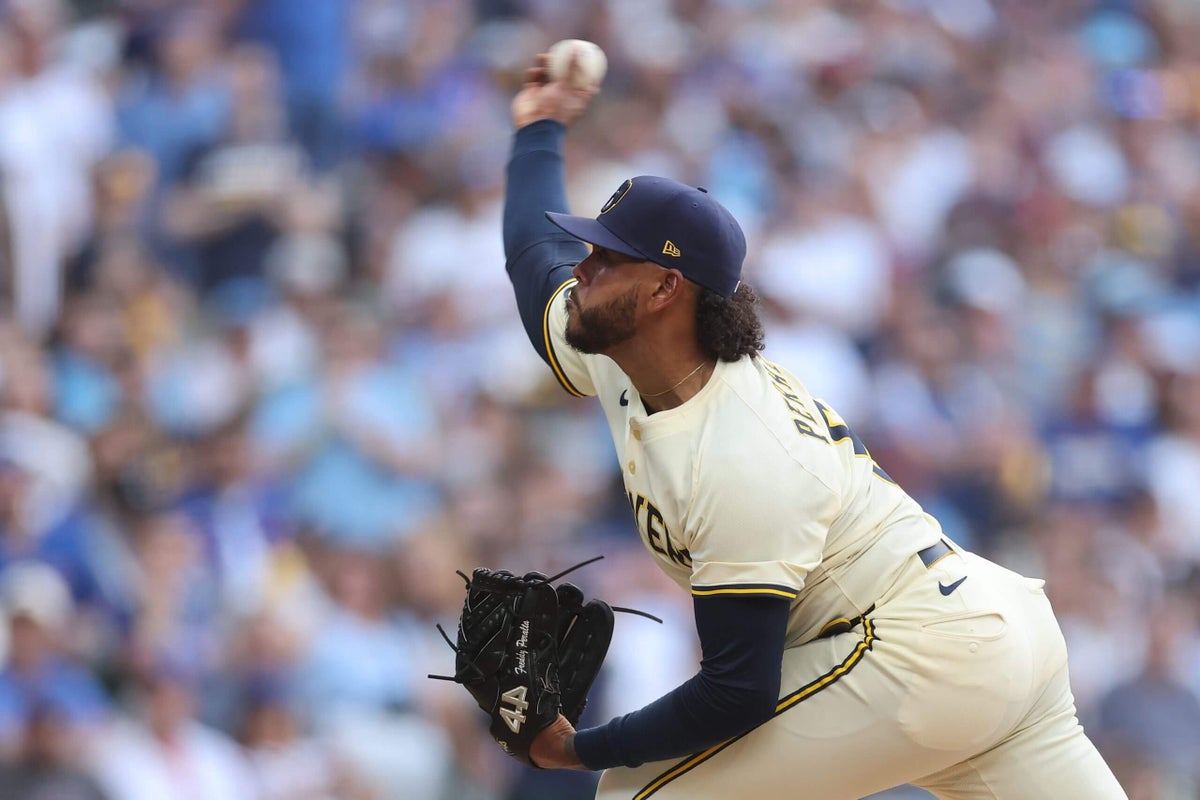
For now, the New York Mets’ focus with Freddy Peralta is on the 2026 season. According to league sources, the plan is to let everyone get comfortable. But after sending out a pair of consensus top-100 prospects in Jett Williams and Brandon Sproat for Peralta’s final year of team control, it’s worth pondering: What would an extension for New York’s new No. 1 starter look like?
Peralta has been one of the game’s most consistent starters since joining Milwaukee’s rotation for good in 2021. His 3.30 ERA over that stretch ranks 12th in baseball (among pitchers with at least 100 starts), and his 29.6 percent strikeout rate is fourth, one-tenth behind Dylan Cease.
To get an idea of what Peralta could fetch in an extension, let’s first look at comparable starters who agreed to extensions in their platform seasons over the last three years:
|
Player
|
Signed
|
Age
|
fWAR1
|
fWAR3
|
fWAR5
|
Years
|
Total
|
Today AAV
|
|---|---|---|---|---|---|---|---|---|
|
2023 |
30-34 |
3.7 |
12.7 |
18.4 |
4 |
96.0 |
26.2 |
|
|
2023 |
30-34 |
3.5 |
9.9 |
15.4 |
5 |
100.0 |
21.8 |
|
|
2026 |
30 |
3.6 |
8.9 |
14.9 |
||||
|
2024 |
30-34 |
3.2 |
5.9 |
9.8 |
4 |
111.6 |
29.3 |
*The money in this chart is new guaranteed money only. For instance, Glasnow’s deal with Los Angeles was for five years and $136.6 million, but because he was already slated to make $25 million in the first year of that deal, it was worth four years and $111.6 million in new money. “Today AAV” calculates for inflation.
Musgrove, the pitcher whose track record most closely resembles Peralta’s, sits at the low end, with a five-year deal worth nearly $22 million in today’s money. Glasnow, despite an injury history that limited his overall production, is at the top end with more than $29 million per season in his new deal. Castillo occupies the middle ground.
Now let’s compare Peralta to the two big-name starters who have signed this winter.
|
Player
|
Signed
|
Age
|
fWAR1
|
fWAR3
|
fWAR5
|
Years
|
Total
|
Today AAV
|
|||
|---|---|---|---|---|---|---|---|---|---|---|---|
|
2026 |
30-36 |
3.4 |
11.7 |
20.6 |
7 |
189.2 |
27.0 |
||||
|
2026 |
30-34 |
4.0 |
9.9 |
15.2 |
5 |
130.0 |
26.0 |
||||
|
2026 |
30 |
3.6 |
8.9 |
14.9 |
Cease, whose deal was for $210 million on paper but contained significant deferrals, outpaces Peralta in WAR (despite a more mediocre ERA). Unlike everyone else here, he was able to land a deal that took him past the age of 34; given the Mets’ emphasis on shorter-term deals under David Stearns, that could be a sticking point in any negotiations with Peralta.
For a projection, let’s go with the consensus and a contract that takes Peralta through his age-34 season in 2030 — four additional seasons of team control. To keep it that short, we’ll up the average annual value over those four years to $28 million per season — better than those received on the open market by Cease and Suárez. That equals four years and $112 million of new money for Peralta — pretty much in line with what Glasnow received from the Dodgers.
The Mets could add the $8 million Peralta is owed this season to make it a five-year, $120 million deal. That’s probably not helpful for them, though: While it would lower how he counts against the luxury tax (from $28 million to $24 million) from 2027 through 2030, it would raise his tax number this season (from $8 million to that $24 million), when the Mets are already paying the highest tax penalty. (Basically, the Mets should fold in Peralta’s 2026 number only if they fear significantly harsher penalties in the next collective-bargaining agreement.)
Peralta’s agency, ACES, has been open to extensions in the past. That includes David Wright’s eight-year extension with the Mets following the 2012 season.
There’s no rush for this type of extension. The second half of March is generally a fruitful time for such deals, as it was for the Mets with both Jacob deGrom and Francisco Lindor. Musgrove didn’t sign his extension until August, just two months before he was set to hit free agency. And if nothing materializes, the Mets could give Peralta a qualifying offer this winter and recoup a draft pick if he signs elsewhere.
At the moment, both sides could prefer to wait until March or even into the regular season to gauge how Peralta fits this roster and this market.