

It was as if Toumani Camara wanted to wrap every element of his identity into one play.
The tenacity, the full-court pressure, the footwork, the drama after contact — Camara placed it all on display.
The Portland Trail Blazers’ wing lives to pester dribblers in places few others would dare. On this play, during a mid-February game against the Utah Jazz, his victim was point guard Isaiah Collier, who received an inbounds pass only inches from the baseline and still had no space in front of him.
Such is the way of the Blazers, who full-court press more than any other team — in part because of head coach Tiago Splitter’s helter-skelter strategies, and in part because they employ Camara.
Look where Camara picks up Collier here, 93 feet away from scoring. This isn’t some faux press. It’s a plan that’s high-risk with anyone but a little more stable when it involves Camara.
He follows Collier up the floor, then crouches into his ultra-defensive stance once they cross half court. Check out Camara’s right hand as Collier dribbles twice through the legs moments later. His palm follows the basketball, a subtle panning in and then back out. This is called “mirroring” the ball. No one in the league does it better than Camara.
Then comes Camara’s most on-brand moment.
He runs through a screen as if it weren’t even there, sticks to Collier on a drive to the hoop, forces a chaotic pass to Jazz center Kyle Filipowski and finally rotates over to the big man to absorb a shove to the chest.
Charge.
Camara has drawn 98 offensive fouls in 2025-26, only one short of Anderson Varejao’s single-season record. Basketball-Reference has been tracking the stat since 2005-06.
These are all types of fouls. He gets so in the face of dribblers that they often get caught pushing him away. He goads opponents into moving screens. When he’s guarding a pick-and-roll, he will notice if a screener dives to the hoop early, then will sprint in his direction, understanding that if they make contact, the result will be a turnover.
Now, Camara is one of five players to make my annual Second Team All-Perimeter-Defense.
The NBA’s actual all-defensive teams’ eliminating positions means the first team can fill up with centers, as it has in recent years, allowing less shine for the guys on the perimeter. So, let’s give the guards and wings their credit.
All-Perimeter-Defense takes on the same format as all-defense: 10 players make it. We observe the NBA’s 65-game rule, which means hounds like Alex Caruso or Ron Holland are not eligible.
First Team will publish next week. Here is the rest of the Second Team:
Lu Dort, Wing, Oklahoma City Thunder
Forget about the fundamentals. Dort is an inventor.
His latest creation? A switch of the hand.
The Thunder’s main stopper is cuckoo for closeouts. Every so often, he’ll deviate from the scouting report. Instead of raising his arm at a shooter, he’ll lower it, then swipe up, as if he’s tossing an imaginary jump ball. Or he’ll kick his knees high as he stutter-steps.
“Anything that I can do to throw him off, I’ll do it,” Dort said in a conversation with The Athletic. “Guys like this are so used to seeing regular closeouts. When they train, they see regular closeouts. So do something different, and sometimes you can throw them off.”
A couple of months ago, Dort came up with a new idea, which he uses on 3-point shooters in the corners.
Dort will rush to an opponent with one arm extended and then, at the last moment, switch to the other arm. He tried it once against the Denver Nuggets’ Jamal Murray and another time against the Orlando Magic’s Desmond Bane.
“My thing on that is whenever I close out, it’s hard to jump with that hand, so that’s why I try to switch it, so I can cover more ground and my contest will be better,” Dort said. “It’s just something new that I am trying just to see if it will throw off whoever is shooting the ball.”
It didn’t throw off Murray or Bane, though that is more because of the shooters than the closeout. Each of those guys is dynamite from beyond the arc, especially on catch-and-shoots from the corners. In these cases, the shots are so open that the defender has to try a frantic, sleight-of-hand technique, one of his many patented flails that are always spirited and sometimes, when a rogue face gets in the way, dangerous.
But such is life for Dort, who the NBA’s No. 1 defense uses on the other team’s best perimeter player each night. According to BBall-Index’s matchup difficulty statistic, no player mans the opposition’s top performer more. And so Dort adapts in his own, peculiar way.
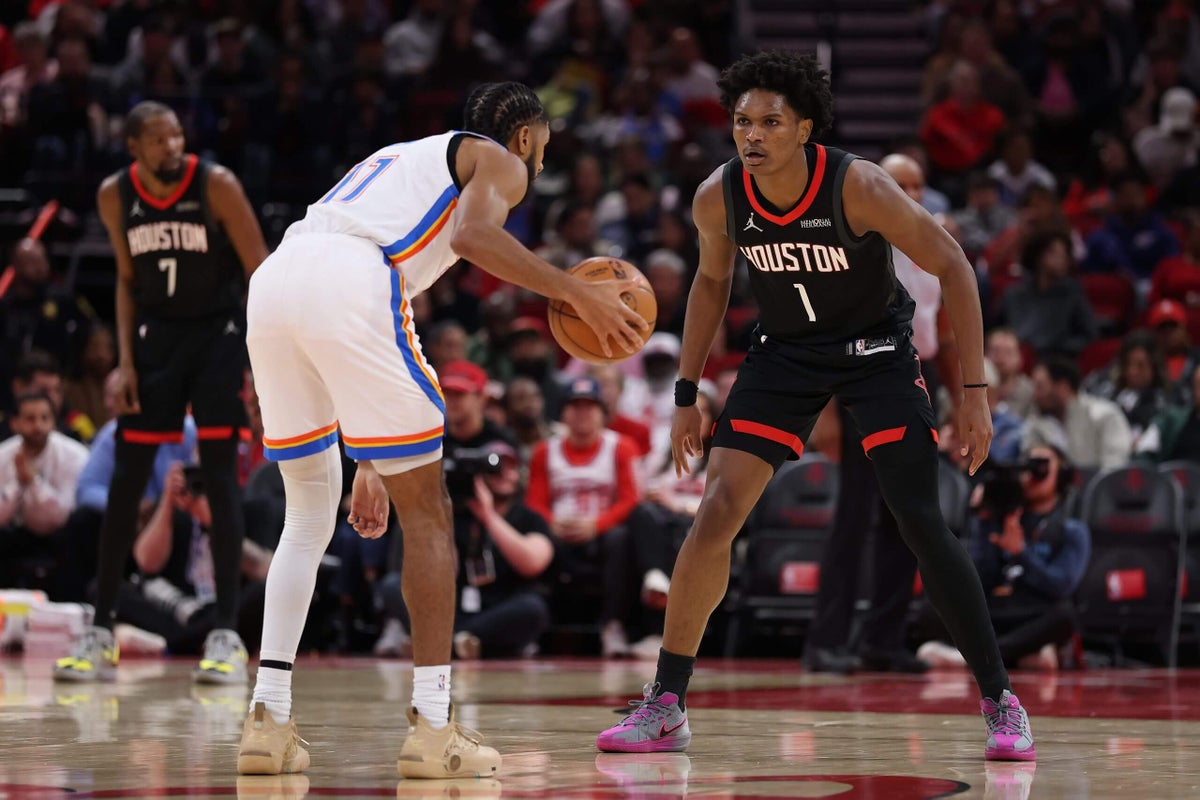
Amen Thompson, Wing, Houston Rockets
Thompson, too, has adapted after a slight adjustment to his role.
A season ago, the Rockets stationed him more often on the weak side on the defense, ready to scamper over in help and provide back-line rim protection. Today, that job more often belongs to Kevin Durant, the 37-year-old who has had an under-the-radar, staunch defensive season. And yet, the Rockets’ defense, which ranks sixth in the NBA in points allowed per possession, starts with its high-flying, third-year wing.
Houston relies on steals, many of which stem from Thompson, who has improved as a disruptor at the top of the defense and whose anticipation while guarding pick-and-rolls is far quicker today than it was over his first two professional seasons.
Each game, Thompson will create or at least inspire a turnover or three. Earlier this week, New Orleans Pelicans guard Dejounte Murray dribbled left around a screen from Zion Williamson. With Thompson following him, Murray tried to bounce a dime to Williamson in the lane.
No go.
Thompson had somehow defended Murray while also taking away the passing lane, and he gobbled up the pass. He’s one of the few defenders with the length, speed, athleticism and now anticipation to pull off such a play.
A year ago, Thompson ranked 116th among qualifying defenders in Bball-Index’s screen-navigation analytic. This season, he’s third. The only two players ahead of him are also members of First or Second Team All-Perimeter defense, including this next one.
Stephon Castle, Guard, San Antonio Spurs
The special part of Castle is how unspecial he can make defense look.
For example, take the play from below, which occurred during an early-March game against the New York Knicks. Castle begins the possession on All-NBA center Karl-Anthony Towns, who jogs up top to set a screen for a fellow star, Jalen Brunson. He powers through a pick as Towns treks up high.
Victor Wembanyama is the face of the Spurs’ stifling defense, but the Defensive Player of the Year favorite isn’t holding up the fortress on his own. Castle has become nearly impossible to impede.
Once Towns lays the screen for Brunson, Castle switches onto the point guard, a crafty one-on-one scorer who chooses not to go at Castle and swings the ball to the other side of the court. By this point, only eight seconds remain in the possession, which ends with an errant 3-pointer from Josh Hart, who the Spurs strategically left open throughout the game.
Castle didn’t swipe away a steal or swat a shot. Heck, he didn’t even get in the face of an aggressive driver, as he’s done countless times this season. But the trust from head coach Mitch Johnson is what stands out here.
The second-year standout defended Towns for much of that game — a 6-foot-6 guard battling with a 7-foot center, which has become the norm for Castle. The Spurs can then switch any screen action, ones around or away from the ball, which stalls opposing offenses. Castle is strong enough to fight with bigger guys. He gets low and pushes them away from the block. He leans into smaller players, taking away drives to the hoop.
On one night, he will defend Towns. Next, he’ll take on lead guards, like Shai Gilgeous-Alexander or Luka Dončić. The Spurs will start him on big wings, like Kawhi Leonard and Durant. When San Antonio played the Minnesota Timberwolves in January, he lined up with brute big man Julius Randle. He is fifth in the NBA in BBall-Index’s matchup difficulty this season.
It transforms the Spurs’ defense. Because Castle can combat anyone, including perimeter-laden big men, it can place Wembanyama on the worst opposing shooter, which allows the sport’s scariest shot-blocker to roam free.
Dyson Daniels, Guard, Atlanta Hawks
Daniels hasn’t received as much attention this season after his all-world 2024-25, when he finished second in Defensive Player of the Year voting and was a member of First Team All-Perimeter Defense. Those highlights when he muscles up a ballhandler, then grabs the basketball away from aren’t as common.
But Daniels set the bar high. In 2025-26, he’s been one of the league’s best perimeter defenders again.
Atlanta’s defense revolves around two guards, Daniels and Nickeil Alexander-Walker, who was a contender to make one of these teams. Both are handsy at the point of attack. Both cause panic. More of Alexander-Walker’s pick-and-rolls (meaning Alexander-Walker is defending the ballhandler) end in turnovers than anyone else’s in the NBA, according to Second Spectrum. Daniels is second.
He’s ninth in the NBA in steal rate and third in deflections per game, trailing two guys who will each be members of this season’s First Team All-Perimeter-Defense. He is a chore to go against one-on-one. He’ll pick up dribblers the moment they cross into the frontcourt, pushing into an opponent and using the halfcourt divider as a sixth defender.
Earlier this week, MVP candidate Jaylen Brown experienced the Daniels effect himself. During an upset victory over the Boston Celtics, Daniels met Brown at the logo and didn’t let him go farther. Before center Amari Williams could even set a screen, Daniels leaned into Brown, who was still 10 feet behind the 3-point arc, and spanked the basketball away.
He’s a master of the underhand steal, which keeps his fouls down despite how aggressive he gets with ballhandlers. He remains atop the scouting report. Opponents scheme to stay away from him, similarly to how quarterbacks treated Ed Reed.
Even when he doesn’t get the steal, Daniels affects behavior. He is always looming.