

As the Boston Red Sox vied for a postseason spot in late August, the back of their rotation was falling apart. They’d just released veteran Walker Buehler after a rough year, cutting their most experienced postseason player weeks before October as their young team clung to a wild-card spot.
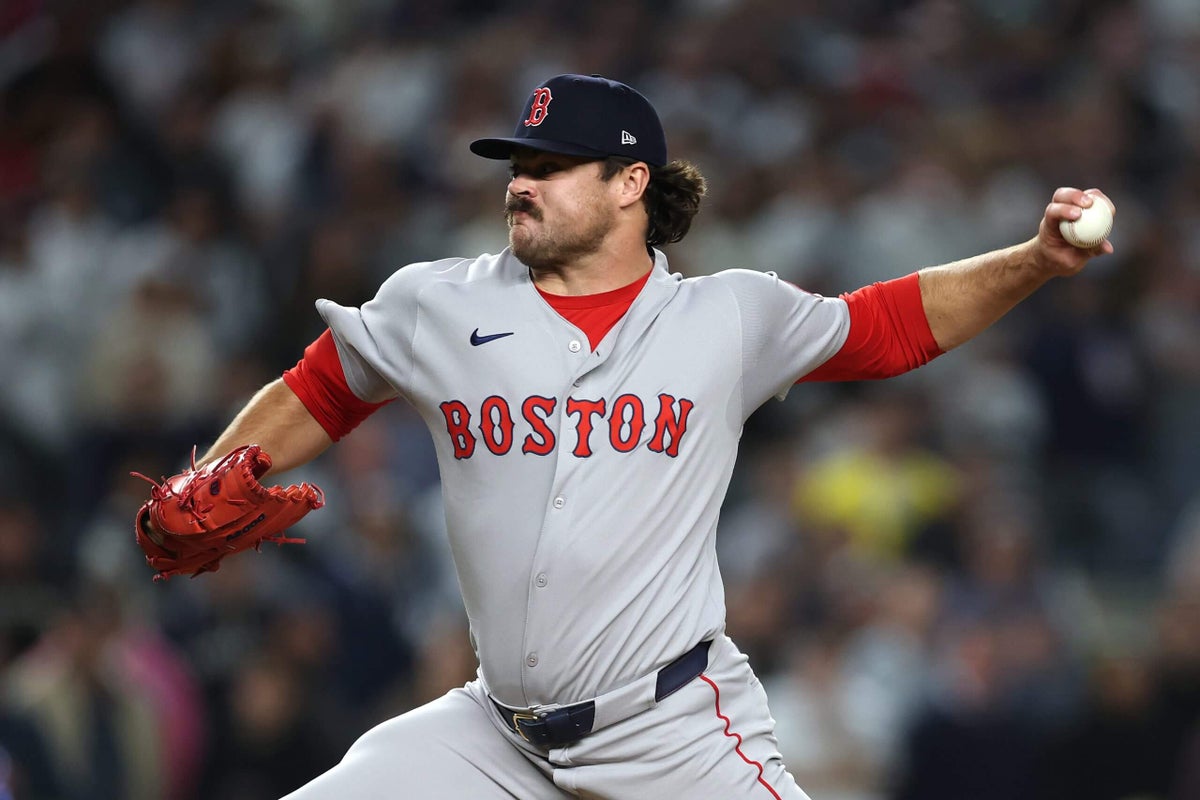
To fill the late-season rotation void, the Red Sox made a surprise move. They promoted a hulking, mustachioed, 6-foot-6 prospect named Payton Tolle. Drafted just 13 months prior, he fit their big-bodied pitching prototype to a tee. The 22-year-old began the year in High-A Greenville and flew through three levels before dominating in his big-league debut on Aug. 29. Tolle struck out eight over 5 1/3 innings while topping out at 99.2 mph. It was the soonest a Red Sox pitcher made his big-league debut after being drafted since Abe Alvarez in 2004.
Eleven days later, with another hole in their rotation as deadline acquisition Dustin May headed to the injured list, the Red Sox dipped into their farm system a second time, turning to another lefty in Connelly Early, smaller in stature, but equally as filthy on the mound, commanding five pitches and possessing a veteran poise thanks to two years at West Point. The 23-year-old 2023 fifth-rounder dazzled, striking out 11 of 21 batters he faced in five scoreless innings, tying a Red Sox franchise record set in 1977 for most strikeouts in a pitcher’s debut.
The arrivals of Early and Tolle signaled a transformative point for the organization: Its revamped pitching infrastructure was working.
In the two years since chief baseball officer Craig Breslow was hired, the Red Sox have restructured their pitching-development program by doubling down on drafting big, projectable pitchers and changing their development process. They introduced an intensive post-draft camp and added a dedicated offseason training program with size, strength and velocity as core principles. Tolle and Early were the first products of this new system.
“It’s really easy to see how they got better,” said former assistant general manager Paul Toboni. “They have success and it helps not just them, but all the other pitchers in the pitching and player development, like, ‘Wow, I’m now buying into this even more because I have a concept of how this can really work.’”

Connelly Early helped the Red Sox down the stretch and during the wild-card series. (Jim McIsaac / Getty Images)
The industry seems to have taken notice of the Red Sox pitching machine. The New York Mets hired Boston’s director of pitching for the last two years, Justin Willard, as their pitching coach. Toboni, who’d joined the Red Sox as an intern in 2015 before rising to scouting director and eventually assistant GM, was hired as the Washington Nationals’ general manager this fall. He took former Red Sox scouting director Devin Pearson to be an assistant GM.
Though each had an outsized impact on the pitching restructuring, the Red Sox hope the processes they’ve put in place will continue running smoothly. The goal is for this pitching pipeline to keep churning out big-league talent to complement a young position-player core, with all of it creating a sustainable contender for deep postseason runs.
“From the pitching side of things, I feel like (the Red Sox have) just done a really good job top to bottom in player development,” Early said. “Making the players know what they’re trying to accomplish every time and what the organization wants to see.”
When Breslow was hired in November 2023 — Boston’s fourth leadership change in 10 years — the headlines focused on his success revamping the Chicago Cubs’ pitching program. He intended to do the same in Boston, where, outside of Tanner Houck and Brayan Bello, there had been a dearth of consistently successful homegrown starters for much of the previous decade.
“What we had done in Chicago was what we needed to do here,” Breslow told The Athletic, “which was to modernize our training principles and methods and also the beliefs and feedback and what we were going to prioritize as being important.”
Breslow had a vision for the pitching program, but he had a much larger role running the organization and needed someone to run the day-to-day pitching operations. He hired Willard, who’d spent the previous five years as a minor-league pitching coordinator for the Minnesota Twins.
Breslow also brought in Driveline founder Kyle Boddy as a senior advisor. Boddy wasn’t full-time, but the Red Sox valued Driveline’s model of success, and Boddy offered insight.
Willard and Boddy, along with Toboni and senior director of player development Brian Abraham, spearheaded a leadership team that would oversee the pitching changes with a slew of coaches and pitching coordinators implementing plans on a day-to-day basis.
But first, they needed pitchers that would fit the system.
In each of the first two drafts under Breslow, Pearson, as scouting director, drafted 29 pitchers with the team’s 41 picks. One trait stood out: Height.
Of the 29 pitchers, 22 were at least 6-foot-3, and 15 of them were over 6-foot-4.
Pearson joked after the 2024 draft, which included the 6-foot-6, 250-pound Tolle, that they could field a basketball team. He wasn’t wrong. Part of the thought process was that bigger bodies could generate more velocity — and velocity in the majors is currency. That became a core tenet of their pitching system.
“Getting projectable bodies that we could add muscle mass to, and introduce to some more aggressive training, paid dividends,” Breslow said. “Creating alignment within the organization from the top down that this was going to matter. I think it was as effective as anything else that we could have done.”

Chief baseball officer Craig Breslow made it a goal to modernize the Red Sox’s pitching efforts. (Danielle Parhizkaran / The Boston Globe via Getty Images)
The next and perhaps most important step was how they would train players.
Rather than send players straight to minor-league affiliates to begin their pro careers, as was customary, the Red Sox dialed it back. After players officially signed, they headed straight to Fort Myers, Fla., to the club’s JetBlue Park facilities, where they would partake in a five-days-a-week program with equal parts education and workouts. The camp lasted roughly six weeks through the end of the minor-league season. Though there had been introductory camps for newly signed players before, this new version was longer and more detailed. The Red Sox wanted their players in the classroom learning the Red Sox way.
The instruction focused on teaching players what the club valued on the mound in velocity, pitch command, usage and design. Coaches mapped out how players could achieve those goals with weight training and nutrition, along with pitching drills and studying real-time feedback. The camp also helped the staff get to know the players better, how they accepted feedback, how quickly they could pick up on coaching cues and their preferred workout styles.
“It was just a way to get them on board to the way we do things, the way we talk about things, kind of flood the system of what we believe in,” Willard said. “It’s a new environment — it’s pro ball, they don’t know any better. They don’t have any other experiences in pro ball, so you can kind of just indoctrinate them with the things that you believe in and really hammer down the core.”
Tolle, drafted in the second round in 2024, was part of the first class of pitchers in the new system. But despite being healthy, it would be more than 10 months until he’d actually pitch in a game.
“A lot of the early post-draft stuff was taking in information, not only (from our end as players), but they were taking information on us, too,” Tolle said. “We had a ton of classroom stuff, what are they evaluating us on? What they’re looking for. It was good for me because I needed the education. I think it benefited a lot of guys.”
There were bullpens and live batting practices, too, in addition to plyometric programs for arm strength. It was a slower, more educational environment compared to pitching in pro games.
“The focus is on long-term success, on long-term development versus the immediate need to get a feel for pro ball,” Abraham said. “I think that allows for, once they do get into the game, that they’re less focused on the results and more focused on the process.”
When the minor-league season ended in mid-September, so did the first-year player camp. Players went home for a couple weeks. Many of them, like Tolle, then returned for the next phase — the offseason training program — which ran the first week of October through late November, just before MLB’s minor-league dead period, which includes a mandatory break through the new year.
Unlike the summer camp, the offseason training program included most newly drafted players, but also other older prospects in the system, about 50 total, half of which were pitchers.
The Red Sox had begun a version of the offseason training program under chief baseball officer Chaim Bloom as a place for players to work out in the winter rather than on their own or at separate facilities. But the focus and educational component became more streamlined under Breslow.
Early had become the poster child for the program. Though he was drafted in 2023 before Breslow and didn’t partake in the same intensive first-year summer camp, he had perfect attendance at the offseason training program in 2023 and 2024, setting him up for success in 2025.
“It’s super nice to be there just because you have a full group of trainers and everything that you could possibly want from a weightlifting side, just to keep tracking your progression, and you have the nutritionist down there as well,” Early said.
Every player in the offseason training program followed individualized plans. Some were heavily focused on weight training and physical development to bulk up for a long season. Older, more advanced prospects who’d been in the farm system continued to refine their arsenals and work on pitch shapes and design.
By the end of 2024, Tolle had not pitched in a professional game yet, but the Red Sox already saw rapid results, watching his four-seamer jump nearly 5 mph in a matter of months thanks to his training.
“It was like, ‘I didn’t expect to see this already,’” Willard recalled. “Then, when he threw a live BP in spring training, he was popping 94-95 mph and just started progressing quickly.”
After finally leaving Fort Myers when spring training ended in March, Tolle began his professional career at High-A Greenville. In 11 games, 10 starts, he posted a 3.62 ERA with a 38 percent strikeout rate, the fruits of his labor seeming to pay off. He was promoted to Double A by June, where he pitched in another six games, five starts, and posted a sterling 1.67 ERA with a 37 percent strikeout rate. As Willard visited each affiliate throughout the year, he was intrigued by Tolle’s poise.
By early August, Tolle bumped up again to Triple A, where he continued to pitch well with a 3.60 ERA and 28 percent strikeout rate over three starts. His four-seamer pushed to the upper 90s. He debuted in Boston by the end of the month. At each affiliate stop, the Red Sox kept Tolle’s player plan and training consistent. Willard and Abraham, along with the organization’s pitching coaches and coordinators, tracked his markers in monthly sitdown meetings.
“A ton of credit to our affiliate staff,” Abraham said. “It should not go unnoticed or unspoken because of how vital a role they play in actual implementation of plans and adjustments and changes for a player to reach their peaks they’ve been able to reach.”
If the Red Sox hadn’t been in a bind with their big league staff, Tolle likely would have stayed in Triple A the remainder of the season. But their confidence to throw him into a postseason chase just 13 months after he’d been drafted spoke volumes.
Meanwhile, Early began his second professional year in Double A with a 2.51 ERA over 15 games, 12 starts, with a 36.7 percent strikeout rate. He reached Triple A in July as he continued to refine his secondaries and flummox hitters with a five-pitch mix. He spent exactly one month in Triple A, posting a 2.83 ERA and 30.7 percent strikeout rate over six starts, before he was called up to Boston.
Early handled the big league stage so well that when Lucas Giolito went down with injury at the start of the wild-card round against the New York Yankees, the Red Sox tapped him for the start.
He credited the offseason pitching program for his preparation.
“I think after 2024, I realized that I really had a shot to get up here,” Early said. “I definitely surprised myself a little bit, but I think the Red Sox did a really good job at setting goals from the nutrition side of things and from just a pitching side of things in-game that we could go back and look and check all the process metrics that we’re going through. What I’m trying to achieve each time I go out there and really stay laser-focused on those. The monthly routine of sitting down with the coaches, figuring out what we really wanted to attack for the month, was really big for me this year.”
Where the pitching program goes from there will be the biggest test. Watching two of its top prospects reach the majors and perform well was a promising start, but making sure they keep progressing, while continuing to develop more pitchers in the pipeline, will be the true measure of the system’s success.
Doing all that without Willard and Toboni will be another challenge.
The Red Sox have not yet replaced Toboni and are still determining whether to fill his role internally or hire externally. Meanwhile, Jake Bruml, who’d been assistant director of amateur scouting under Pearson, was promoted to scouting director and will lead the 2026 draft, where adding big pitchers will undoubtedly remain the focus.
As far as Willard’s role, the Red Sox recently hired Quinn Cleary as assistant director of pitching and head pitching strategist, though Breslow noted there may be another addition to fill Willard’s void. Cleary had spent the last two years as pitching coordinator in Seattle, an organization known for churning out top pitchers.
Breslow acknowledged the success of Tolle and Early as a step forward for the organization. Early, in particular, may have a shot at a rotation spot come this spring, while Tolle continues to work on refining his secondary pitches. Other pitchers in the pipeline like Luis Perales, Brandon Clarke and 2025 first-rounder Kyson Witherspoon are reaping the benefits of the system now and will be knocking on the big league door soon. Breslow knows, though, the work is far from done.
“Now that I think there is a baseline level of velocity and stuff, the next phase here is ensuring that we can execute it consistently in the strike zone,” Breslow said. “The final piece is ensuring that every pitcher has a good idea of his identity in terms of pitch usages and locations and make sure that they’re deploying their repertoires in a way that hopefully, creates the best outcomes for themselves and for the team.”