

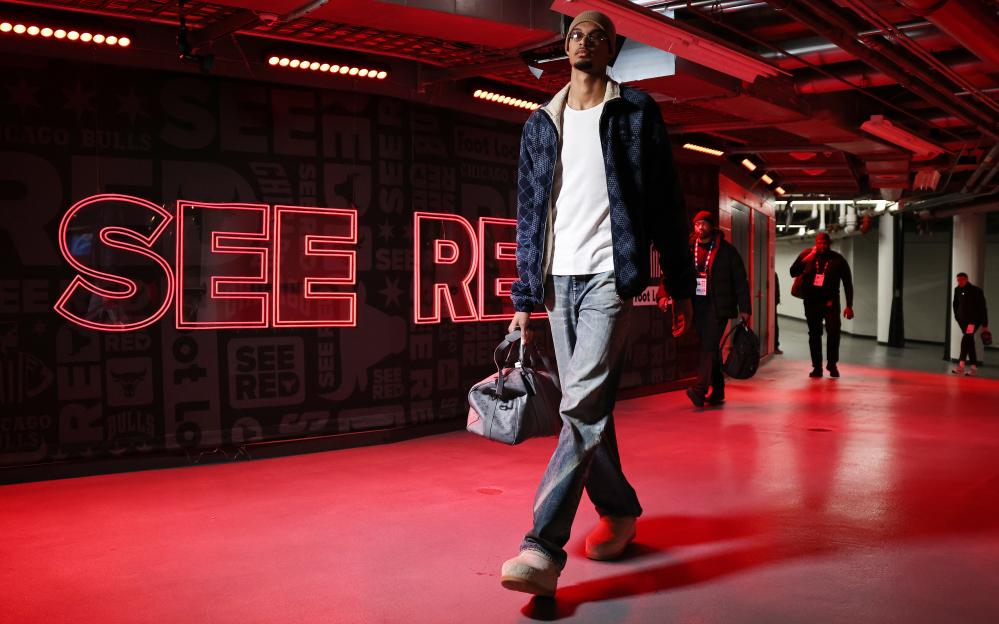
Lonzo Ball’s froze in confusion. The question – “What do you think about the NBA dress code?” – hung in the air for a second before he cracked a sheepish grin.
“There’s a dress code?” he said, smiling.
Advertisement
Twenty years after the introduction of a rule that once roiled the league and ignited a culture war over image and identity, one of the NBA’s current players didn’t even know it existed.
“Now do-rags are flying, along with jerseys and baggy stuff,” said Ball, a point guard for the Cleveland Cavaliers. “I didn’t know we had a dress code. I just knew we had to put something on.”
Former NBA commissioner David Stern instituted the dress code, which went into effect at the start of the 2005–06 season. The policy has been relaxed since Adam Silver succeeded Stern in 2014, but the initial rollout – as with most change – came with controversy and pushback.
The code required all players to dress in business or conservative attire when arriving and departing games, on the bench when injured, and when conducting official NBA business.
Advertisement
Players bristled at the announcement because the policy effectively banned oversized T-shirts, do-rags, jerseys, and other “hip-hop-inspired” attire.
The league’s move was widely seen as a critique of Black culture – a policing of expression and a response to the NBA’s discomfort with hip-hop aesthetics that had become inseparable from basketball itself. The backlash was immediate, loud, and deeply personal.
Related: Mark Cuban made the Mavericks relevant. But is his legacy rotten? | Lee Escobedo
For many, it was also a direct attack on Philadelphia 76ers guard Allen Iverson, who became the poster child for what not to wear. Iverson, then one of the biggest stars in the league, was known for his tattoos, braids, and baggy gear.
Advertisement
In a recent interview on The Breakfast Club radio show and podcast, Iverson said his influence on other players helped trigger the NBA’s response. “David Stern and the rest of the NBA were like, ‘No,’ because it was all right when I was doing it,” Iverson recalled. “But then everybody else said, ‘OK, if he can do that, we can do this.’ You see Kobe coming in with diamond chains and baggy clothes, and everyone started doing it. Then the league was like, ‘Hold on, we’ve got to do something about that.’”
Twenty years later, that moment – once seen as a culture war between the league office and players – has come to represent something far more complicated. Instead of erasing individuality, the rule inadvertently helped create a fashion renaissance that reshaped both the NBA and global style.
What began as a mandate for “professionalism” evolved into tunnels lined with photographers, endorsement deals with high-fashion brands, and players driving global trends in ways the league never imagined. Former NBA forward Ira Newble, who remains racially conscious, vividly remembers the tension.
“Everyone seemed upset and up in arms about the dress code,” Newble, who was playing for the Cavaliers when the ban came in, says. “No one wanted to have a dress code. It was a big deal.”
Advertisement
Players were used to traveling in sweats, hoodies, or whatever felt comfortable during long road swings. The style of the time – oversized clothing, long white tees, and baggy jeans – was heavily linked to hip-hop culture.
“My style at that time reflected hip-hop culture,” Newble says. “I had the braids and wore baggy clothes. The sentiment among players was that the NBA was trying to take away from the cultural end. Iverson was an influence of that culture. That’s what the controversy was about. It felt as though they were trying to change and get rid of hip-hop culture.”
But Newble also recognizes how the moment evolved. “Everything kind of grew in a different direction where hip-hop culture can still be embraced within the dress code,” he says. “So it’s cool to see how it evolved.”
Inside the league offices, the intent was different, according to Kathy Behrens, the NBA’s president of social responsibility and player programs.
Advertisement
“We felt at the time that it was important for our players to present themselves in a more professional fashion when on league business,” Behrens says. “We were not demanding a suit culture, but we did want to raise the level of how players showed up.”
She says the league anticipated pushback, but emphasized it was never meant to sanitize hip-hop expression.
“We knew what the goal was, and it had nothing to do with changing our players’ fashion or culture,” she says. “We talked with many players about this change before implementing it.”
What the NBA didn’t expect, Behrens admits, was what happened next.
Advertisement
“The reality is our players embraced the change very quickly and truly raised the level much higher than we anticipated,” she says. “Pre-game ‘fits’ became a thing. It soon became a competition over who could dress the best. How you dress became a cultural touchpoint.”
Two decades later, the league still maintains a dress policy, though it has evolved with changing definitions of “professional attire” and is not as strict as it once was, allowing the players to be more creative with their fashion choices. But the legacy remains.
“When the people most impacted by it embrace it the way our players have, you have to feel that it worked as intended,” Behrens says.
When the rule came in, Jameer Nelson was in his second NBA season with the Orlando Magic. Nelson, now the 76ers’ assistant general manager, can appreciate how the policy unified the league.
Advertisement
“So it didn’t affect me either way,” Nelson says. “But it was cool to see the brotherhood, the fraternity of basketball players, move in the same direction, whether we liked it or not.”
Nelson laughs at how players have flipped the narrative completely.
“You can see now how the personalities are being shown through fashion,” he says. “I have my own style, more old school, more casual. Somebody told me yesterday I dress hip-hop slash front office.”
He says players today simply have more tools to showcase their creativity.
“These brands, because of social media, take advantage of it,” Nelson says. “If social media was as big back in 2005, we probably would’ve done the same thing. Getting dressed is art. It’s how you express yourself without even speaking.”
Advertisement
Few players symbolize that shift more than those in the current era, where tunnel entrances resemble fashion runways and some players are followed by photographers and videographers from the parking garage to the locker room.
Take Cavaliers star Darius Garland, considered one of the team’s most fashionable players. He marvels at how far things have come.
“The league implemented a dress code 20 years ago – that’s crazy,” Garland says. “Now we can put on our own stuff. We can express ourselves.”
To Garland, fashion and business are intertwined.
“A lot of guys have different avenues of revenue with clothing pieces,” he says. “Guys have Lululemon deals, Armani deals. It’s crazy now. With the dress code not being a dress code anymore, it’s giving us money we can put in our pockets, and it lets us express ourselves.”
Advertisement
If only the league had embraced a more relaxed dress policy earlier, says Garland.
“Hip-hop culture influences basketball, and basketball influences hip-hop culture,” he says. “Everyone wants to see what athletes are wearing so they can wear it. We are the influencers.”
What began as a controversial, racially charged flashpoint has become a cultural engine, embraced by the league, celebrated by players, and followed by millions worldwide.
The NBA tried to define professionalism. The players redefined it instead. The dress code did not suppress the culture. It amplified it.
Years later, the runway to the locker room, once a battleground, is now one of the most influential stages in global fashion.
Advertisement
“You can trace the swag back to [Iverson],” Ball says. “The tattoos, the braids, the baggy stuff. We came a long way from [the NBA] punishing him for expressing himself. Now [hip-hop fashion] is at an all-time high again. We need to give Allen Iverson a lot of respect.”