

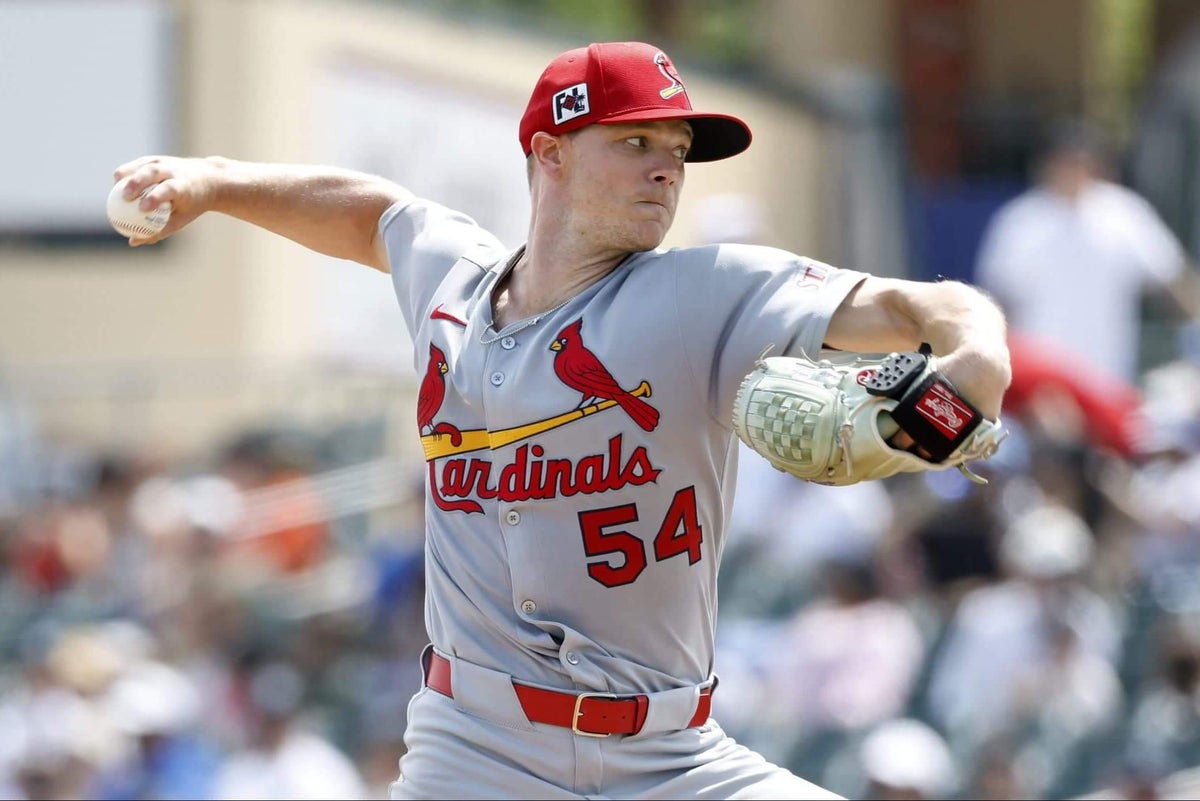
The Red Sox entered this offseason with only two definite starters in their 2026 rotation, Cy Young runner-up Garrett Crochet and righty Brayan Bello, with rookie lefties Peyton Tolle and Connolly Early likely to win spots. That’s probably three candidates short of what they’ll need next year, so they traded for Sonny Gray, who also helps balance out their handedness, by sending one pitching prospect and one fringe big-league arm back to St. Louis.
Gray just turned 36 earlier in November, and as he’s gotten older, he’s adapted to some of the natural velocity loss by becoming an elite strike-thrower — his walk rate in 2025 was just 5 percent, the lowest of his career. That increased efficiency has allowed him to reach 180 innings and 32 starts twice in the last three years, thresholds he hadn’t hit since 2015 with Oakland. He’s always had excellent ability and feel to spin the ball, so it’s no surprise that his best pitch is a breaking ball — his sweeper — while his curveball is still plus, even though he doesn’t use it as much as he once did. His four-seamer has lost effectiveness as he’s gotten older, and he may be better served throwing it less often and his two-seamer more. His ERA last year of 4.28 was much worse than his peripherals because he was awful with men on base, especially with men in scoring position. That hadn’t been an issue for him previously; it’s probably a combination of bad luck and hitters hunting that four-seamer, which he used much less often with men on base but which still accounted for a significant amount of the damage he gave up in those spots. I think he can bounce back and be an above-average starter for the Red Sox, who are only paying a minimum of $21 million for his services this year, including the buyout of the 2027 mutual option, should they choose not to retain him. Given the cost in talent, this is a no-brainer for Boston.
Gray was going to make $35 million in 2026 in the final year of his three-year deal with the Cardinals.
Lefty Brandon Clarke started the year on fire as a 22-year-old in Low A, where he struck out 17 guys in 9 2/3 innings over three starts; add in his first High-A start, where he punched out 7 more, and through four outings, he had a 45 percent strikeout rate and 0.63 ERA. Then he missed a start, made three more, missed a month with a blister on his throwing hand, and was never that effective again, ending his time in High A with a 5.08 ERA and an 18 percent walk rate in 28 1/3 innings. Clarke sits 97-98, but the pitch doesn’t miss as many bats as you’d expect from the velocity, with his slider by far his most effective weapon. He’s got a very long arm swing that’s hard to repeat, and his elbow is pretty high in back as well; when he comes around his body, he’s below ¾ and gets a lot of tilt on his slider, with the best ones similar to how Andrew Miller threw it when he was still a prospect. As is, he’s very likely to be a reliever, although I imagine the Cardinals will try to clean up the delivery at the very least.
Right-hander Richard Fitts will turn 26 next month and is a replacement-level starter, with a basket of fringe-average to average pitches, lacking the command and control to truly succeed with that kind of arsenal (8.2 percent walk rate in the majors, 7.9 percent in Triple A). He gave up 11 homers in 45 innings for the Red Sox last year and has been similarly homer-prone since he reached Double A in the Yankees’ system in 2023. To become more than just a sixth starter, he’d need a new (and more effective) pitch, or a big leap in command. They’re both inventory arms, good guys to have in the system, but not likely to be difference-makers as they are right now. Given that, this seems more like a salary dump for the Cardinals than a move focused on talent acquisition. Even with what the Cardinals are paying of Gray’s salary, they still clear about $21 million, which would be better used trying to boost the offense after they finished second-to-last in the National League in home runs in 2025.