

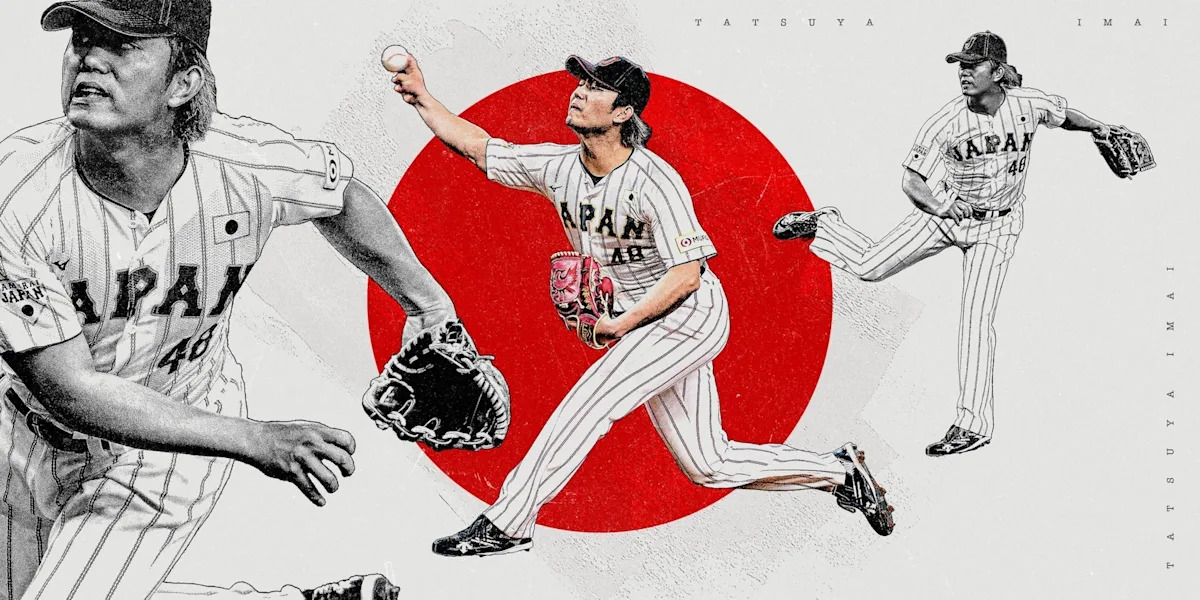
For Tatsuya Imai, this offseason’s top Japanese free-agent pitcher, the clock is ticking.
The 27-year-old right-hander must sign with an MLB team before the expiration of his posting window at 5 p.m. ET Friday. While few teams have been definitively linked to the longtime Seibu Lions hurler, the overwhelming expectation within the industry is that Imai will come to terms with a big-league club before the deadline.
Advertisement
That’s because he offers an enticing combination of ceiling and floor at a relatively young age for a free-agent pitcher.
To be clear: Yoshinobu Yamamoto he is not. Imai’s athleticism, track record and pitch quality pale in comparison to those of the 2025 World Series MVP. As such, Imai won’t sniff the 12-year, $325 million deal that Yamamoto secured two winters ago. Still, a substantial payday is in order; Imai should eclipse the $100 million mark. That is, at least, what his representative, agent Scott Boras, is gunning for.
And based on Imai’s talent and résumé, that’s a very reasonable goal.
Across the Pacific, Imai has been a known commodity, a famous figure, for quite a while. He rose to fame during the 2016 edition of Summer Koshien, Japan’s immensely popular high school baseball tournament. In the final, Imai delivered a heroic performance as the ace of Sakushin Gakuin High School, tossing a nine-strikeout, one-run complete game. That propelled him to national prominence and the No. 1 pick in the 2016 NPB Draft.
Advertisement
But pro success didn’t come right away. As a 20-year-old rookie with Seibu in 2018, Imai struggled to a 4.81 ERA across 78 2/3 innings. Things gradually improved as he got comfortable at the highest level, but injuries and a lack of control limited his production.
Free passes, in particular, were a massive bugaboo. Between 2018 and 2023, Imai posted a total walk rate over 13%. For comparison, just one MLB starter over the past decade (Blake Snell in 2023) has recorded a season with such wildness. This past season, only two qualified starters (Cleveland’s Gavin Williams and Anaheim’s José Soriano) had walk rates north of 10%. Simply put, it was an unsustainable way for Imai to live.
So the 5-foot-11 righty changed course, purposefully altering his mechanics to improve his strike-throwing. In turn, his numbers took a huge step forward, with the walk rate dropping to 9.8% in 2024 and then a tidy 7.0% in 2025. Even more impressively, Imai’s strikeout numbers increased alongside his boost in control.
It all culminated in a phenomenal 2025 season in which Imai cruised to a 1.92 ERA with more than a strikeout per inning across 24 starts.
That breakout sent Imai zooming up MLB wish lists, as practically every club — except, perhaps, the Dodgers — could use another rotation piece. And unlike fellow Japanese free-agent Munetaka Murakami, whose high-risk profile stunted his market, Imai seems like a reliable proposition.
Advertisement
Part of that is simply a product of the hitter/pitcher divide in regard to NPB players. Projecting whether or not a Japanese hitter will adjust to MLB pitching is a much trickier exercise than doing the same with a Japanese pitcher. Advances in tracking data mean that we can compare Imai’s arsenal, release points, velocities and pitch shapes to those already present in the bigs. That provides us — and, crucially, MLB teams — a better sense of how arms will translate from the second-best to the best league in the world.
And Imai’s stuff passes the smell test. His heater last year averaged right around 95 mph, above the MLB starter average of 94.1. He leans on that four-seam fastball quite a bit, particularly against right-handed hitters, to whom he threw the pitch 53% of the time. His slider accounted for another 39% against same-sided bats, meaning Imai rarely uses a third pitch against righties. That puts him in a small group of pitchers — think Spencer Strider, Jacob deGrom, Jared Jones — with such a small right-on-right mix.
Facing lefties, Imai turns toward his changeup and splitter to keep opponents off-balance, using those offering 16% and 7% of the time, respectively. It all comes out of a relatively low slot, which adds deception to his heater/slider combo.
The indomitable Yuri Karasawa of JapanBall, the internet’s premier source for English-language Japanese baseball coverage, compared Imai to Mariners righty Luis Castillo in a recent YouTube video. It’s an interesting comp, based on their similar heater/slider reliance and low arm slots.
Advertisement
One key difference: Castillo has been commendably durable for most of his career, while Imai has never started more than 25 games in a season. But if Imai can match Castillo in terms of efficacy, that would be a massive win for whichever team ends up with the Japanese hurler. No front-runner has yet emerged, as the typical host of deep-pocketed clubs in Los Angeles, New York and Toronto have pretty stocked starting staffs.
The Mets, whose starting pitching woes sank their 2025 season, have been connected to Imai, but they would probably need to subtract from their assortment of arms if they reel him in. The Phillies, potentially without ace Zack Wheeler for the start of the season and around $35 million below last year’s final payroll, would make some sense. The Cubs desperately need another frontline arm but haven’t shown the willingness to push their payroll far beyond $200 million. The same is true for the Giants, who haven’t added much to their big-league roster so far this winter.
To be fair, a player of Imai’s caliber fits pretty much anywhere; playoff hopefuls in Baltimore, Detroit, Miami, Arizona and even Sacramento should all pick up the phone and inquire. His history of gradual, year-over-year improvement, willingness to make adjustments, on-mound athleticism and arsenal all suggest he’ll be a solid mid-rotation hurler in MLB, with the potential for more if he continues to develop.
That’s a pretty exciting player — one who should be a whole lot richer in a few days.