

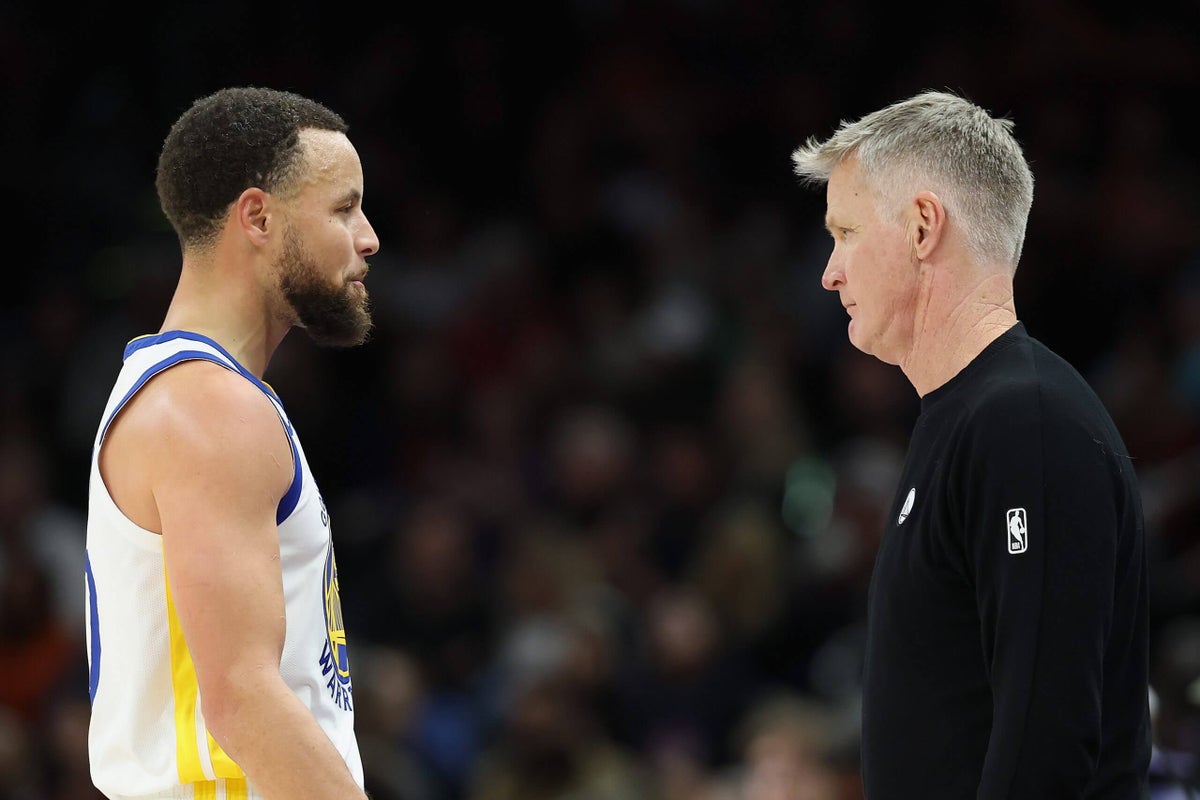
On Christmas Eve, Golden State coach Steve Kerr addressed the ghosts in the room.
“We are no longer the ’17 Warriors dominating the league,” he told reporters after practice. “We are a fading dynasty. We know that. Everybody knows that. So what is up to us? How do we carry ourselves night to night? How connected are we? And can we give ourselves another swing at the plate? … We know where we are. We’ve got to know who we are. We got to know what’s possible and we have to take pride in the struggle because this is part of life.”
It was a startling bit of honesty from the Warriors’ longtime coach and an admission that surprised no one.
A day later, the Warriors won a Christmas Day matchup against the woeful Dallas Mavericks. Inside the Chase Center, an indulgent monument to the once-thriving dynasty, you could witness an aging Steph Curry doing Steph Curry things — he scored 28 points but went 6-for-18 from the field — Jimmy Butler doing Jimmy Butler things (he just missed a triple-double) and Draymond Green, uh, keeping busy in his golden years.
Curry, who turns 38 in March, is, like fellow aging millennial LeBron James of the Los Angeles Lakers, still a viable star. But his Warriors are no longer a contender. Kerr, who has first-hand experience with the abrupt ending of a dynasty, wants to believe the Warriors can hang around long enough to win one more. But he knows better.
Kerr is the coach of a middle-of-the-road team trying to win a few more games than it loses and put up a good effort. He sees their struggle as a universal one. What do you do when you’re no longer as good as you once were?
Since their last-gasp championship in 2022, the Warriors have finished sixth, 10th and seventh in the Western Conference. This season, they’re currently in eighth. Everyone is aware that “dynasty” is in the past tense now. What’s left is an organization unwilling to tank, and comfortable enough with being good and not great. Is it wrong to want to go out fighting?
Steve Kerr kept it real on the Tom Tolbert Show, and might’ve given the Spurs the biggest compliment yet:
“We’re not where we were 5–6 years ago… I just don’t want anyone thinking we’re delusional and should be competing for titles year in and year out with San Antonio and OKC.… pic.twitter.com/BMWu896r7S
— SpursRΞPORTΞR (@SpursReporter) January 2, 2026
While other teams in their situation would clean house, the Warriors aren’t getting rid of Curry, the franchise icon, until he retires. And they’ve been resistant to dumping the 35-year-old Green despite his declining play.
“One of the things I love about Draymond is he knows where he is right now,” Kerr said that day. “He’s told me, ‘I know I’m not the same player I was eight years ago. And two years from now, I’m not gonna be the same guy I am now. So I know I have to play the role that’s best for the team and best for me now.’”
It feels like just yesterday that Green was an on-court dervish and Golden State was changing the NBA one 3-pointer at a time, but the league has evolved and now the Warriors are the old guys at the gym, armed with experience and memories of what they could do when they were young.
For most franchises, now would be the time to rebuild and start over. The Warriors are soldiering on. It’s admirable, I suppose.
But what about the fans who have been conditioned to want more than being the No. 8 seed in the West? Should they be content with fond memories and fading banners? Is it OK for a dynasty to linger like this?
“It’s true. Dynasties don’t last forever,” Green said of Kerr’s comments on his podcast. “What you do is try to prolong them as much as you can, you try to build on them as much as you can.”
To be a modern sports dynasty — which doesn’t have to be formally defined by consecutive championships — you need superstars and role players, executives and owners who aren’t too smart for their own good. You need money. You need a lot of luck. The Warriors had all of these things.
With free agency, player empowerment, salary caps, impatient owners and would-be brainiac executives, extended success is more difficult to achieve than ever.
In most sports, parity reigns. Even the Los Angeles Dodgers, with a clear financial edge on everyone else, were pushed to the limit last fall.
Any fan of a team that’s managed to even be in this discussion of a dynasty should feel gratified, but that’s not how it works. Goal posts are moved, and expectations change.

Patrick Mahomes (15) and Travis Kelce (87) lead the Chiefs onto the field before their game in Jacksonville. The Jaguars won 31-28. (Mike Carlson / Getty Images)
I count the Warriors and Kansas City Chiefs among recent “modern” dynasties in the NFL, NBA, MLB and NHL, joining the Chicago Blackhawks (three titles in six seasons), New England Patriots (six titles in 18 seasons), the Dodgers (three World Series in six seasons and counting), the Lakers (five titles between 2000 and 2010) and the nomadic James, a one-man fading dynasty who made the Finals with two different teams in eight straight seasons from 2011 through 2018, winning three, and won his fourth ring with his third team in the 2020 bubble.
The Florida Panthers, winners of the last two Stanley Cups and a loser of the one before, are right there, as are the Sidney Crosby Pittsburgh Penguins, who won three Cups between 2009 and 2017.
When I think of a fading dynasty, I think of Jonathan Toews and Patrick Kane, the core guys from the Blackhawks’ run, sticking around for years after the team was relevant. Crosby and Evgeni Malkin have been on a similar track for the last nine years.
I think of the late Kobe Bryant, the last man standing from his championship teams, scoring 60 in his final game, for no reason other than he could. I think of Bill Belichick futilely trying to prove he didn’t need Tom Brady to win. I think of LeBron missing the playoffs in Los Angeles.
Occasionally, a team will figure out how to segue from one era to another, usually through fortuitous draft successes.
In San Antonio, for instance, Gregg Popovich and veterans Tim Duncan, Manu Ginobili and Tony Parker welcomed Kawhi Leonard, and he won them another title in 2014. It was the fifth for Popovich and Duncan, who won their first in 1999.
After that fell apart, San Antonio tanked and got lucky enough to draft a future star in Victor Wembanyama. For all their high-mindedness, the Spurs have never been shy about dabbling in the dark arts of the NBA, from tanking to “load management.” Now, the Spurs are likely set as contenders for the next decade.
Soon, Golden State will be just another has-been team living in a mansion.
Of course, blowing it up can go the other way too. Kerr played on the second three-peat Bulls, who ended their run on a perfect note with Michael Jordan burying a Finals winner in Utah. Could they have won one more title if they kept the team together? Perhaps, but every sign pointed to the end.
The problem was the Jerrys (Reinsdorf and Krause) didn’t have a clue what to do next. In the 28 seasons since, only Reinsdorf remains, and the Bulls have won just five playoff series, made one conference finals and endured 14 losing seasons (and counting).
After successfully adding Kevin Durant at their peak to win two more titles, the Warriors have tried to keep their championship window open with high draft picks (James Wiseman, Jonathan Kuminga) and big trades (Andrew Wiggins, Jimmy Butler), but nothing has worked. They’re a .500 team now.
A few years after the Warriors broke through, so did another entertaining team: the Chiefs.
In 2018, Patrick Mahomes’ first year as a starter, they made it to the AFC championship, and that began a seven-year run in which they won three Super Bowls (including back-to-back in 2022-23), lost two, and also lost a pair of conference championships. Mahomes was the football version of Curry, the son of a professional athlete who made the impossible look easy.
The AFC Playoffs will be without Patrick Mahomes, Lamar Jackson and Joe Burrow. pic.twitter.com/CIfiBNgEdf
— The Athletic NFL (@TheAthleticNFL) January 5, 2026
But reality has hit Mahomes too. This month, for the first time since 2017, the Chiefs won’t be in the AFC Championship after a 6-11 season. Mahomes got hurt, Travis Kelce might retire, Andy Reid is turning 68 in March. But hey, at least they’re building a new stadium in Kansas, a Chase Center in the heartland.
The Chiefs went 15-2 last season, but in the Super Bowl, they were manhandled by the Eagles 40-22, ending their three-peat hopes and alerting everyone that their run was likely ending. And now, like the Warriors, they will try and soldier on as a fading dynasty.
Mahomes just turned 30 in September. Maybe Kansas City can reinvent itself.
The Chiefs’ goal, of course, should be to emulate the Patriots, who kept their run going for nearly two decades behind a quarterback (Brady) and a coach (Belichick). Despite all of their success, the run ended abruptly. Belichick pushed out Brady (who went on to win a Super Bowl in Tampa Bay) and then Belichick was fired by owner Robert Kraft.
Now, two years after that unceremonious ending, and with a new coach and a new young QB, the Patriots are rising again. They are one of the favorites to win the Super Bowl.
In thinking about fading dynasties, I come back to the team I root for in my free time: the Pittsburgh Steelers. They were a fading dynasty in the early 1980s, and now, they are one again, albeit on a lower level. They are a dynasty of competence, not championships.
Mike Tomlin is in his 19th season as the Steelers’ head coach. Famously, he’s never had a losing season (and only three 8-8 campaigns).
On Monday night, Tomlin will be coaching in the playoffs for the 13th time. He is tied for the most regular-season wins in franchise history with Chuck Noll, but Tomlin “only” has won one Super Bowl, which came in his second season after taking over for Bill Cowher, who finally won his Super Bowl in the 2005 season.
The last time Tomlin won a playoff game was nine years ago, and if the Steelers lose Monday and he were fired on Tuesday — which won’t happen — at least half the fan base would rejoice. Tomlin’s non-losing streak has become somewhat of a pejorative for Pittsburgh fans who expect more than 10-7 seasons and are tired of the status quo. Unlike the Chiefs and Warriors, these Steelers didn’t win enough rings to be considered a modern dynasty.
In my time covering the Chicago Bears, I’ve learned that consistent competitiveness isn’t a given, and I warn my Steelers fan friends not to take the team’s success, however muted, for granted. But I see their point. Watching a haggard Aaron Rodgers try to will this team to one last playoff run isn’t exactly inspiring.
In the end, all a fading dynasty does is remind you that you’re getting older and your best memories are in the past.