

The NFL regular season is over and the book is closed for the 2025 rookies who are not active in the playoffs. Fantasy seasons ended with the likes of Tyler Shough, Luther Burden, and more winning managers championships. This piece will aim to give a final recap on key fantasy-relevant rookies from this season. The order the players are listed in their respective section can be used as a rough fantasy ranking of the rookies heading into the offseason. Thanks for coming along for the ride this season and enjoy the final check-in.
▶ Rookie Quarterback Check-In
|
Player |
Completion Percentage |
Passing Yards |
Yards per Attempt |
TD : INT |
Rushing Yards |
Total TD |
|
Jaxson Dart |
63.7% |
2,272 |
6.7 |
15:5 |
487 |
24 |
|
Tyler Shough |
67.6% |
2,384 |
7.3 |
10:6 |
186 |
13 |
|
Cam Ward |
59.8% |
3,169 |
5.9 |
15:7 |
159 |
17 |
|
Shedeur Sanders |
56.6% |
1,400 |
6.6 |
7:10 |
169 |
8 |
|
Dillon Gabriel |
59.5% |
937 |
5.1 |
7:2 |
86 |
7 |
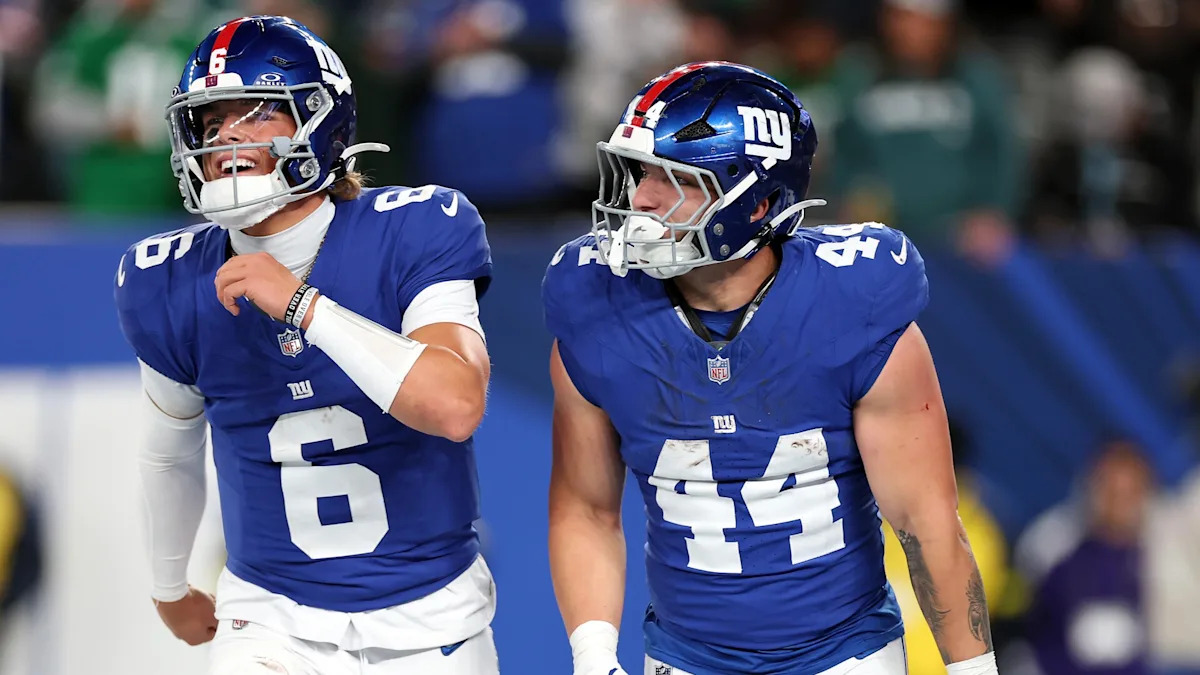
The best rookie quarterback for fantasy purposes was the Giants’ first-round pick, Jaxson Dart. He started from Week 4 onwards, running with a violent dual-threat play style that often found him in concussion protocol. Though the Giants did not have a successful season, Dart’s play was enough to cement him as the starting quarterback. Despite a 68.4 PFF grade (No. 30 among quarterbacks), he was No. 9 in quarterback rushing grade and added nine scores on the ground. That is salivating dual-threat production for fantasy managers. He will need to work on taking less sacks (35 sacks in 14 games) and his passing will develop, but Dart will be in the fantasy QB1 mix next season.
Advertisement
The surging rookie quarterback at the end of the season was the Saints’ Tyler Shough. The second-round pick is the oldest rookie quarterback of this year’s class and took over as starter in Week 9. He dropped below 7.0 yards per attempt just once in his final five starts and threw for over 300 yards twice this season. Shough even added value as a scrambler, generating 67-percent of his rushing yards off scrambles and creating a rushing upside to his fantasy value. His connection with Chris Olave certainly won some fantasy managers championships on the backs of Shough/Olave stacks and heads into next season as the Saints’ QB1 and a fantasy QB2.
The only rookie quarterback to start every game for his team was Titans No. 1 overall pick Cam Ward. The Titans only won three games and PFF gave Ward a 58.5 overall grade, good for No. 39 among quarterbacks. He struggled with 23 turnover-worthy plays (No. 23) and a 23.9-percent (No. 38) Pressure-to-Sack Rate. However, Ward faced a coaching change during the season and a sparse Titans skill group. Not a whole lot of positives, but there is a lot of raw arm talent to build on, as evidenced by some of his throws this season. For fantasy purposes, Ward was a QB3 with 11.4 fantasy points per game. He will have QB2 upside under a new coaching regime next season.
The Browns used two rookie quarterbacks this season, though it’s possible neither is the franchise piece. Third-round pick Dillon Gabriel started six games and struggled to push the ball downfield, ranking last among quarterbacks with at least 200 plays with a 5.96-yard average depth of target. Fifth-round pick Shedeur Sanders started seven games and finished with more turnovers than touchdowns. Despite a league-leading 3.3 seconds of time to throw, Sanders’ scrambling led to 23 sacks as the bulk of his rushing yards came on scrambles. Neither Sanders nor Gabriel are designed runners and both ranked outside the top-32 quarterbacks in EPA per play and PFF grade. With Deshaun Watson nearing a return for the Browns, neither is a good long-term fantasy quarterback bet.
▶ Running Backs

2025_final_rookie_rbs.png
Workhorses
Volume is the first and foremost driver of fantasy production, especially for boosting running backs into RB1 finishes. A few rookie running backs crossed 16 opportunities (carries + targets) per game this season, becoming workhorse backs for their teams. Ashton Jeanty finished with a disappointing fantasy season, but still racked up over 300 touches behind an offensive line that was dead last in PFF’s offensive line rankings. Jeanty’s volume was good for five games as an RB1 in PPR scoring and a high-end RB2 overall finish. He ranked No. 7 in targets and routes run among running backs, giving him a high pass-catching floor. With the hope that the Raiders offensive line gets upgrades, Jeanty is in the RB1 mix next season and is a top-seven Dynasty running back.
Advertisement
As one of the contributors to the Browns rookie takeover, Quinshon Judkins took the reins to the backfield after returning from suspension in Week 4, until suffering a dislocated ankle and fractured fibula in Week 16. Like Jeanty, inefficiency plagued Judkins and the Ohio State product ranked No. 40 among running backs with an Explosive Play Rate of 5.65-percent. He still managed four RB1 finishes, with his biggest spike being a three-touchdown Week 7 performance against the Dolphins. The Browns offense caps Judkins’ upside, but he sits in the RB2 range to close out the season.
The two workhorse backs we didn’t get to see much were Omarion Hampton and Cam Skattebo. Hampton took over the Chargers backfield after Najee Harris suffered an Achilles injury in Week 3, though he suffered an ankle injury in Week 5 and missed the middle of the season. He returned in Week 14 and finished with back-to-back top-20 PPR fantasy finishes in Weeks 16-17. Hampton earned an 84.8 (No. 8) PFF rushing grade and finished No. 10 among backs in Target Share. When healthy, Hampton sits on the RB1 borderline. Meanwhile, Skattebo took over as the Giants’ starter after Week 3 and was a borderline fantasy RB1. His aggressive playstyle managed to get him 22 forced missed tackles in eight games. Skattebo earned an 82.7 PFF receiving grade, No. 6 among running backs; he has pass-catching upside while also playing like a downhill runner. A brutal ankle injury ended his season in Week 8, but Skattebo will be squarely in the fantasy RB2 mix next season.
Ashton Jeanty, Las Vegas Raiders
266 carries, 975 rushing yards, 55 receptions, 346 receiving yards, 10 total touchdowns, 14.4 PPR FPPG
Omarion Hampton, Los Angeles Chargers
124 carries, 545 rushing yards, 32 receptions, 192 receiving yards, 5 total touchdowns, 15.1 PPR FPPG
Advertisement
Quinshon Judkins, Cleveland Browns
230 carries, 827 rushing yards, 26 receptions, 171 receiving yards, 7 total touchdowns, 12.1 PPR FPPG
Cam Skattebo, New York Giants
101 carries, 410 rushing yards, 24 receptions, 207 receiving yards, seven total touchdowns, 16.0 PPR FPPG
Starters
Several rookies showed fantasy relevance as starters in lineups throughout the season, though they may have faced inconsistent production, roles and usage. Woody Marks took over a Texans backfield that only had Nick Chubb as competition. Marks was tackled for loss at a 14.3-percent rate, fourth-highest among running backs with 100 carries with Ashton Jeanty the only rookie at a higher rate. His 3.6 yards per carry ranked No. 49 as his inefficiencies made him touchdown-dependent and gave him a fantasy RB3 finish. Offensive line play and play-calling made his early down runs inefficient but with Joe Mixon out for the season, Marks had opportunity. The only reason he isn’t in the workhorse category is his low draft capital and the likelihood the Texans have another back or two to at least put Marks into a committee next season.
Advertisement
RJ Harvey and TreVeyon Henderson saw more opportunities in the second half of the season after backfield injuries. After J.K. Dobbins went down for the Broncos, Harvey entered workhorse territory with at least 16 touches in five of his last six games. Sean Payton’s committee usage of running backs can be irritating, but Harvey’s 9.9-percent Target Share ranked No. 4 among rookie backs and gives him a solid floor. For the Patriots, Henderson relied on explosiveness for his output, ranking No. 3 in Breakaway Rate. Long touchdowns gave him spike weeks and he still saw double-digit touches in every game but one after Rhamondre Stevenson returned from injury. Harvey and Henderson gave fantasy managers good spike weeks throughout their rookie seasons and will be in the RB2 mix for next year.
Bears rookie seventh-rounder Kyle Monangai carved out a role in Ben Johnson’s offense quickly, seeing double-digits touches in nine games this season. Sumer Sports has Monangai at No. 12 among running backs in Success Rate, totaling five touchdowns as the Bears’ RB2 on the season. Jacory Croskey-Merritt put up similar production for the season but got there on a rollercoaster. He had two top-seven fantasy finishes and no other games inside the top-12. Croskey-Merritt ranked No. 7 in yards after contact per attempt after an up-and-down season spent splitting time with Chris Rodriguez. He is less of a receiver than Monangai, capping Croskey-Merritt’s upside lower. Monangai is a more concrete RB3 while Croskey-Merritt is in the back-end RB3 range.
RJ Harvey, Denver Broncos
146 carries, 540 rushing yards, 47 receptions, 356 receiving yards, 12 total touchdowns, 12.2 PPR FPPG
TreVeyon Henderson, New England Patriots
180 carries, 911 rushing yards, 35 receptions, 221 receiving yards, 10 total touchdowns, 12.1 PPR FPPG
Advertisement
Woody Marks, Houston Texans
196 carries, 703 rushing yards, 24 receptions, 208 receiving yards, six total touchdowns, 9.4 PPR FPPG
Kyle Monangai, Chicago Bears
169 carries, 783 rushing yards, 18 receptions, 164 receiving yards, five total touchdowns, 8.6 PPR FPPG
Jacory Croskey-Merritt, Washington Commanders
175 carries, 805 rushing yards, nine receptions, 68 receiving yards, eight total touchdowns, 8.3 PPR FPPG
Handcuffs
When backfield leaders were injured, the handcuff backs (mostly) saw more opportunities. Dylan Sampson saw opportunities in the Browns’ passing game and got more carries when Quinshon Judkins was banged up. His highlight was a Shedeur Sanders screen pass that Sampson took 66 yards for the score. Ollie Gordon was the Dolphins’ short-yardage back at times and averaged 2.8 yards per carry and scored four touchdowns as a result. Bhayshul Tuten never quite took over the Jaguars backfield, finishing with 93 total touches and seven touchdowns. LeQuint Allen took on a small passing-down role in the Jags’ offense, totaling 10 receptions to 23 carries.
Advertisement
Devin Neal was the Saints’ starter for three games before going down with an injury of his own to end the season. Brashard Smith is in an ambiguous Chiefs backfield but saw just two games of double-digit touches – both against the Raiders in either garbage time or after Kansas City was eliminated from playoff contention. All the handcuffs listed will have their fantasy relevance determined over offseason buzz and competition.
Dylan Sampson, Cleveland Browns
Bhaysul Tuten/LeQuint Allen, Jacksonville Jaguars
Devin Neal, New Orleans Saints
Ollie Gordon, Miami Dolphins
Brashard Smith, Kansas City Chiefs
▶ Wide Receivers

2025_final_rookie_wrs.png
Starters & Streamers
Despite no star WR1 performances ala Malik Nabers or Ja’Marr Chase, rookie receivers were consistently in the starting/streaming conversation this past fantasy season. Emeka Egbuka saw a tale of two seasons amidst the Buccaneers’ wide receiver injuries. He averaged 7.5 targets per game while getting just 10 total targets across the Bucs’ final three games. Egbuka notably suffered a mid-season hamstring strain and tallied just two double-digit fantasy games after Week 6, despite five straight double-digit games to start. His usage fell under Jalen McMillan to close what was a disappointing end to the Bucs’ season. Egbuka’s value is tied to what the team’s receiver room looks like next season. He finishes the season a WR3 but has more long-term value for Dynasty leagues.
Advertisement
Tetairoa McMillan spent the season as the WR1 in a Panthers offense that averaged the seventh-least passing yards per game. Despite the low volume, McMillan’s 25.4-percent Target Share ranked No. 13 among qualifying wideouts and led to the only rookie 1,000-yard receiving season. He averaged 1.84 yards per route run, good for first among rookie wide receivers. McMillan was touchdown-dependent for fantasy purposes due to his big slice of a small pie and managed a WR2 finish. He will be back in that range for next season.
Jayden Higgins and Luther Burden started the season as depth receivers who saw more usage over the course of the season. Higgins did not run more than 20 routes in a game until after the Texans’ Week 6 bye. He only saw four games of more than five targets as the Texans limited the usage of their rookie receivers, but Higgins has a 41.7-percent Contested Catch Rate to build on. Burden saw at least six targets in three of the final four games of the regular season with Rome Odunze sidelined. He saw a lot of usage in space and showcased burst on his touches, averaging 7.3 yards after catch per reception and 2.7 yards per route run, both No. 3 across all NFL wide receivers. Burden’s efficiency and trend for a larger role gives him WR3 upside next season. Higgins is in a shakier offense but can be in the WR3 range if he grabs the No. 2 receiving role in Houston.
Travis Hunter suffered a season-ending knee injury after Week 7, depriving Jaguars fans of his full dual-position abilities. He split time at wide receiver and cornerback, making him fun to watch but frustrating for fantasy projections. Hunter’s best game was an eight-reception, 101-yard, one-touchdown performance against the Rams where he ran 48 routes. The Jags now have a crowded receiver room with Jakobi Meyers, Parker Washington, and Brian Thomas Jr. in the mix. Jacksonville is still planning to play Hunter on both sides of the ball, so his fantasy relevance will depend on how his usage is trending and what the Jaguars do with their receiving room in the offseason.
Tetairoa McMillan, Carolina Panthers
12.4 PPR FPPG, caught 70-of-122 targets for 1,014 yards and seven touchdowns
Advertisement
Emeka Egbuka, Tampa Bay Buccaneers
11.5 PPR FPPG, caught 63-of-127 targets for 938 yards and six touchdowns
Luther Burden, Chicago Bears
8.5 PPR FPPG, caught 47-of-60 targets for 652 yards and two touchdowns
Jayden Higgins, Houston Texans
7.6 PPR FPPG, caught 41-of-68 targets for 525 yards and six touchdowns
Travis Hunter, Jacksonville Jaguars
9.1 PPR FPPG, caught 28-45 targets for 298 yards and one touchdown
Deep Leagues & Dynasty Stashes
Rookie receivers were not as prominent on fantasy radars as rookie running backs this season. However, receiver development takes longer, and guys will carve out roles in the future. Some rookies were thrust into large roles in subpar offenses, like Chimere Dike and Elic Ayomanor on the Titans. Others saw larger roles later in the season but were stuck behind a filled depth chart. Pat Bryant, Jaylin Noel, Kyle Williams, and more all flashed potential in receiving rooms with veteran preference. Matthew Golden had a chance at a large role early on but fell to the wayside when Jayden Reed returned for the Packers. Isaac TeSlaa deserves a shoutout for almost only catching touchdowns. He finished the season with six touchdown catches on 16 receptions.
Advertisement
Ultimately, the receivers listed below were not consistently fantasy-relevant, seeing a variety of different roles and usage as rookies. These guys should be rostered for their long-term value in Dynasty formats, but offseason buzz will play a larger role in how they are valued next season. The Illinois alum in me would love to see Pat Bryant ascend to the No. 2 role in Denver…
Pat Bryant, Denver Broncos
Matthew Golden, Green Bay Packers
Elic Ayomanor/Chimere Dike, Tennessee Titans
Jaylin Noel, Houston Texans
Kyle Williams, New England Patriots
Tre Harris, Los Angeles Chargers
Tory Horton, Seattle Seahawks
Isaac TeSlaa, Detroit Lions
Jaylin Lane, Washington Commanders
Isaiah Bond, Cleveland Browns
Tez Johnson, Tampa Bay Buccaneers
Konata Mumpfield, Los Angeles Rams
Jack Bech/Dont’e Thornton, Las Vegas Raiders
▶ Tight Ends
Starters
Much of the pre-season was spent debating Tyler Warren vs Colston Loveland…but was the answer Harold Fannin Jr.? Fannin was the Browns’ leading receiver on the season with 72 receptions for 731 yards. He ranked No. 4 among tight ends in targets, finished with a 76.4 PFF receiving grade (No. 12), and even saw seven carries. Fannin split his time between the slot and in-line alignments while also lining up in the backfield on occasion. While the next Browns coaching staff will introduce new wrinkles to the offense, Fanning is certainly in the borderline fantasy TE1 conversation.
Advertisement
Warren’s production slowed down after Daniel Jones’ Achilles injury, failing to exceed 43 yards receiving in three Philip Rivers games. The good news is Warren had consistently high usage in the Colts offense. He ranked No. 6 among tight ends than ran at least 50 routes with a 21.1-percent Target Share, just barely trailing Fannin in that category. Versatility as both a receiver and blocker sees Warren on the field for nearly every offensive snap. His value is tied to the Colts’ quarterback situation, but Warren has enough opportunity to sit on the fantasy TE1 borderline.
Lastly, Loveland took on a larger role as the season progressed. He caught all six of his touchdowns after Week 8 and tallied 23 combined targets in the last two games of the regular season.
Loveland developed into a good downfield target for Caleb Williams, ranking top-seven among all tight ends in both yards per route run and average depth of target. He is trending up, up, and away to finish the season and joins Warren and Fannin as tight ends who can reach 100 targets and the fantasy TE1 range.
Harold Fannin Jr., Cleveland Browns
11.7 PPR FPPG, caught 72-of-107 targets for 731 yards and six touchdowns
Tyler Warren, Indianapolis Colts
11.1 PPR FPPG, caught 76-of-112 targets for 817 yards and four touchdowns
Advertisement
Colston Loveland, Chicago Bears
10.3 PPR FPPG, caught 58-of-81 targets for 713 yards and six touchdowns
Streamers & Stashes
The Chargers’ passing offense faltered with offensive line injuries, otherwise Oronde Gadsden was looking like the smash waiver pickup of the year. He finishes with a solid 49 receptions for 664 yards highlighted by four straight top-12 PPR finishes from Weeks 6-9. Gadsden is a good bet as a fantasy TE2 heading into the offseason. Mason Taylor and Gunnar Helm both carved out roles on two of the most anemic offenses of the season. Helm is tied to Ward and should see increased opportunities as the offense grows under a new coaching staff. Taylor’s outlook is a bit murkier with the Jets’ quarterback situation up in the air. Taylor and Helm are better Dynasty players than Redraft next season but will still be on the radar with TE2 upside.
Oronde Gadsden, Los Angeles Chargers
8.8 PPR FPPG, caught 49-of-69 targets for 664 yards and three touchdowns
Advertisement
Mason Taylor, New York Jets
6.8 PPR FPPG, caught 44-of-65 targets for 369 yards and one touchdowns
Gunnar Helm, Tennessee Titans
5.7 PPR FPPG, caught 44-of-55 targets for 357 yards and two touchdowns
Various Stats mentioned from Sumer Sports and Pro Football Focus