

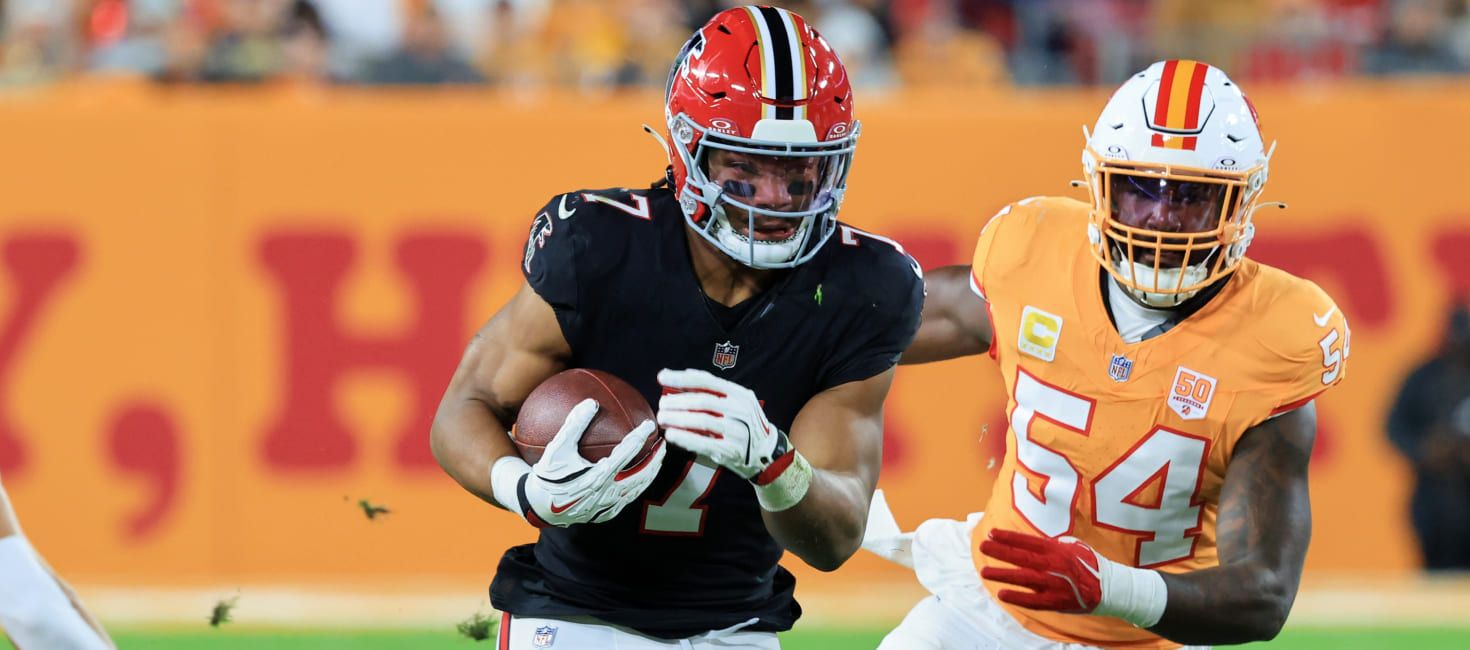
Would Zero-RB have been a less controversial fantasy football strategy with better branding? What if it had been called Pass Catcher Onslaught or Catch-a-Palooza?
There are few things in fantasy football more satisfying than having a stud running back anchoring your lineup, piling up yardage and touchdowns week after week. A strategy whose title suggests we eschew the pursuit of such players was bound to get pushback.
But Zero RB isn’t about punting running back. It’s more about attacking the RB position in stealthy ways.
The father of the Zero RB strategy is Shawn Siegele of RotoViz, a successful high-stakes player who introduced it in a 2013 article titled “Zero RB, Antifragility, and the Myth of Value-Based Drafting.”
The key word is “antifragility.” Running back is a volatile position typically subject to high injury rates and high turnover. If your roster can be harmed by injuries and turnover, it’s fragile. But if your roster can potentially benefit from injuries and turnover, it’s antifragile.
Tackle football is a violent game, and NFL injury rates are sky-high. Any fantasy football roster can be damaged by injuries. But when a wide receiver or tight end gets hurt and misses time, his production is typically replaced by several players who inherit the vacated targets. When a running back gets hurt, his production is often primarily replaced by just one player.
Using the Zero RB strategy means attacking the WR and TE positions early and back-filling the RB position with players who could potentially benefit from other running backs being injured or demoted.
The last two seasons have not been particularly friendly to the RB strategy because there have not been a lot of RB injuries. But of course, that could change in 2026.
Fantasy Football Draft Strategy, Targets & Avoids: Running Backs
Four RB Strategies
This is not a Zero RB article; it’s about how to handle the RB position in 2026 fantasy drafts. But no discussion of running-back strategy in fantasy football would be complete without a mention of Siegele’s innovative approach.
There are essentially four RB strategies. Zero RB is one.
The others:
Hero RB: This strategy allows drafting a top running back in one of the first two rounds, with other early-round picks dedicated to non-RBs.
Robust RB: This strategy involves an RB-heavy approach in the early rounds – typically three RBs in the first four rounds.
Opportunistic RB: This is simply a value-hunting approach to the position. Is there value at RB in the early rounds? Jump on it. If not, be patient and get your RBs later. Tailor your draft strategy to the way your draft is falling. Take the value wherever you find it.
I have tried all four strategies. I have had successes and failures with all of them. The Opportunistic RB approach best fits my draft philosophies and tends to be the strategy I use in most drafts, but I would use any of these strategies under the right circumstances.
Key Considerations
Let’s look at a few key considerations for the position.
The number of wide receivers you’re required to start each week should drive your RB strategy.
If you only have to start two wide receivers each week, it’s less important to aggressively attack the WR position. Merely keeping up with your competitors at wide receiver is acceptable as long as you’re building positional advantages elsewhere.
If you have to start three receivers each week, investing heavily in the WR position is imperative.
Wide receiver is a crucial position in 3WR leagues simply because receivers make up such a large percentage of your starting lineup. If your league requires you to start 1 QB, 2 RBs, 3 WRs, 1 TE and 1 FLEX, at least 37.5% of your non-defense, non-kicker starters will be WRs. That percentage jumps to 50% if you put a WR in the flex spot.
In a league where you only have to start two wide receivers every week, drafting a pair of running backs in the first two or three rounds is a viable strategy.
In a league where you have to start three wide receivers every week, pounding the RB opposition in the early rounds puts you at risk of shorting yourself at the WR position – a position that has amplified importance because you have to start so many.
Talent matters most at WR; opportunity matters most at RB.
I would contend that a wide receiver can’t provide sustained fantasy value without being a good player. Modestly talented receivers might have spurts of production aided by favorable circumstances. But it is rare for an average receiver to finish as a top-10 or top-15 fantasy scorer at the position.
A modestly talented running back can deliver sustained fantasy value as long as his NFL team gives him opportunities.
It takes talent for a wide receiver to earn targets because earning targets depends on a receiver’s ability to separate from defenders and get open. It takes talent for a wide receiver to haul in off-target throws and make contested catches.
Most any NFL running back can provide fantasy value if he’s getting 15 or more carries per game and his offensive line is creating running room.
When assessing wide receivers, I try to downplay the circumstantial stuff. I don’t want to get caught up in “too many mouths to feed” narratives. Talent will keep a wide receiver well-fed. I don’t want to fret too much about playcalling or projected game scripts. A wide receiver’s quarterback is a concern, but not an overriding one.
At running back, the circumstantial stuff matters more. How good is a running back’s offensive line? How good is a running back’s playcaller at designing a running game? How easy would it be for a backup running back to ascend a depth chart? How often is a running back likely to get run-friendly game scripts? Such considerations often matter.
Embrace, don’t run from, ambiguous backfields.
Some teams have a clear pecking order in their backfields. A single player gets a majority of the RB touches, and one or more backups get what’s left over.
Other teams will enter the regular season with backfield ambiguity. It won’t be clear how the running backs on each of those teams will divide the work.
Backfield ambiguity holds down RB prices in fantasy football drafts. No one is going to spend an early-round pick on a player who might not be the top running back on his own team.
As a result, running backs in ambiguous backfields are available in the middle or late rounds. If a running back drafted in the middle or late rounds winds up becoming the top RB on his NFL team, the payoff on a modest investment could be immense.
Study ambiguous backfields and invest in them.
Receiving ability matters.
This is fairly obvious, but it makes sense to favor running backs with pass-catching ability because those RBs offer multiple paths to value.
Scott Barrett of Fantasy Points found that an RB target is worth about 2.5x as many fantasy points as a carry in PPR leagues and about 2x as many in half-point PPR leagues.
One need only look at the fantasy value Christian McCaffrey has provided over the years to understand how valuable pass-catching running backs can be.
A Word About RB Handcuffing
Dedicating two roster spots to the RB position on a single NFL team – a practice known as handcuffing – is a suboptimal strategy in your draft and early in the season. You’re better off spreading your bets around and trying to strike gold in a different backfield.
Let’s say you spend an early draft pick on James Cook. Some fantasy managers believe that if you draft Cook, you should also draft his primary backup on the Bills, Ray Davis. But Davis has no stand-alone value and would be no more than an insurance policy.
And a lot of lead running backs don’t have “clean” handcuffs. Sometimes it’s not clear who’s No. 2 and who’s No. 3 in a given backfield. Or a team might divide the labor if its starting running back were to get hurt. In the case of the Bills, Davis would probably get most of the early-down work if Cook were to miss time, but Ty Johnson would probably play on passing downs – and perhaps on some early downs, too.
Drafting Ray Davis robs you of a chance to hit an unexpected home run with a late-round running back who becomes the lead back on his NFL team, whether on the merits or due to an injury to that team’s starter.
Handcuffing a running back in fantasy football is like taking insurance at a blackjack table. Sometimes it works out, but over the long run, it will make you less profitable.

Fantasy Football Targets & Avoids
Here are some of the running backs I’m targeting and avoiding in 2026 fantasy drafts, based on their price points.
Targets: Bijan Robinson (ATL) and Jahmyr Gibbs (DET)
If I get pick 1.01 or 1.02 in any draft – whether it’s PPR, half-PPR or standard scoring – I’m taking either Robinson or Gibbs.
Robinson had nearly 1,900 yards from scrimmage in 2024 and nearly 2,300 last year. Gibbs has been nearly as prolific a yardage earner as Robinson and has scored 49 touchdowns in 49 career regular-season games.
Avoid: De’Von Achane (MIA)
Remember the earlier point about talent vs. opportunity at the RB position? If talent were the primary consideration, Achane would not be a fade. He’s averaged 5.6 yards per carry over his three-year career and has scored in double digits in every season.
Achane has had 145 catches over the last two seasons, but the reception volume could dry up this season. Miami’s new quarterback, Malik Willis, averaged 18 pass attempts per game across his three starts for the Packers over the last two seasons. Only eight of his 54 throws in those three starts went to running backs.
Also, the Dolphins’ offensive line is expected to be among the worst in the league.
Target: Jeremiyah Love (ARI)
The recent history of running backs selected with early picks in the NFL Draft suggests that Love is a good percentage play.
From 2015 to 2025, there have been eight running backs taken in the top 12: Todd Gurley, Ezekiel Elliott, Leonard Fournette, Christian McCaffrey, Saquon Barkley, Bijan Robinson, Jahmyr Gibbs, and Ashton Jeanty.
Those eight running backs averaged 1,474 yards from scrimmage and 10.9 touchdowns in their rookie seasons. The worst statistical output among those rookies came from McCaffrey, who had 1,086 scrimmage yards and seven touchdowns for the Panthers in 2017. McCaffrey was RB11 in half-point PPR scoring that year.
For those who would argue that the Cardinals might not provide Love with a healthy offensive ecosystem, consider that the combined winning percentage of the teams that drafted those eight rookie RBs in the seasons before they were drafted was .320.
Avoid: Breece Hall (NYJ)
Jets head coach Aaron Glenn has talked about the Jets using a three-headed backfield this season, with Hall sharing work with Braelon Allen and Isaiah Davis.
Hall is under contract with the Jets for the next three years. With the Jets clearly in rebuilding mode, they have no incentive to give Hall a punishing workload.
And with Geno Smith at quarterback, the Jets aren’t likely to have a high-powered offense, so Hall could have limited opportunities to score touchdowns.
Target: Bucky Irving (TB)
People seem to have forgotten how good Irving was over the second half of his rookie season in 2024 after taking over the backfield from Rachaad White. From Week 10 through the playoffs, Irving averaged 111.6 yards from scrimmage, with six touchdowns in nine games. He averaged 5.4 yards per carry and 3.93 yards after contact per carry.
Last year, Irving averaged 3.4 yards per carry and 2.33 yards after contact per carry. But he was banged up, and so was his offensive line, which ranked No. 2 in the run-blocking metric adjusted line yards in 2024 but ranked 22nd last year.
People also seem to have forgotten that Irving still averaged 20.3 touches per game last season despite his drop in rushing efficiency.
It’s possible that Kenneth Gainwell steals some passing-down work from Irving and Sean Tucker steals some goal-line work. Evidence suggests, however, that Irving is a better pass catcher than Gainwell. Irving has averaged 1.56 yards per route run in the NFL. Gainwell has averaged 1.19 yards per route run.
Irving has become a popular fade, but I’m buying.
Avoid: Jadarian Price (SEA)
Fantasy managers often get mesmerized by NFL Draft capital, and that might be the case with Price, whom the Seahawks selected with the 32nd overall pick in this year’s draft.
Price is a talented prospect and would fit well into a Seattle running scheme that figures to be heavy on outside-zone runs.
But Price also has a limited resume since he was Jeremiyah Love‘s backup at Notre Dame. Price had only 15 catches in three college seasons.
While he figures to get a good amount of work while Zach Charbonnet recovers from a torn ACL, Price’s usage could drop upon Charbonnet’s return, and Seattle might have an RB committee by the time the fantasy playoffs roll around.
Target: Jaylen Warren (PIT)
Warren and Rico Dowdle have similar ADPs, but Warren is the better bet because he’s exactly what Steelers QB Aaron Rodgers needs.
The 42-year-old Rodgers is immobile and unwilling to stand in the pocket and take hits. He needs a running back who can protect him as a blocker and be a safety valve as a pass catcher. (Rodgers was a check-down machine last year, as Steelers RBs accounted for 25.4% of the team’s targets – the second-highest percentage in the league.)
Warren has averaged 2.6 receptions per game and 1.41 yards per route run over his career. Dowdle has averaged 1.4 receptions per game and 1.05 yards per route run over his career.
Warren received a PFF pass-blocking grade of 72.0 last season. Dowdle received a PFF pass-blocking grade of 24.6 last year.
Warren is simply a much better fit with Rodgers than Dowdle is.
Avoid: RJ Harvey (DEN)
Harvey had a golden opportunity to plant his flag atop the Denver backfield last season after J.K. Dobbins sustained what proved to be a season-ending foot injury, but Harvey bombed the audition.
After Dobbins went down, Harvey averaged 3.3 yards per carry over nine games (including the playoffs) while running behind a good Broncos offensive line.
The Broncos not only re-signed Dobbins but also drafted University of Washington RB Jonah Coleman in the fourth round. Broncos head coach Sean Payton has long favored a committee approach at running back. It seems unlikely that Harvey will be the Broncos’ top running back this season after his disappointing performance in Dobbins’ absence in 2025.
Target: Jonathon Brooks (CAR)
Brooks has torn his right ACL twice – once at the University of Texas and once in December 2024 in his third NFL game.
The Panthers reportedly had a highly regarded surgeon repair the second tear using a double-bundle technique that improves the knee’s rotational stability and yields a stronger reconstruction. By the time training camps open, it will have been 20 months since Brooks’ most recent knee injury.
The Panthers didn’t take another running back in this year’s NFL Draft. Brooks is projected to be the backup to Chuba Hubbard, who’s had an unremarkable NFL career aside from a strong 2024 season.
Brooks, a talented former second-round pick, could take over as Carolina’s back if he’s as good as advertised.
Avoid: Kenneth Gainwell (TB)
Gainwell had career highs in catches (76) and touchdowns (8) with the Steelers last season, but his role with the Buccaneers might not be as substantial as his supporters believe.
Gainwell averaged 6.7 carries per game with Pittsburgh last season, a career high.
Fantasy Football Running Back Rankings & Tiers
Here are the top 50 running backs in my redraft rankings, sorted into tiers, with brief notes on a few players from each tier.
Tier 1
Bijan Robinson (ATL)
Jahmyr Gibbs (DET)
As mentioned above, Bijan Robinson and Jahmyr Gibbs are worthy of the top two picks in any 1QB fantasy draft, and I think there’s very little separation between the two.
Tier 2
Christian McCaffrey (SF)
Ashton Jeanty (LV)
James Cook (BUF)
Jonathan Taylor (IND)
Kenneth Walker III (KC)
There’s a case to be made that Christian McCaffrey belongs on Tier 1, but he has an extensive injury history, he’s now on the wrong side of 30, and he averaged only 3.9 yards per carry last season.
Despite an arid offensive ecosystem in Las Vegas last season, Ashton Jeanty scored 10 touchdowns, caught 55 passes, and finished RB13 in half-point PPR scoring. Better coaching, quarterbacking, and offensive line play could lead to a big season for Jeanty in 2026.
Kenneth Walker III went berserk for the Seahawks down the stretch last season, averaging 128.5 yards from scrimmage and scoring five touchdowns over his final six games, including the playoffs. Walker has never had more than 228 regular-season carries, but the Chiefs didn’t give him big money to be a committee back. He’s the dynamic backfield playmaker Kansas City has been looking for.
Tier 3
Saquon Barkley (PHI)
Omarion Hampton (LAC)
De’Von Achane (MIA)
Jeremiyah Love (ARI)
Chase Brown (CIN)
Derrick Henry (BAL)
Kyren Williams (LAR)
Saquon Barkley‘s 1,140 rushing yards and nine touchdowns in 2025 were a letdown after he churned out 2,005 rushing yards and 15 touchdowns in 2025, but Barkley is still going to have a big workload in what should at least be an above-average Eagles offense.
A broken ankle limited Omarion Hampton to nine games as a rookie, but he showed potential as a dual run-catch threat. With better health along the offensive line and more innovative playcalling from new offensive coordinator Mike McDaniel, the Chargers could have a dynamic attack this year.
Walter Payton had 1,551 rushing yards and 2,034 yards from scrimmage at age 32. John Riggins ran for 1,347 yards and 24 touchdowns at age 34. Who’s to say that 32-year-old Derrick Henry can’t keep on keepin’ on for a few more years? Buyers should probably insist on at least a slight age discount, however.
Tier 4
Breece Hall (NYJ)
Josh Jacobs (GB)
Bucky Irving (TB)
Travis Etienne Jr. (NO)
Cam Skattebo (NYG)
David Montgomery (HOU)
Javonte Williams (DAL)
Josh Jacobs was arrested for a domestic incident in May but has not been charged. Jacobs has averaged 19.0 touches a game in his two seasons with the Packers and has scored 30 touchdowns in 32 regular-season contests.
Skattebo played only eight offensive snaps in his Week 1 debut and only 11 snaps in the game in which he sustained a season-ending injury. In the six full games he played, Skattebo averaged 19.5 touches, and he had five touchdowns. He could be a do-everything back for the Giants, but will he be 100% after an ankle dislocation, tibia fracture, and significant ligament damage?
David Montgomery won’t be a sexy draft pick this year, but he should be a sound one. Montgomery is expected to be the undisputed lead back for the Texans, whose airtight defense should create many run-friendly game scripts.
Tier 5
TreVeyon Henderson (NE)
D’Andre Swift (CHI)
Quinshon Judkins (CLE)
TreVeyon Henderson was a nonfactor for the Patriots in the playoffs last season, but I suspect that’s because his pass blocking was disappointing, and the Pats didn’t want to risk QB Drake Maye‘s health against the murderers’ row of defenses they faced. Let’s not forget that three-game stretch last season from Week 9 to Week 11 when Rhamondre Stevenson was hurt, and Henderson averaged 110 scrimmage yards per game and had two touchdowns. (Henderson also had 148 rushing yards and two touchdowns against the Bills in Week 15 when Stevenson was healthy.)
Quinshon Judkins averaged 18.3 touches a game for the Browns as a rookie despite missing training camp, the preseason, and Week 1 due to legal issues resulting from an arrest for battery. He ran for 75 or more yards in six of his 14 games and scored seven touchdowns. But Judkins dislocated his right ankle and fractured his fibula late in the season. He’ll also be playing in what’s expected to be an anemic Cleveland offense with a reconstructed offensive line
Tier 6
Bhayshul Tuten (JAC)
Jaylen Warren (PIT)
Jadarian Price (SEA)
Tony Pollard (TEN)
Blake Corum (LAR)
Kyle Monangai (CHI)
J.K. Dobbins (DEN)
Rhamondre Stevenson (NE)
Bhayshul Tuten has 4.32 speed and averaged 3.31 yards after contact per attempt last season. It’s possible he leads the Jaguars backfield in touches, and Jaguars head coach Liam Coen has been a rainmaker for his RBs. But Tuten could lose early-down and goal-line work to Chris Rodriguez Jr. (who had a 1,300-yard rushing season for Coen at the University of Kentucky), and Tuten could lose passing-down work to LeQuint Allen.
Blake Corum and Kyle Monangai are both No. 2 running backs who get enough volume to offer some stand-alone fantasy value, and either could be a fantasy monster if the running back ahead of them on the depth chart were to miss games. Corum and Monangai also play for two of the best running-game designers in the league, the Rams’ Sean McVay and the Bears’ Ben Johnson, respectively.
Tier 7
Jonathon Brooks (CAR)
Chuba Hubbard (CAR)
Rico Dowdle (PIT)
Jacory Croskey-Merritt (WAS)
Aaron Jones Sr. (MIN)
Rachaad White (WAS)
Kenneth Gainwell (TB)
Jordan Mason (MIN)
RJ Harvey (DEN)
Zach Charbonnet (SEA)
Jacorey-Croskey Merritt got a lot of preseason buzz last year but didn’t live up to the hype. He had 805 rushing yards and eight touchdowns, but he caught only nine passes for 68 yards. The numbers suggest that Croskey-Merritt was actually a pretty efficient rusher. He averaged 4.6 yards per carry, was sixth in yards after contact per attempt among RBs with at least 70 carries, and led all RBs in rushing success rate. Croskey-Merritt might be a post-hype sleeper.
Aaron Jones has been an impactful fantasy performer for years, but he’s 31 now and averaged a career-low 4.2 yards per carry over 12 games last season.
Tier 8
Chris Rodriguez Jr. (JAC)
Jonah Coleman (DEN)
Tyler Allgeier (ARI)
Tyrone Tracy Jr. (NYG)
Dylan Sampson (CLE)
Isiah Pacheco (DET)
Emmett Johnson (KC)
Emanuel Wilson (SEA)
Tyrone Tracy is a former college receiver with dual run-catch ability. It’s possible he gets substantial work for the Giants early in the season with Cam Skattebo returning from a major injury.
If the Lions hand Isiah Pacheco the role that David Montgomery played for the Lions in recent years, Pacheco could be a late-round value pick.
It isn’t clear whether veteran Emari Demercado or fifth-round rookie Emmett Johnson will be the primary backup to Kenneth Walker III. My money is on Johnson, who averaged 20.9 carries and 24.8 carries a game in his final season at Nebraska and could handle a big load if Walker were to miss time.

Subscribe: YouTube | Spotify | Apple Podcasts | iHeart | Castbox | Amazon Music | Podcast Addict | TuneIn