

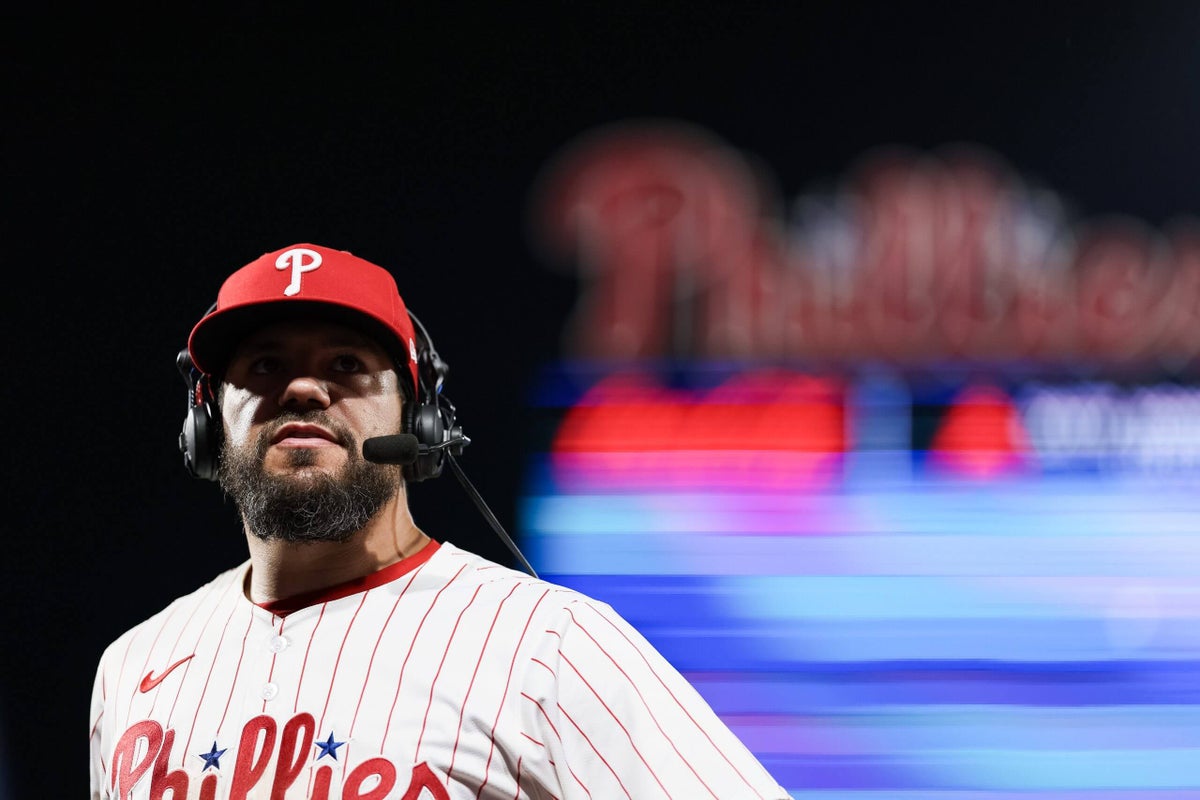
Typically, he watches on the television in his living room. Sometimes he’s on a tablet at his apartment complex pool, and more than once, he’s watched from the parking lot of a Dave Matthews Band concert. One way or another, Aaron Capista watches every Kyle Schwarber at-bat, and he swears he can feel Schwarber’s thoughts through the television screen.
Capista will pace his apartment floor, arguing bad calls, cheering well-executed swings, and working through multiple drafts of postgame text messages when Schwarber lets a good pitch go by or whiffs on a pitch he should have crushed.
“He knows I’m watching,” Capista said. “He knows I might have just thrown my remote at my TV.”
The nature of their relationship is not unusual. Schwarber is an All-Star slugger, and Capista is his personal hitting coach. A lot of elite hitters employ their own hitting gurus, but what sets Schwarber and Capista apart is the depth of their partnership and the extent of its impact on what might be a Cooperstown-worthy career.
Last week, Schwarber signed a five-year, $150-million contract with the Philadelphia Phillies, and next month, Capista will drive from Texas to Ohio to begin their annual six-week offseason hitting program. Monday through Friday, from the first week of January until the start of spring training, Schwarber and Capista will hit together in one-on-one sessions that are methodically professional but also deeply personal.
Capista has other clients, and Schwarber has a strong relationship with Phillies hitting coach Kevin Long, but Capista and Schwarber have worked together for eight years and talk to one another almost daily. Their collaboration can turn combative, but they like it that way, because it’s a partnership built on trust, honesty and total commitment.
“He’s played the game,” Schwarber said. “He understands what it’s like to be in the box and trying to figure it out on a day-to-day basis. There’s times where I go through it, and I’ll call him, and then he lets me have it, and I let him have it, but we’re both at an understanding. What he’s saying’s right. What I’m saying’s right.”
The proof is in the numbers.
Nine years ago, Schwarber felt out of sync with the modern game. He’d won a World Series, but he’d since been optioned to the minor leagues and benched against left-handed pitchers. He couldn’t keep up with the proliferation of high-spin, top-of-the-zone fastballs.
Today, Schwarber feasts on high fastballs, and there are few in the league who hit left-handed pitching better. After years of Capista’s urging, Schwarber increased his in-the-zone swing rate last season and finished second in NL MVP voting. By the end of his new contract, Schwarber could very well have 500 career home runs, and every player who’s reached that milestone has been at least a compelling candidate for the Hall of Fame.
So, where does a long-retired minor league infielder fit into such a career arc? Capista could be Schwarber’s biggest cheerleader — he certainly believes in him enough — but Capista describes himself more like sandpaper.
“You need somebody,” he said, “to rub you the wrong way.”
A lot of hitters talk about “feel good” batting practice. Schwarber and Capista talk about “eating s—” as a core philosophy.
Their hitting sessions are uncomfortable by design, Capista poking and proding at Schwarber’s every weakness, setting high velocity pitching machines at extreme angles, then selecting pitch sequences to expose Schwarber’s vulnerabilities. When Capista throws max-effort batting practice from 45 feet away, he screams at Schwarber for taking pitches he should have hit, and Schwarber screams back when he hits one into Kentucky.
“Undoubtedly,” Capista said, “there have been many times when he probably wanted to fight me.”
That they’ve never really come to blows is a testament to their trust and loyalty.
Schwarber met Capista through a mutual friend in 2016, but the first time they really talked hitting was in the fall of 2017 when Schwarber was just coming to grips with his offensive limitations.

Aaron Capista with Schwarber at the 2025 All-Star Game. (Courtesy of Aaron Capista)
The fourth overall draft pick in 2014, Schwarber spent barely a year in the minor leagues before he raked in his half-season, Major League debut in 2015. He got hurt in early 2016 only to return in time to win the World Series. Schwarber was flying high until 2017 when his 99 OPS+ was slightly below league-average, the Chicago Cubs shipped him back to the minors for a couple of weeks, and he began riding the bench against left-handed pitchers.
“I was getting exposed,” Schwarber said.
Their mutual friend suggested Capista might have some ideas that would help, and so Capista flew from Las Vegas to Tampa with a laptop, a notebook, and an assumption that he had one hour to prove himself. In those 60 minutes, Capista sugarcoated nothing. Schwarber’s load was too big. He had a tendency to dive out over the plate. His posture was a mess, and when he lost his posture, he lost his hands, which made him lose his barrel.
By the end of that first meeting, the notebook was cast aside, and they were hitting together for the first time.
“I think the thing that drew me to him was just honesty,” Schwarber said. “That’s really the biggest thing in our game, honesty, and being able to look yourself in the mirror and say, ‘I need to improve that.’”
Schwarber and Capista have been in near constant communication ever since. When Schwarber moved his family to Ohio in 2021, Capista began spending his winters there, too, first staying in a room at Schwarber’s house and then — after the Schwarbers had kids — renting an Airbnb down the street.
When the regular season starts, Capista and Schwarber remain in touch almost daily. Sometimes it’s Capista reaching out with an idea. Other times it’s Schwarber sending a “What do you got?” text message. At all times, Capista has thoughts. His phone is loaded with folders, notes and videos of Schwarber’s at-bats. He says it would be “counterproductive” to do anything less.
“It means a lot to me, man,” Capista said. “It’s my work. It’s what I do.”
Schwarber and Capista are not alone in this endeavor. Schwarber has been with Phillies hitting coach Long since 2021 and credits him with being especially helpful against left-handers. Capista has other Major League clients and preps elite amateurs for the draft. But there remains something singular about Schwarber and Capista’s relationship. It’s trust and dedication, sacrifice and results.
“I have a great appreciation,” Schwarber said. “He’s honest with me, and he’s not afraid to tell me what he thinks.”
If Capista had been honest with himself 20 years ago, he might have saved his own career from becoming little more than an obscure bit of baseball trivia.
Capista was an 18-year-old shortstop out of Illinois when the Boston Red Sox selected him 57th overall in the 1997 draft. He was the compensation pick for losing Roger Clemens to free agency, but after five years of pro ball, Capista was languishing in the minor leagues, and he had no idea what to do about it. Desperate and aggravated, he stormed away from Double-A Trenton in the middle of the 2002 season, venting frustration on his way out and leaving tattered relationships in his rearview mirror.
“My entire career was a regret,” he said. “I regret it to this day. I was a quitter.”
Capista recognizes now his own ego ran amuck. He was too proud. Too stubborn.
“I talk about egos a lot,” he said, “because I think egos ruin careers.”
Ditching the game his father taught him, Capista began working in Las Vegas casinos, rising quickly in that world while ignoring baseball completely. But Capista had friends whose kids began to play, and inevitably, they came to Capista for advice. He agreed to give a few lessons, and then a few more, and in 2009, Capista rented industrial space to open Cappy’s Cage, a hitting facility where he gave 40-some-odd lessons a week to promising professionals and little kids in blue jeans.
One Yelp review: “Cappy is great with the kids. He is honest about the kids ability. He doesn’t waste our time or money.”
Honestly became a trademark, and when Capista met Schwarber, he recognized a player who was willing to hear it.
During their early years together, Schwarber’s swing “kind of looked like a softball player,” Capista said, so they went to work on his posture, his stride, his alignment, and his hands. When they fixed the foundation, Schwarber’s numbers jumped. He was better in 2018, and Capista considers 2019 to be his true breakout.
“He was getting more from doing less,” Capista said.
Schwarber’s 2020 was a mess — “We don’t even talk about ’20,” Capista said — but it was also an outlier, and Schwarber rebounded in 2021 to make his first All-Star Game. He moved his family to Ohio that offseason, which proved to be perfect timing.
When Schwarber lived in Florida, he and Capista would often train with other hitters — Tampa’s a hotbed for professional baseball players, and their sessions were a kind of open invitation — but in Ohio, it was just the two of them, and it was time to drill down on Schwarber’s specific needs.
Capista hammered him with high fastballs until even elite four-seamers became comfortable prey. He set pitching machines at more extreme angles to get Schwarber comfortable against high-octane lefties. Capista argued relentlessly for a more aggressive approach in the zone, making a statistical case that Schwarber could sacrifice a little patience to do more damage.

Not every day was pretty — there were strikeouts and arguments, and Schwarber took a few beatings in the cage — but the breakthroughs just kept coming.
“He really embraces that suffering that hitters need to go through to figure things out,” Capista said.
Since 2021, Schwarber ranks 10th in the Majors in slugging percentage, 14th in OPS, 16th in wRC+, and only Aaron Judge and Shohei Ohtani have hit more home runs. The past two seasons, only five hitters — all of them righties — have a higher OPS against left-handed pitching. Last season, Schwarber’s in-the-zone swing rate increased, and at 32 years old, he had the best season of his career.
Capista thinks it was only the beginning. He learned long ago that Schwarber’s motivation comes from within — it’s not about chasing numbers or achieving accolades; it’s about leaving nothing on the table — and so, when Schwarber signed his new contract, Capista texted his congratulations by telling Schwarber that he’s just now entering his prime years. In three weeks, Capista will drive to Ohio to work and sweat, laugh and cuss, and push Schwarber to be even better.
“I like the challenge,” Schwarber said. “I like when he s— talks me.”
For Capista, those are words of commitment. They’re words of belief. And he’s always watching.