

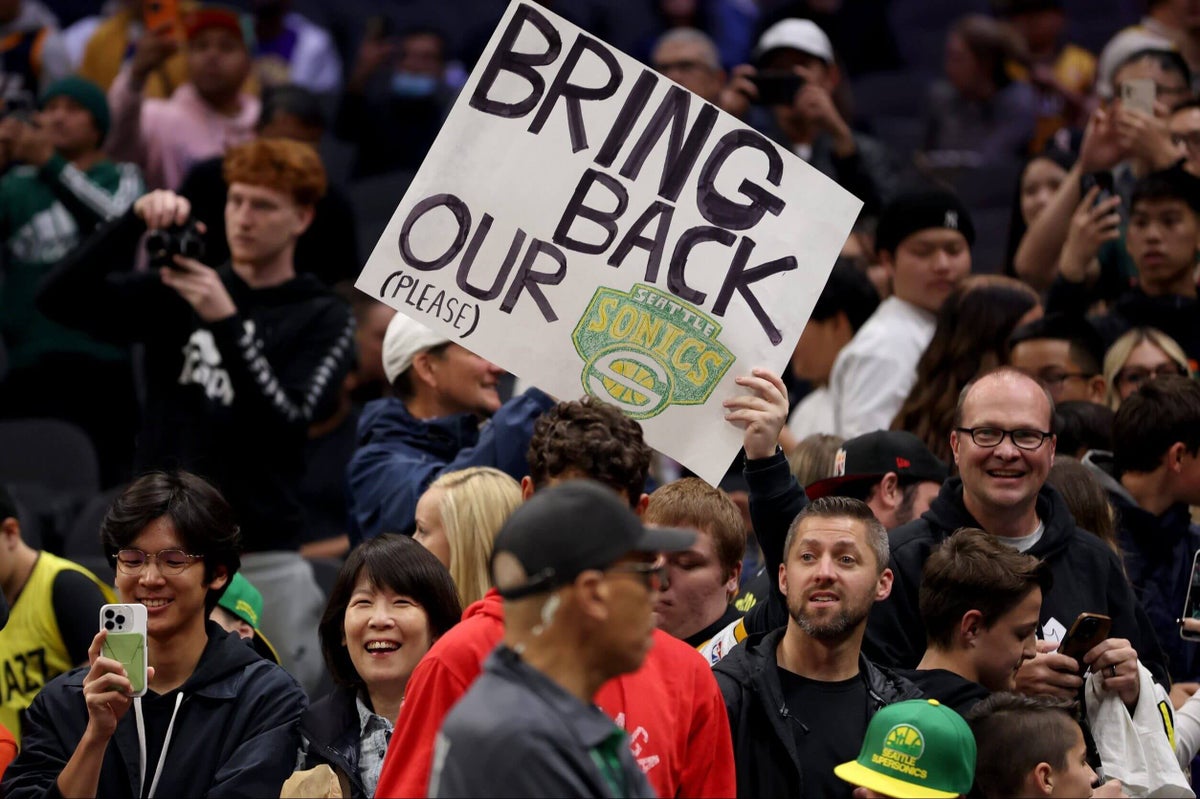
Glad to hear the NBA is finally going to get around to expansion, one way or another, in 2026. But the next proper noun out of Adam Silver’s mouth on the subject next year had better be “Seattle.”
This has gone on long enough. The Emerald City, through no fault of its own, has been without an NBA team for 17 years. It has watched the team it once had and supported for 40 years, the SuperSonics, move to Oklahoma City in 2008 and become the league’s current champion — the Thunder, a team with a telegenic superstar, an undeniably successful culture and a rabid fan base. And after winning the title last June, the Thunder is set up to become a dynasty in short order.
TL;DR: Your ex is thriving. Remarried. And looking goooood.
Silver, in a news conference in Las Vegas before Tuesday’s NBA Cup final between the New York Knicks and San Antonio Spurs, said the league, finally, is ready to decide whether to expand beyond its current 30-team structure, which it’s had since 2004, by one or two teams. Silver told The Athletic after the news conference that the NBA was centering its focus on Seattle and Las Vegas, two cities long rumored to be the favorites if and when the league expands.
“Not a secret we’re looking at this market in Las Vegas,” Silver said Tuesday. “We are looking at Seattle. We’ve looked at other markets, as well. I’d say I want to be sensitive there about this notion that we’re somehow teasing these markets, because I know we’ve been talking about it for a while. … I think Seattle and Las Vegas are two incredible cities. Obviously, we had a team in Seattle that had great success. We have a WNBA team in Las Vegas in the Aces. We’ve been playing the summer league here for 20 years. We’re playing our cup games here, so we’re very familiar with this market.
“I don’t have any doubt that Las Vegas, despite all of the other major-league teams that are here now, the other entertainment properties, that this city could support an NBA team. I think now we’re in the process of working with our teams and gauging the level of interest and having a better understanding of what the economics would be on the ground for those particular teams and what a pro forma would look like for them. And then sometime in 2026, we’ll make a determination.”
It is not a given, however, that a final choice will be made by the league’s governors in the next 12 months. Two high-ranking team executives contacted by The Athletic Wednesday, who spoke on condition of anonymity in order to speak freely about sensitive discussions, indicated some uncertainty about whether there would be a decision.
“I do believe we address it,” one executive said, but also added there was “no consensus” about whether to expand at all, or to expand by one or two teams.
The other executive guessed at “slightly better” than 50/50 odds that there would be resolution of the expansion question in 2026.
The issue, of course, starts and ends with money. The new 11-year, $76 billion media rights deal that began this season — with games broadcast by NBC and ABC on over-the-air television, ESPN on cable, NBC’s streaming platform Peacock and the video subscription service Amazon Prime — nearly tripled the NBA’s previous contract to televise its games. It’s a significant injection of new money — an increase of almost $40 million per team per year over last year’s media payouts, according to Sports Business Journal — reaching a maximum $280.5 million per team in the final season of the deal, 2035-36.
The NBA has also had its attention on its proposed NBA Europe league, as well as finalizing the sales of the Los Angeles Lakers (at a valuation of $10 billion), the Boston Celtics (a $6.1 billion valuation sale) and the Portland Trail Blazers ($4.25 billion). Each NBA Europe team will also pay a hefty price for admission. All those transactions will only push the price of admission for expansion cities further north. Industry sources now believe the expansion buy-in price will be likely north of $7 billion per team/city.
Silver “will not be shy,” one industry source said.
The league’s current teams have been reluctant to immediately bring in two new markets via expansion, even as many governors continue to believe that Seattle should ultimately be made whole. Bringing in one or two teams cuts the slice of the financial pie each of the current teams presently enjoy for themselves. But there is precedent for expansion teams coming into the league not immediately getting a cut of its national TV money.
The four ABA teams that joined the NBA in 1976 — the Denver Nuggets, New York Nets, Spurs and Indiana Pacers — did not, as a requirement of the merger between the NBA and ABA, receive any national TV money during their first three years in the league. There’s nothing to keep today’s NBA teams from demanding a similar financial sacrifice for expansion teams/cities coming in this time around. Nor does it necessarily have to come at the front end of the deal.
Bill Simmons said on his podcast last month that there was “Vegas buzz” building for the NBA to expand to Las Vegas only in its next round of expansion. The talk has bounced between one and two teams for the last few years, but if the NBA only expanded by one city, it could, at least for a while, handle conference imbalance.
Expanding by two makes more sense, financially and in terms of conference realignment. But in either case, Seattle has to be at the top of the list.
The economic argument for Seattle remains obvious. The city’s population grew significantly from 2010 to 2020 and has increased another 6 percent between 2020 and 2024, with its current estimate at more than 780,000, according to the U.S. Census Bureau, keeping it in the top 20 nationally. The business community remains anchored by corporate behemoths like Amazon (thought some of its corporate infrastructure has left the city), Microsoft, Starbucks, Costco and Zillow. Seattle proper continues to be a top-10 major city in annual income. Sammamish, about 30 miles from Seattle, had the highest median income of any city in the United States in 2025, according to U.S. News and World Report, at $238,750.
And while over-the-air TV ratings no longer are the sole determinant of who is watching games, the city is still a top-20 Nielsen television market.
There also is the matter of a team that, well into the early 2000s, was one of the toughest to play — not just because the Sonics had Gary Payton and Shawn Kemp throughout the 1990s, but because of a hoops-mad local culture in a metropolitan area that produced the likes of Jamal Crawford, Brandon Roy, Doug Christie (now the Sacramento Kings’ head coach) and Spencer Hawes back in the day, and current players like Paolo Banchero, Dejounte Murray and Jaden McDaniels.
Everything has been set up for a few years now in Seattle for an NBA return.
The old Key Arena, now Climate Pledge Arena, where the Sonics played for most of their four decades in Seattle, has been completely renovated and is NBA ready. The ownership group for the NHL’s Seattle Kraken, now playing its fifth season in Climate Pledge, is full of former NBA people, people who Silver has known and could personally vet. Samantha Holloway, the Kraken’s majority owner, is the daughter of the late David Bonderman, the co-founder and co-majority owner of the Kraken and a former minority owner of the Celtics. Tod Leiweke, the Kraken’s CEO and president, has been an NBA executive for the Houston Rockets, Golden State Warriors and Blazers. Brothers Chris and Ted Ackerley, minority owners of the Kraken, are the sons of the Sonics’ former longtime owner Barry Ackerley.
Climate Pledge was developed by the Oak View Group, which manages and develops dozens of arenas and stadiums around the world. Leiweke’s brother Tim, who was president of the Nuggets from 1991-95, was the former CEO of Oak View, but was indicted by the Justice Department in July for alleged bid rigging on the University of Texas’ Moody Center, a 15,000-seat venue where the school’s men’s and women’s basketball teams play. (Tim Leiweke was pardoned by President Donald Trump earlier this month.) He was replaced as CEO by Chris Granger, who was president and COO of the Sacramento Kings from 2013 to 2017.
Oak View has also been front and center to help Vegas in its potential bid for an NBA expansion team. The company had announced plans in 2022 for a 20,000-seat, $3 billion arena, which would be part of a hotel/casino project, on 66 acres south of the Las Vegas Strip near the two main freeways that run through Vegas, Interstate 15 and Interstate 215. But Tim Leiweke’s legal problems reportedly have slowed the company’s momentum toward building the new arena. Another development company, LVXP, has plans for its own NBA arena/hotel/casino mixed-use project in Vegas.
Nothing against Sin City — which has supported the NBA Summer League, the Aces, the NHL’s Vegas Golden Knights, and the NFL’s Las Vegas Raiders (well, at least the fans of the teams that come to Allegiant Stadium to play the Raiders) — or Mexico City or Kansas City or Louisville or Paris. All terrific towns with their own flavor. But Seattle got sold a bill of goods a generation ago — when its beloved team was sold out from underneath it.
To be crystal clear: Clay Bennett did nothing illegal, or immoral, after he and his group bought the team from Starbucks magnate Howard Schulz. But everyone with a functioning cerebral cortex knew what was going to happen next. Bennett, born and raised in Oklahoma City and who was inducted into the Oklahoma Hall of Fame in 2007, and who had been instrumental in helping the New Orleans Hornets temporarily move to Oklahoma City to play for two years after Hurricane Katrina, decided to leave Seattle after perfunctory attempts at working out a deal with the city, and moved the Sonics back to his hometown.
The move has been, by any metric, wildly successful.
But Seattle was still done wrong. And the NBA must, finally, make it right.