

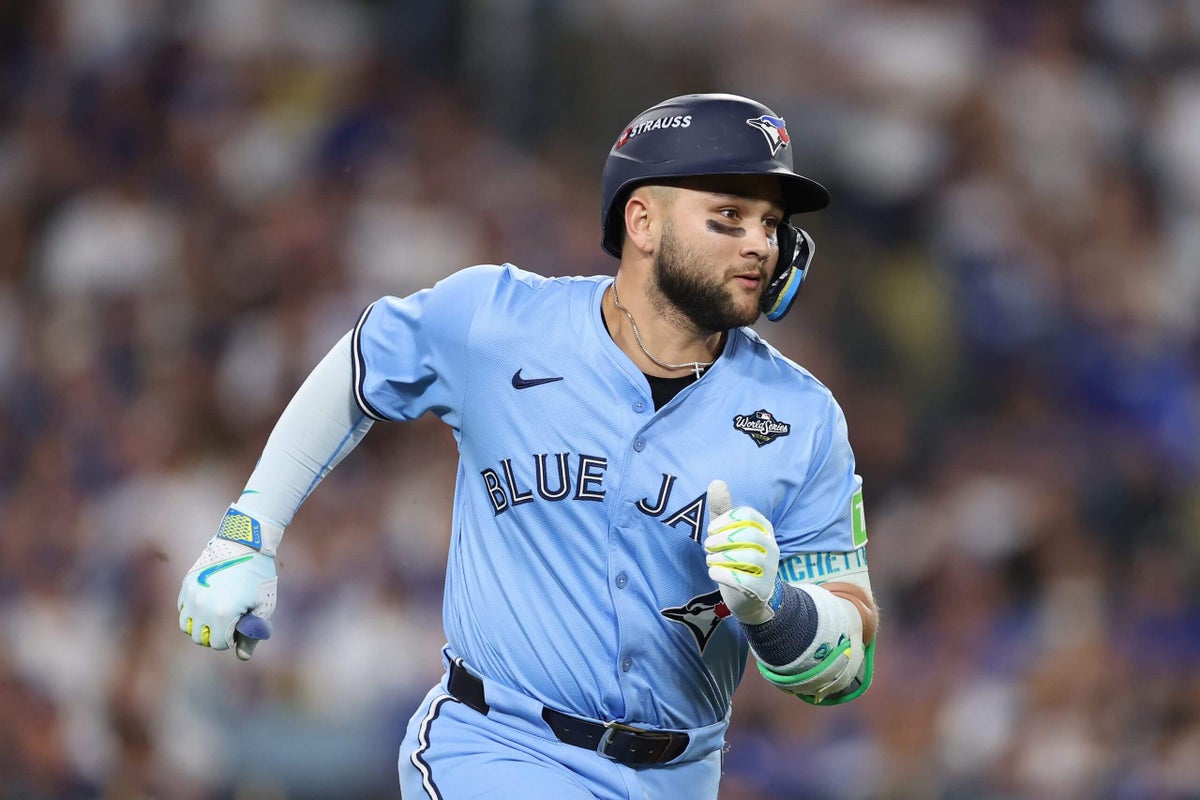
There was no verbal agreement or signed memorandum of understanding, but as far as the Phillies were concerned last week, they were going to acquire Bo Bichette. Dave Dombrowski was willing to concede that much Tuesday during a video conference call to reintroduce their consolation prize, J.T. Realmuto, who would not have returned had Bichette accepted the Phillies’ offer.
“I can’t say that we ever thought it was done,” said Dombrowski, the club’s president of baseball operations. “We thought we were very close to having a deal done. We thought it was going to happen. But it wasn’t done.”
The Phillies were willing to rearrange their roster in a significant way to accommodate Bichette. It was so close to happening that Dombrowski called Realmuto’s agent, Matt Ricatto at CAA Sports, to tell him the Phillies were going in a different direction.
But Bichette did not accept what league sources said was a seven-year offer in the range of $190 million to $200 million. He chose an appealing path provided by the New York Mets — a three-year, $126 million deal that allows Bichette to return to the free-agent market next offseason after earning $47 million in 2026.
“It’s a gut punch,” Dombrowski said. “I mean, you feel it. That day, you are very upset, I guess is the way to say it. But you have to pick yourself up and shake it off. Because you can’t just wallow in what took place. So, after a time period of feeling that way, you need to move forward. That’s how you handle it.”
Moving forward meant a three-year, $45 million deal to Realmuto. The Phillies are not expected to pursue other multiyear deals with free agents. Bichette was the best player left on the market after Kyle Tucker signed with the Los Angeles Dodgers. The Phillies will not pivot to Cody Bellinger or any remaining big-name free agent.

After missing out on Bo Bichette, the Phillies quickly re-signed catcher J.T. Realmuto. (Terence Lewis / Icon Sportswire via Getty Images)
So there will always be an alternative universe in which the Phillies and Bichette were united. The Phillies were not seriously pursuing him until a few weeks ago when they made contact with his representatives, league sources said. The Phillies saw an opening for a long-term deal. Dombrowski, in revisiting how everything unfolded, believed the interest was mutual.
“I could be wrong,” Dombrowski said. “So I’m not saying this for sure. I do think he was sincere about thinking about coming to Philadelphia. Yes, I do. I think he was. And I think what ended up happening is the dollar numbers … we were at the numbers they really asked us to match. We were still going through some nuances, but I think in that last time period, the Mets jumped in full bore ahead. Their short-term offer ended up being so much that they decided to take the short-term offer rather than the long-term offer.”
To be clear: The Phillies failed to sign Bichette because of money — not their refusal to offer an opt-out clause, a Dombrowski policy. They had discussed a shorter-term deal with Bichette, but were far apart on the dollars. The Phillies preferred to stretch the money over a longer period; it was their only shot at managing a massive luxury-tax bill. They were aware that the Mets and Dodgers lurked with high-salary, short-term proposals. Both clubs have more financial wherewithal to do such a structure. In essence, the Phillies believed they were presenting Bichette with a scenario he did not have.
And, in the end, Bichette chose otherwise.