

Last week, we broke down the elite tier of WRs and explored why WR scoring felt flatter than usual in 2025. This week, we zoom out to the next range, WR11 through WR20, where context, usage, and how the points were scored mattered far more than where players finished.
If you are new to the series, you might also want to check out the TRUTH about the top-20 QBs and RBs, covered in these articles by Kurt Mullen (QBs) and Kemper Trull (RBs).
Connect with the show:
To hear the full breakdown, don’t forget to check out the WR TRUTH Part 2 episode of the podcast.
WR Scoring Context (Why This Tier Was Weird)
The macro trend didn’t improve as we moved down the rankings. WR accounted for just 58% of total team targets, the lowest rate since 2018. Every single type of WR target lost value compared to 2024, and deep targets hit rock bottom. Defenses were pretty good this year against deep passes. We saw the fewest 20+ air-yard TDs in the last seven seasons, with the league-average deep completion rate sitting at just 39%. Fun fact: the only two teams that completed over 50% of these deep passes will face each other in the Super Bowl: the Patriots and the Seahawks.
In short, this was a season where WRs could still accumulate volume, but efficiency, especially downfield, was brutally hard to come by.
Before starting with the WR11, here’s a quick reference guide to how the Fantasy Footballers’ TRUTH algorithm evaluates fantasy performances (Weeks 1-17 only):
Great Games: 20+ fantasy points
Good Games: 12.5+ fantasy points
Bust Games: Fewer than 7.5 fantasy points
Missed Games (injury) do not count against consistency
All data is based on Half-PPR scoring.

Sean Thomas-Imagn Images
Age: 30.2 | ADP: 5.03/WR21
Consistency Rank: 13 | 1st half: 11 / 2nd half: 22
| Great games | Good games | Bust games |
| 12% | 47% | 29% |
Honestly, no one below WR6 feels like they had a good season. Courtland Sutton was not an exciting player this season, but he was exactly what he’s been in recent years. He posted nearly identical numbers to 2024, finishing with 74/1,017/7 on 124 targets, and once again relied heavily on TDs to boost his fantasy value. He actually performed better against top-16 defenses than bottom-16 ones, but the weekly ceiling just wasn’t there often enough.
His consistency dropped during the second half as Troy Franklin and Pat Bryant’s names started appearing more often in fantasy waiver talk. Also, the Broncos’ defense was so good that their offense didn’t need to do a lot to win. Now locked into a four-year extension, the uncomfortable question becomes unavoidable: Is this just who Sutton is now? An unsexy, TD-dependent WR2 who won’t kill you but rarely wins you a week?
Age: 27.1 | ADP: 3.07/WR13
Consistency Rank: 12 | 1st half: 25 / 2nd half: 5
| Great games | Good games | Bust games |
| 13% | 47% | 27% |
Tee Higgins remains one of the most polarizing fantasy WRs in the league. Despite missing time and spending much of the season without Joe Burrow, Higgins finished with 11 TDs on just 59 receptions. Only four WRs in the last decade have posted double-digit TDs on fewer than 60 catches, and Higgins is one of them: a true difference maker, efficiency-wise.
He posted a 125.2 passer rating when targeted, but through the first eight weeks of the season, he sat at WR32. But after the Bengals fixed their backup QB situation by hiring Joe Flacco, Higgins’ consistency score skyrocketed. He is a very good WR, and this year he had a healthier season. Cincinnati’s defense is still pretty bad, which elevates their offensive players’ ceiling. If you’re willing to live with volatility for week-winning upside, Tee Higgins is your guy.
Age: 25.9 | ADP: Undrafted
Consistency Rank: 25 | 1st half: 49 / 2nd half: 6
| Great games | Good games | Bust games |
| 12% | 35% | 47% |
Michael Wilson’s season came in two completely different acts. Through the first nine games, he averaged 4.5 fantasy points per game and totaled just 231 receiving yards. That’s the fewest ever at that point for a WR who would later finish with 1,000+ yards. From Weeks 11 to 18, he scored 17.7 fantasy points per game, 97 yards per game, with production matched only by Puka Nacua.
Wilson ran 601 routes (third-most in the NFL) and finished seventh among all WRs in first-read targets. The talent showed up late, but at that point in the season, the Cardinals were pretty banged up, and Jacoby Brissett was on pace for over 700 pass attempts. Even if Michael Wilson maintains his target share (which is a big if with a healthy Marvin Harrison Jr. on the field), that kind of volume is simply unsustainable.

Amber Searls-Imagn Images
Age: 28.6 | ADP: 2.07/WR9
Consistency Rank: 14 | 1st half: 36 / 2nd half: 8
| Great games | Good games | Bust games |
| 20% | 40% | 33% |
This was a strange A.J. Brown season. He posted career lows in yards per reception, yards per route run, and YAC per reception. His good game rate was the second-lowest of his career, and the explosive plays we’re used to seeing from him just weren’t consistent. At some point, he was even tweeting about wanting to leave the team.
Having said that, Brown showed he is still elite against man coverage, and he was also pretty good against zone. So the concern isn’t talent, it’s whether this version of the Eagles offense caps his ceiling relative to draft cost. He is still under contract for four seasons, which is one more than Devonta Smith, who still had a pretty bad season with only two red zone TDs, just 6% good games, and 59% bust games.
The truth is, the Eagles weren’t that great in fantasy or real life in 2025. But we’ve seen how explosive they can be with a good offensive coordinator, so there is hope in the offseason.
Age: 22.8 | ADP: 5.08/WR23
Consistency Rank: 20 | 1st half: 27 / 2nd half: 23
| Great games | Good games | Bust games |
| 6% | 29% | 29% |
Quietly, McMillan delivered one of the strongest rookie WR seasons of the last decade. He finished with 70/1,014/7, joined an elite group of rookie WRs to hit that line, and posted a 26%+ target share, which is better than what Puka Nacua and Justin Jefferson had in their rookie years.
He was dominant versus man coverage and significantly better in three-WR sets. Big body. Alpha usage. Flashes of dominance. It would’ve been great to see him get more opportunities, but he made the most out of the chances he had. The Panthers seem to finally be on the right track, and the future looks bright for Tetairoa McMillan.

Junfu Han / USA TODAY NETWORK via Imagn Images
Age: 25.0 | ADP: Undrafted
Consistency Rank: 21 | 1st half: 29 / 2nd half: 21
| Great games | Good games | Bust games |
| 13% | 38% | 44% |
Wan’Dale Robinson continues to be overlooked. But with Jaxson Dart, he managed to finish as a WR2, thanks in part to Malik Nabers’ injury early in the season. He averaged 16.4 fantasy points per game against bottom-16 defenses, and only 7.3 against the top half. He was a matchup-dependent WR in a matchup-dependent offense.
But still, we have to give him some credit after logging two excellent consecutive years. He joined Ja’Marr Chase and Amon-Ra St. Brown as the only WRs with 140+ targets and 90+ receptions in each of the last two seasons, while earning four top-12 finishes. That’s more than Sutton or Higgins. This season, he also more than tripled his career total of 20+ air-yard receptions.
With free agency looming and big coaching staff changes, his role is still in the air, but the chemistry with Dart is undeniable, and we know Robinson is one of General Manager Joe Schoen’s favorites. I’m curious to see where his ADP settles this next draft season.
Age: 24.5 | ADP: 2.05/WR8
Consistency Rank: 9 | 1st half: 12 / 2nd half: 12
| Great games | Good games | Bust games |
| 33% | 50% | 33% |
Drake London’s season was marred by injury. But when healthy, he was exactly who we thought he was – he was on pace for 159 targets, 96 receptions, 1,302 yards, and 10 TDs. So yes, he should still be a top-10 guy and the clear #1 for a team without a #2. Hopefully, his fantasy finish will lower his ADP a little next season.
On a per-route basis, expected fantasy points and actual fantasy points lined up perfectly. London was dominant when moved into the slot, posting one of the highest slot TPRRs in the league, only behind Puka Nacua and Rashee Rice. He will get paid this offseason as he enters his fifth year, because his talent is unquestioned, and the only questions will be QB play and the new play-caller in 2026.
Age: 26 | ADP: 8.09/WR42)
Consistency Rank: 26 | 1st half: 32 / 2nd half: 24
| Great games | Good games | Bust games |
| 0% | 35% | 41% |
This wasn’t vintage Diggs, but it was definitely an efficient Diggs who stayed healthy all season.
He shifted heavily into the slot, posted his highest YPRR since 2020, led all WRs with an 83% catch rate, and recorded the highest contested catch rate of his career. He is no longer a pure volume monster, but he’s also not dust. Diggs averaged 2.53 yards per route run, his highest since his first year in Buffalo, and also had the highest contested catch rate of his career. Whether all this matters for fantasy depends on how much ceiling you’re willing to sacrifice for a solid floor.
Age: 23.2 | ADP: 8.01/WR38
Consistency Rank: 36 | 1st half: 16 / 2nd half: 43
| Great games | Good games | Bust games |
| 25% | 0% | 56% |
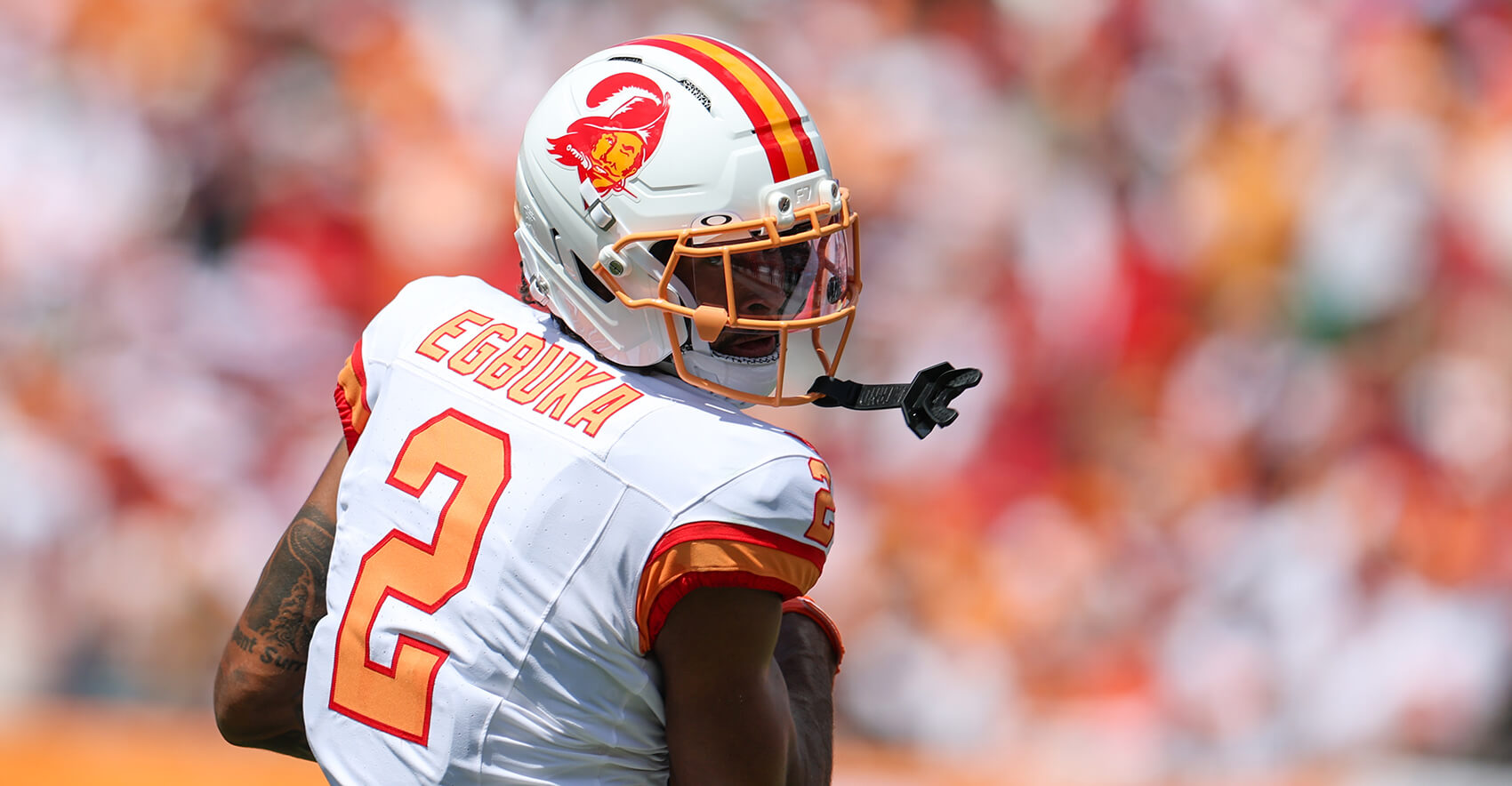
Egbuka’s rookie season started on fire, and then completely collapsed. Through five weeks, he posted the second-most fantasy points ever to start a career. However, from Week 6 on, he averaged only 6.2 fantasy points per game, driven by brutal QB play by Baker Mayfield, who was dead last in the NFL against man coverage with only 4.99 yards per attempt. Yes, even the Browns’ Dillon Gabriel was better. Only 64% of Egbuka’s targets were catchable, and it was even worse from Week 11 on, dropping down to 55%.
So what is the TRUTH about Emeka Egbuka? The talent is real, but the environment around him was not. But Baker Mayfield has shown he can be good for his weapons, so there is hope for a bounce-back season in 2026.

Kevin Jairaj-Imagn Images
Age: 26.8 | ADP: 1.06 (WR3)
Consistency Rank: 10 | 1st half: 14 / 2nd half: 13
| Great games | Good games | Bust games |
| 7% | 50% | 21% |
CeeDee technically lands in this WR20-ish range in the data, and even though he was discussed along with George Pickens in the top 10, let’s take a quick look at him.
This season marked his lowest share of Dallas’ receiving yards since his rookie year. Not because his role shrank, but because it changed. Lamb posted career highs in aDOT (12.7), yards per reception (14.4), and percentage of routes run out wide (65%), signaling a clear shift in how he was deployed. The route tree confirms it. Dallas moved Lamb away from slants and screens, leaning harder into go routes and crossers, pushing him further downfield and away from the easy, high-percentage volume that previously buoyed his fantasy floor.
The elite talent is still there, but the role adjustment matters. In 2026, Lamb’s value hinges less on raw target dominance and more on whether this deeper, more volatile usage is something the Cowboys want to keep.
Final Note: The Big Names With Weird Seasons (and the Colts Problem)
Just to underline how messy the WR landscape was in 2025:
The Vikings’ Justin Jefferson (WR25) turned 141 targets into just two receiving TDs, becoming one of only eight WRs in NFL history to see 140+ targets with fewer than three scores. Even worse, he led the league with 10 interceptions when targeted, more than Puka Nacua, Jaxon Smith-Njigba, and George Pickens combined.
DK Metcalf (WR26) had to completely rewire his game in Pittsburgh’s “smaller passing pie” offense, where only 37% of Steelers completions went to WRs. However, he still posted a career-high 7.1 yards after catch per reception while being pressed on 47% of his routes, the highest rate in the NFL.
Rashee Rice (WR40) barely played due to his early suspension and late concussion, but his role in Kansas City remains loud. Through three seasons, he’s been targeted on 30% of his routes, a rate surpassed only by Puka Nacua and Malik Nabers, and in 2025, he led the Chiefs in red-zone targets and receptions despite missing nine games.
And then there were the Colts, who perfectly captured the WR chaos of 2025. Michael Pittman Jr. (WR22) continued to soak up volume (111+ targets for the fifth straight season) and set a career high with seven receiving TDs, but did it while giving you 0% great weeks in fantasy. Meanwhile, Alec Pierce (WR24) went in the opposite direction, posting the fewest receptions in a 1,000-yard season since 1990, leading the NFL in yards per catch, and thriving once Indianapolis fully leaned into vertical usage. Two WRs from the same offense with similar fantasy finishes reached through completely different paths.