

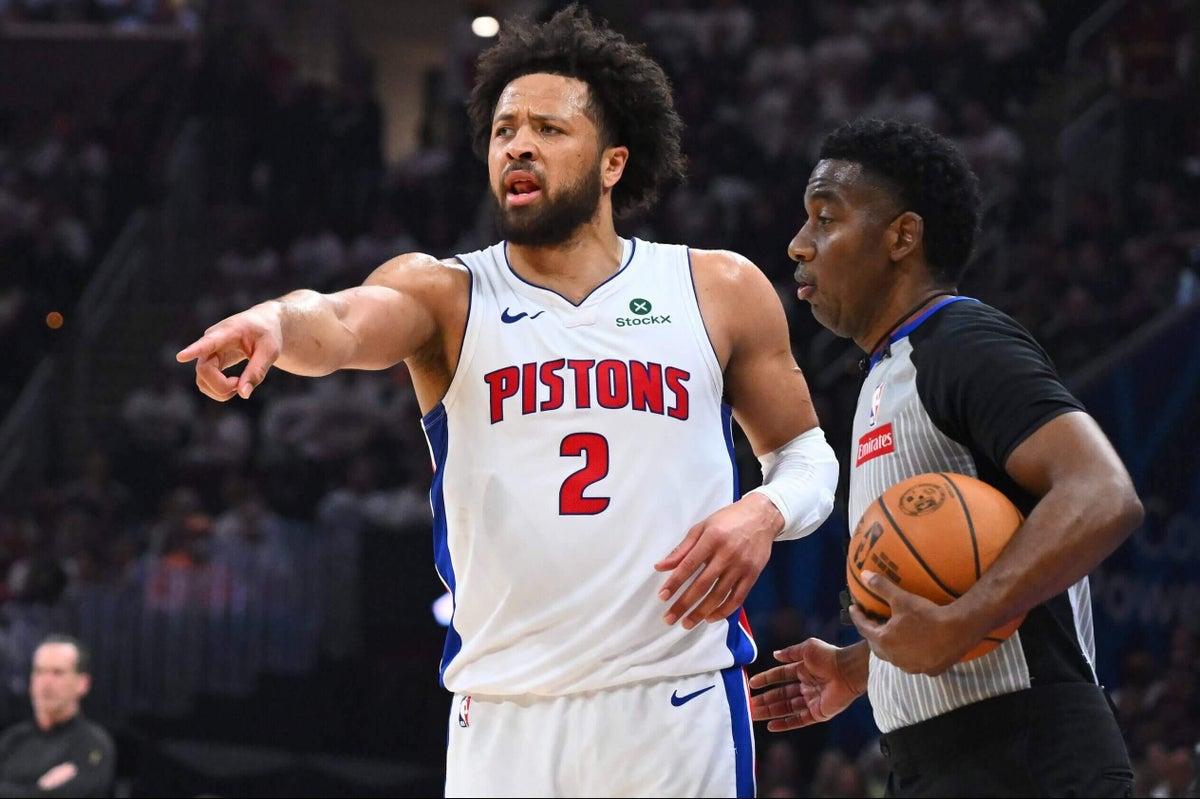
CLEVELAND — As Donovan Mitchell sized Cade Cunningham up with just over five minutes remaining in the fourth quarter, fans at Rocket Arena could sense what was brewing. Mitchell was in the midst of a historic second-half scoring showcase, and Cunningham looked intent on putting an end to it.
Mitchell went to his left before crossing over to his right, stepping back to throw Cunningham off balance and creating more than enough separation to get a clean look off from beyond the arc. Cleveland Cavaliers fans began cheering before the ball even went through the net.
Once it did, Mitchell had words for his bench as he pounded his chest and seemingly expressed that Cunningham couldn’t guard him.
It was fitting considering the Detroit Pistons had no answers for Mitchell in Monday’s 112-103 Game 4 loss that evened this Eastern Conference second-round series at 2-2. Mitchell torched the Pistons’ hopes for a commanding series lead while tying a postseason record with 39 second-half points.
In the process, Mitchell highlighted Detroit’s weaknesses. When the game becomes a shootout, the Pistons become vulnerable. When an opposing superstar is cooking, which can happen in the playoffs, their firepower becomes an issue.
Their offensive flow grinds to a halt. So when Detroit can’t get stops, it can’t get wins.
That presents a troubling quandary, considering who’s waiting in the next round. The New York Knicks are putting up historic offensive numbers. But the Pistons’ biggest problem is the one in front of them: the Cavaliers, who have two players who can catch fire on offense.
It was James Harden in Game 3, Mitchell in Game 4. Despite having one of the best defenses in the league, Detroit couldn’t cool them off. In Game 3, Cunningham nearly matched Harden bucket for bucket. But in Game 4, the Pistons’ offense stood no chance.
“We’ve got to have more ball movement, more making them chase us,” Detroit coach J.B. Bickerstaff said. “Understanding where we create our advantages. Less stagnant, less one-on-one opportunities. Just trying to move them, put the guys in the matchups that we like. Then be aggressive, and the play doesn’t always have to be for me. Now I’m attacking, the help comes and now I can find a spray. We’ll get to more of that.”
The Pistons unraveled to start the third quarter. They committed five turnovers and missed eight consecutive shots. On top of that, they couldn’t contain Mitchell, who exploded for 21 of his 43 total points in the third. His flurry of floaters, midrange jumpers and triples landed like haymakers. As a result, Cleveland scored the first 22 points of the quarter — the longest playoff run in franchise history.
Game 4 continued a trend that’s emerged in this series. In third quarters, the Cavaliers are averaging 29.8 points on 59.2 percent shooting, including 14-of-32 from 3-point range.
“They came out and played with more force and tenacity than we did to start the quarter,” Bickerstaff said. “We just didn’t match it.”
The Pistons’ offensive challenges were as apparent as their lack of defensive resistance. Detroit lacked movement, turned the ball over six times in the third and looked stagnant overall. And Cunningham couldn’t save the day this time, unable to conjure up his typical third-quarter rhythm. He went scoreless on two shots with three turnovers during the game-deciding 12 minutes.
This marked the first time in Cunningham’s career that he was held below 20 points in a playoff game, snapping a streak of 16 straight. The two-time All-Star registered 19 points on 7-of-16 shooting. His shot attempts were also a postseason career low.
The Cavaliers’ scheme to limit Cunningham worked. Monday was the first time someone other than Cunningham led the Pistons in scoring during these playoffs.
“I’ve seen all these things before. I’ve struggled against these things and I’ve succeeded against these things before,” he said. “So really it’s just about clearing my mind and being better as the point guard. I pride myself on making sure my team has the best point guard on the floor. I didn’t do a great job of that tonight.
“But I’m excited about the challenge coming forward, getting us organized and making sure everybody is comfortable in their spots and knowing what to do.”
Cleveland picked up Cunningham full court, pressuring him as he got Detroit into its offense. The Cavaliers have taken to blitzing the Pistons’ point guard in pick-and-roll actions, forcing him to give the ball up. And when he does get downhill, they clog his path with multiple bodies.
Cleveland is essentially daring someone else to beat them.
Caris LeVert was game. The Pistons wing and former Cavalier had his best game since coming to Detroit, scoring a season-high 24 points. The Pistons outscored Cleveland by 15 points when LeVert was on the court. By comparison, Ausar Thompson was minus-27, and Cunningham was minus-23.
LeVert’s 31 minutes were the most he’s played in a Detroit uniform, and his usage might be an adjustment moving forward for Bickerstaff. LeVert looked to be one of the few players who could make an impact on both ends.
What LeVert couldn’t solve, however, was the Pistons’ incessant fouling. They committed seven in the third and 27 in total. The Cavaliers shot 34 free-throw attempts, making 30. Detroit was 9-of-12 from the charity stripe. Mitchell scored 13 of his points from the line.
As is NBA tradition, the road team pointed to an unfavorable whistle as the reason for the free-throw disparity.
“It’s unacceptable, it is,” Bickerstaff said. “We didn’t do enough to help ourselves, and I’ll start there. But ever since we came to Cleveland, the whistle has changed. There’s no way one guy on their team shoots more free throws than our team.”
So Bickerstaff decided to play the same game as Cavaliers coach Kenny Atkinson, who said before Game 3 that the way the first two games were officiated gave the more physical Pistons an advantage. He stressed that he and his team had to adapt to the style of play the referees were allowing Detroit to dictate.
Atkinson said the Pistons’ physicality was “completely within how the game’s being called today” and put it on his Cavaliers to find ways to adjust.
Then, in Games 3 and 4 combined, the Pistons were called for 52 fouls and the Cavaliers 32.
Bickerstaff pointed to Detroit’s style of play as evidence of inconsistency. The Pistons aren’t a jump-shooting team, he said. They don’t settle. They drive the ball, attack the paint.
“So what was done out there tonight, it’s frustrating,” Bickerstaff said. “But we can’t allow that to be the reason why. Because we didn’t play well enough and play to the best of our capabilities. But you look at the foul count, you look at the disparity and that’s hard to overcome. And you wonder the reason why. It’s interesting (that) since Kenny made his comments publicly about us, the whistle’s changed in this series.”