

There is a moment frozen in my mind.
A single garbage-time catch from George Kittle in Week 17 kept my lineup from surpassing a million dollars in a DraftKings tournament. That result changed how I play Best Ball. I realized it’s the easiest form of fantasy football to play, but the hardest to win.
One ADP discount, one correlated game environment, one late-round player, pod luck or playoff spike week can completely change the outcome of your season (and your life?).
To win on DraftKins in 2026, you’ll battle 940,900+ lineups shooting the same shot. For context, Charlotte, NC, has a population of 943,000+. You’re not competing against 11 league mates; you’re aiming to beat a field the size of a major city, like where the Panthers reside.
But, the good news? We do it in 12-player pods until the Week 17 final, when we face only 1,089 players. Instead of fighting an urban metropolis, we just need to beat a field about the size of a village in the Hamptons at the end.
Still, that is a tall order. The path to first place does not start with beating the entire tournament. It starts with winning the room you are drafting in.
What is Best Ball?
Best Ball is a draft-only fantasy football format with no waivers, trades, or start-sit decisions. The draft is not just part of the game; it is the game. The draft is the best part of fantasy anyway, right? Well, that’s Best Ball.
Your highest-scoring players are automatically placed into your lineup each week from Weeks 1 – 14, so you play the majority of the season against the people you drafted with, hoping to finish with the most (or second most) points in your pod.
In Week 15, the playoffs start. Most DK tournaments advance the top two highest-scoring teams*. Those teams are placed in pods with 11 other advancing lineups where they compete for a single week. Payouts:
- The highest-scoring team advances to Week 16.
- 2nd – 3rd: $50
- 4th – 12th: $40
Week 16 is similar to Week 15.
- The highest-scoring team advances to Week 17
- 2nd – 3rd: $150
- 4th – 12th: $125
Week 17 = Primetime. This is where dreams come true. The field narrows to 1,089 lineups, with the worst you can walk away with being $1,250.
Takeaway: WE PLAY FOR FIRST. Be aggressive; playing conservatively does nothing for us. If you ain’t first, you’re last. – Ricky Bobby.
*For simplicity, we used the Milly Maker’s advance rate structure. Make sure to read the rules of any other contest for different advance rates (that may change your strategy to be more/less aggressive when drafting).
Week 17 Payout Structure
For this year’s flagship tourney, first place is $3. Million. Dollars. Holy smokes, Batman. That’s some serious cheddar for a $25 entry.
| Place | Payout |
| 1st | $3,000,000 |
| 2nd | $2,000,000 |
| 3rd | $1,000,000 |
| 4th | $500,645 |
| 5th | $400,000 |
| 6th | $300,000 |
| 7th | $250,000 |
| 8th | $200,000 |
| 9th-10th | $150,000 |
| 11th-15th | $100,000 |
| 16th – 20th | $50,000 |
| 21st – 25th | $40,000 |
| 26th – 35th | $30,000 |
| 36th – 50th | $20,000 |
| 51st – 75th | $15,000 |
| 76th – 100th | 10,000 |
| 101st – 150th | $7,500 |
| 151st.- 200th | $5,000 |
| 201st – 300th | $4,000 |
| 301st – 400th | $3,000 |
| 401st – 500th | $2,000 |
| 501st – 700th | $1,500 |
| 701st – 1089th | $1,250 |
DraftKings Scoring
The most important strategy shift is the scoring differences. We list out each difference compared to Underdog, followed by player examples.
- Full PPR. Reception = +1
- 20 Round Draft
- 300+ Yard Passing Game = +3
- 100+ Yard Rushing Game = +3
- 100+ Yard Receiving Game = +3
Full PPR
DraftKings uses a full PPR (points per reception) format, which assigns different values for players. Target hogs are more valuable on DK than TD-dependent sites like Underdog, where a reception is only worth .5.
Derrick Henry | ADP 22.1 vs Chase Brown
Henry ranks 8th in our 0.5 PPR rankings. But, in full PPR, he’s 11th. Over the last two seasons, he’s only caught 34 passes. Chase Brown‘s ADP is 21.1, and he had twice as many receptions last year (69) as Henry did in the previous two seasons.
They’re drafted next to each other. So, while Henry may get more TDs, Brown likely gets more catches and increases his value on a full PPR site. Conversely, Brown is ranked 8th in PPR, but 10th in .5 PPR.
But, what if Brown finds the right side of TD variance and has the same amount as King Henry? He’s a better selection on DK, thanks to the catches, if that comes to fruition. On UD, Henry would be the unquestionable, stronger pick.
Wan’Dale Robinson | ADP 100.9 vs Quentin Johnston
Wan’Dale is a possession WR with 90+ receptions in each of the last two seasons. Quentin Johnston‘s season high is 55 (FIFTY FIVE!). QueJ has a knack for TDs, but what if WanDale’s transition to a new Titan team gets him more chances for Toudies?
Since they are drafted right next to each other, Wan’Dale makes more sense on DK than he would on Underdog. Does he make more sense than QJ on DK?
20 Round Draft
In 18-round drafts, every roster spot has to carry weight. That makes a third QB or third TE expensive because those positions have only one dedicated starting spot. When that extra QB or TE lands on your bench, you are giving up another shot at an RB or WR spike week. TE at least has one escape hatch because it can still hit the FLEX. QB does not.
That is the real reason QB is not always the engine of a Best Ball roster. It is not because QBs are bad fantasy scorers. It is because QB scoring is more condensed. Most usable QBs live in a similar weekly range, while RBs and WRs have wider spike week outcomes. In Best Ball, we do not have to predict when those weeks happen. We just need to draft enough players capable of creating them.
A 22-point QB week keeps you alive. A 38-point WR week can win the pod. That is why every extra RB and WR bullet matters.
This changes in 20-round drafts, where the added roster spots make a third QB or third TE easier to justify. You can protect fragile builds, add contingent upside, or cover late-season uncertainty without cutting as deeply into your RB and WR ceiling. The opportunity cost still matters, but the extra two rounds give you more room to chase stability at onesie positions while still maintaining enough RB and WR firepower to capture spike weeks. I have no problem with a QB room like Jared Goff, Malik Willis, and Sam Darnold.
300+ Passing Yard Bonus
Pocket QBs cut the rushing QBs’ edge thanks to the 300+ yard passing bonus. Traditional pocket passers in the middle rounds (7-13ish) can fill out a roster and secure enough upside that we don’t need to reach for Konami Code types in the early rounds (Josh Allen, Lamar Jackson, etc). Over the last two years, six of the seven top QB win rates came from pocket passers.
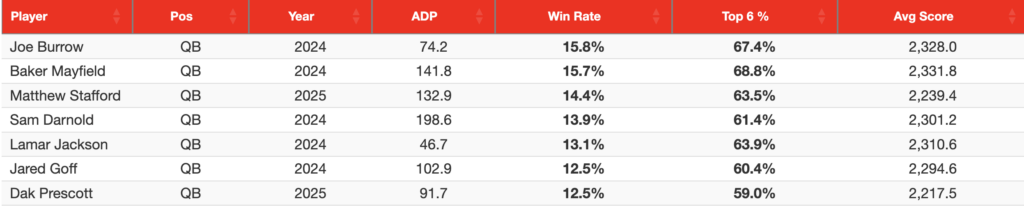
All stats are from FFPC Slims (1 QB, PPR scoring like DK) via RotoViz.
Jared Goff | ADP 103.6 vs Kyler Murray
Jared Garrff has had 49 games with over 300 passing yards since 2017. Kyler Murray only has 15 in that same span. Yet, they are going back-to-back in drafts. With the 300+ bonus upside, Goff’s +3 points for passing volume mutes Murray’s rushing upside, making him just as valuable.
100+ Rushing Yard Bonus
Tony Pollard | ADP 82.8 vs Jaylen Warren
Over the last four years, Pollard has produced 10 games with 100-plus rushing yards. In DK Best Ball, those games matter because the 100-yard bonus adds three points on top of the yardage itself. Warren has only four such games over that same span.
That difference matters when you are choosing between players in the same ADP range. If you are filling an RB2 or RB3 spot, Pollard gives you more access to the type of rushing spike week that can actually separate in a pod. When two RBs have similar projected roles, lean toward the one with the better chance to clear 100 yards and unlock the bonus.
100+ Receiving Yard Bonus
Alec Pierce | ADP 70.2 vs Parker Washington
Pierce just got paid and enters 2026 as the likely 1A for IND alongside Josh Downs and Nick Westbrook-Ikhine, who should not be a major threat. He is also no stranger to spike weeks. Pierce already has six career games with 100-plus receiving yards, and his role gives him a real path to more. He averaged 86% of snaps, and that was with Michael Pittman still on the team (Pittman went to PIT).
That makes the Parker Washington ADP gap tough to justify. Washington has to share the JAX passing pie with Brian Thomas Jr. and Jakobi Meyers, two WRs also being drafted inside the top 102 picks. Pierce has the cleaner path to upside and spike weeks. Three of Washington’s four career 100-yard games are fresh in drafters’ minds because they happened just a few months ago, but that is exactly where recency bias can sneak into Best Ball rooms. At a similar price, I would rather bet on Pierce.
Player Advance Rate – An Introduction
Win rate is one of the cleanest ways to see whether a player actually helped Best Ball teams advance. Projections tell us what a player is expected to score. Win rate tells us how often teams with that player beat their pod. Kyle wrote an excellent piece on advance rates here.
Advance rate matters because Best Ball is not just about raw points. It is about price, roster construction, spike weeks, and their timing. A player can look fine in projections but still fail to separate at ADP, leading to a low advance rate (so bye-bye, money). Another player can feel volatile week to week, but if his ceiling games are strong enough, he can become exactly the type of player who pushes rosters at the right draft cost.
Stacking
Stacking is where you take players from the same team together. The hope is that this team smashes all year and you get tons of points. It is about building a roster that can capture scoring environments when they erupt. This table shows that teams with a QB1 + WR1 + RB1 combination posted a 9.3% win rate, compared to 8.3% for all other builds.
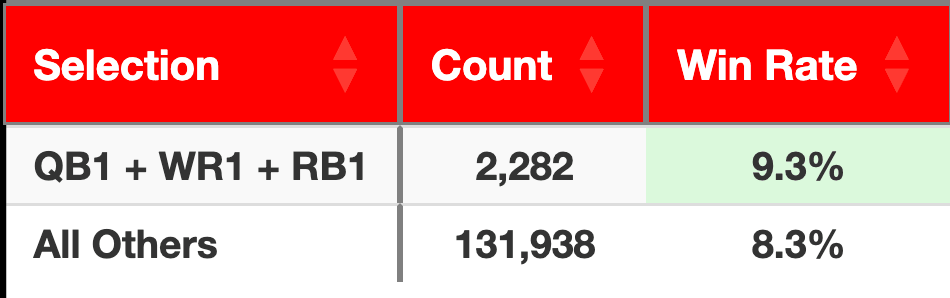
This is also where uniqueness comes in. Only 1.7% of the field stacked that combo. Most drafters understand QB plus pass catcher stacks. Fewer are willing to build around a fuller game script that includes the RB.
This year, NO plays ATL in Week 17, a stack like Tyler Shough + Jordan Tyson + Travis Etienne could separate if NO is forced into volume and Etienne adds rushing, receiving, or TD equity. On the other side, Michael Penix Jr. (or Tua?) + Bijan Robinson + Kyle Pitts give you access to an ATL eruption in multiple ways.
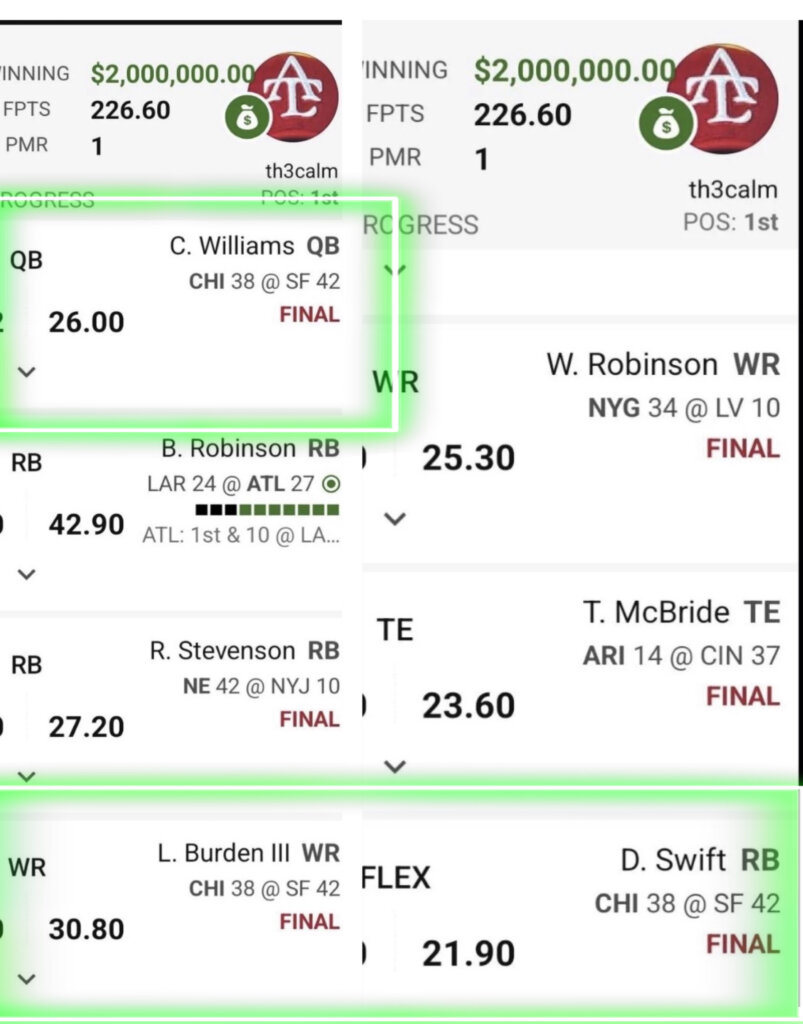
The goal is not to force stacks just to feel different. The goal is to give your roster a path to a unique ceiling. Last year, a Chicago stack won first with Caleb Williams + Luther Burden + D’Andre Swift. The Bears/49ers put up 80 total points; that’s what’s up and our goal.
Position Strategy
QBs. In 20-round drafts, I usually want three QBs. The goal is not to collect safe QB points. The goal is to capture the ceiling without spending too much on a position that cannot hit the FLEX. Two QBs are viable as well if you get Josh Allen or spend draft capital early (like pairing Joe Burrow + Ja’Marr Chase and then taking Jayden Daniels if he falls).
RB. RB is where roster construction can swing quickly. You do not need every RB to project for 20 touches, but you do need access to spike weeks. Prioritize players with paths to goal line work, pass catching, explosive plays, or 100-yard bonus upside. In Best Ball, backup RBs are more valuable when their role can change dramatically with one injury (think Tank Bigsby in PHI, Brian Robinson in ATL, or Braelon Allen in NYJ).
WR. WR should be the backbone of most builds. You’ll need four in the first seven rounds to maintain a strong enough lineup to win a pod (I actually prefer four WRs in the first six rounds, but it depends on what players are falling in ADP and other factors). It is the deepest position, but it also creates the most weekly separation. WRs can win through target volume, long TDs, yardage bonuses, and shootout environments. Since you have to start multiple WRs and can use them in the FLEX, every extra WR gives you another chance to capture a spike week.
TE: TE is similar to QB because it has only one dedicated starting spot, but it does have FLEX eligibility. Elite TEs can give you a real edge because they separate from the position. Later TEs need a clear path to routes, red zone usage, or an offense that can support spike weeks. Luckily, there are a ton of options after Round 13 where you can wait on TEs and find players like Mark Andrews, Juwan Johnson, AJ Barner, and Pat Freiermuth.
Check out this article on last year’s TE stats. After combing through the TE data, late-round TE is in play at current ADP pricing.
Set Your Own Rankings
ADP tells you what the room thinks. Your rankings tell you where you are willing to be different!
One of the easiest ways to draft a more unique roster is to set your own rankings before you enter the room. ADP shows us the market, but it can also become an anchor. Once the draft room puts a player at the top of the queue, it is natural to treat him like the “right” pick (even if he isn’t and is just chilling there at the top).
That is the primacy effect. Drafters click the first name they see instead of asking whether that player actually fits their build, stack, or tournament goal.
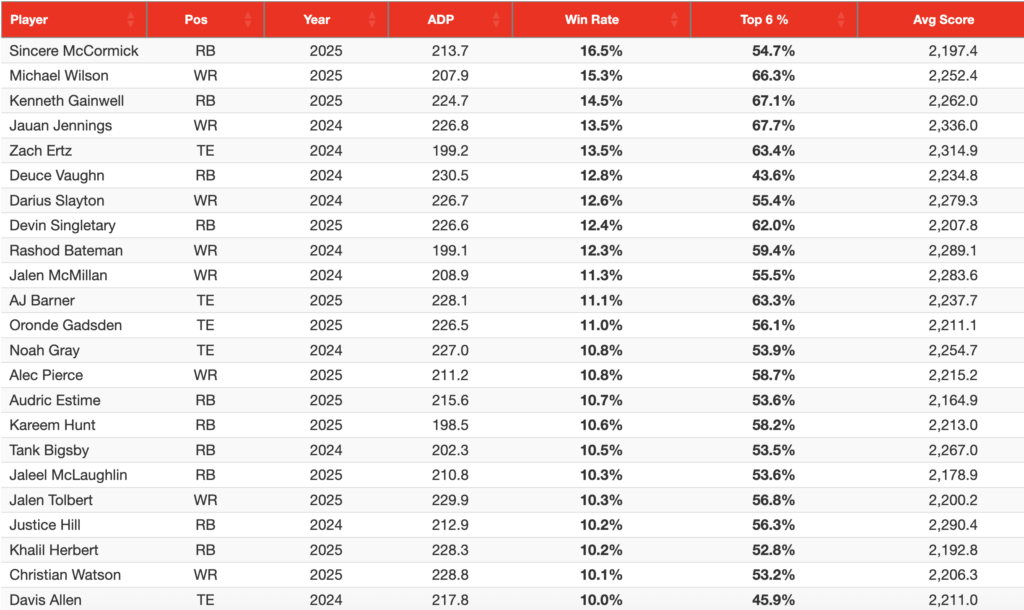
Your rankings do not need to be wildly different. They just need to be yours. Even small changes over 20 rounds can create a roster that looks different from the field. That matters most after pick 200, where players like Sincere McCormick (lol), Michael Wilson, Kenneth Gainwell, and Alec Pierce posted strong win rates despite being nearly free over the last two years.
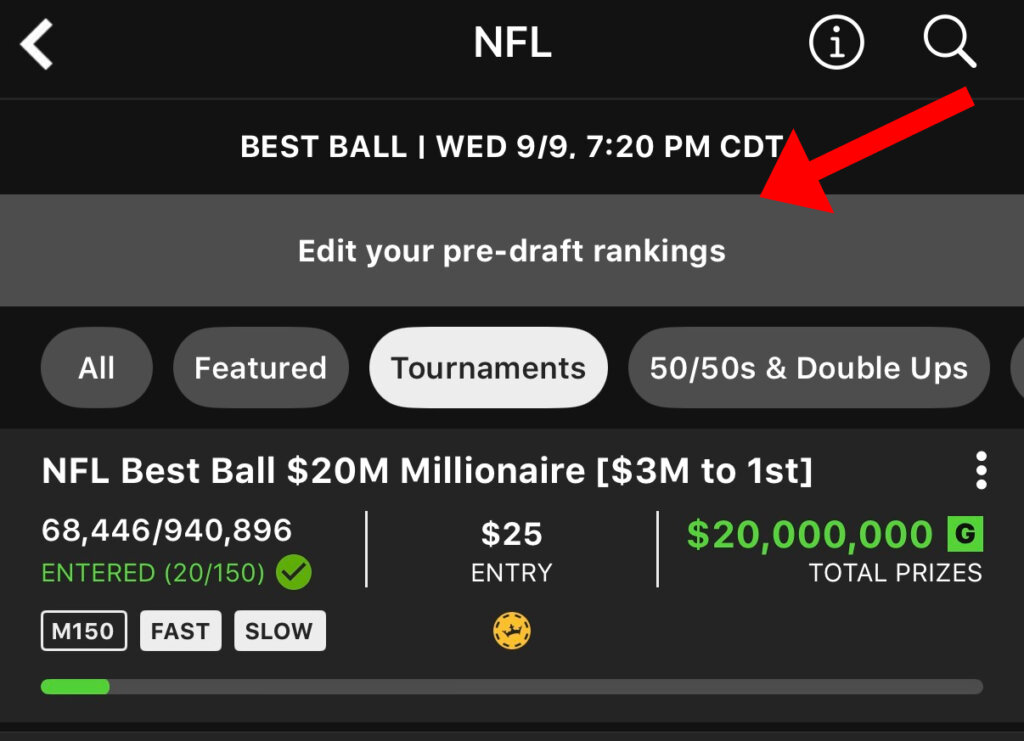
You can go here to edit your Milly csv on a desktop or click here on your phone to do it manually.
Best Ball is a Market-Based Game
Drafting the market means understanding that ADP is not static. ADP moves with injuries, depth-chart news, contract updates, beat reports, and QB changes. The edge comes from knowing which players are likely to get cheaper and which players are not.
If Malik Nabers has a lingering injury, Quinshon Judkins is unlikely to be ready for Week 1, Shedeur Sanders loses steam because Watson is getting starter buzz, or George Pickens contract issues linger, those players could continue to fall. You do not have to catch these falling knives now, because they’ll be cheaper later this summer, and you’ll have an advantage over drafters picking them at higher ADP currently.
The opposite is true for players with obvious market catalysts. Aaron Rodgers could rise when he signs. Cam Skattebo could rise if his recovery from injury continues to trend well. Tua Tagovailoa could rise if the starting QB uncertainty disappears. Those are the spots where drafting ahead of the room can create closing line value.
Tools
- Best Ball Rankings*
- Best Ball Archives
- Fantasy.vip
Fantasy.vip is a free site where @ooooftw puts the NFL schedule, stacks, exposure, etc., at your fingertips.
*Best Ball Rankings are for UD and do not take DK scoring considerations into account. Adjust accordingly or find me on X for DK rankings
2026 best ball schedule cheatsheet with bye weeks
11 minutes faster than last year haha https://t.co/mXU0tBfZXk pic.twitter.com/Qrpe6qr07z
— michael (@ooooftw) May 14, 2026