

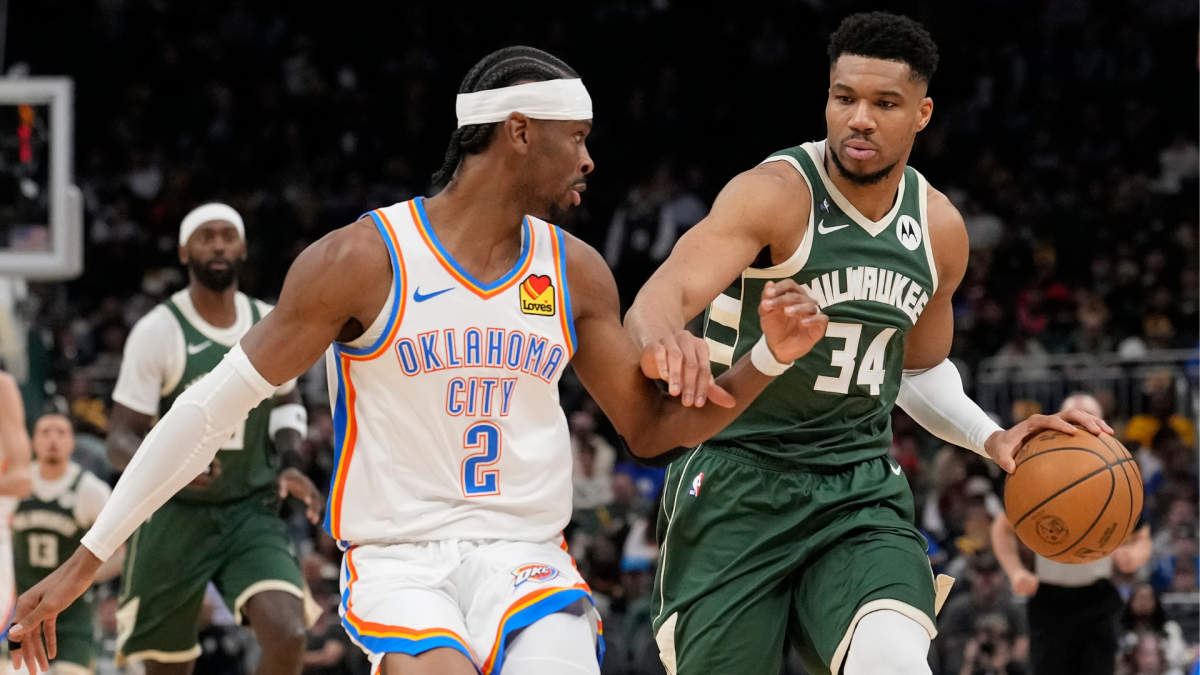
The Oklahoma City Thunder have spent the past few seasons growing into the NBA’s preeminent villain. And yet, if you asked most NBA teams which championship outcome would be most beneficial to them, they’d likely have told you that the answer was another Thunder title. The San Antonio Spurs are still ascending. They’re not about to do anything rash. The New York Knicks are already all in.
But a winning Thunder team is a patient Thunder team. Had they repeated as champions, they almost certainly would have brought back the bulk of their team next year, minus some cuts to duck the second apron, and gone for the continuity approach in their three-peat.
But their loss to San Antonio in the Western Conference Finals was perhaps the only possible trigger for a more aggressive mindset. After all, those young Spurs are only going to get better. Injuries were a big part of Oklahoma City’s loss, but there’s no guarantee they’d be healthier next year. The Thunder are as asset-rich as any team has ever been in NBA history. The Spurs have backed them into a corner. There’s no telling what they might do to push their way out of it.
We’re all thinking the same thing at this point. Could the Thunder’s elimination at the hands of the Spurs compel them to pursue Giannis Antetokounmpo? The Athletic’s Sam Amick has reported that it’s unlikely, but this is the NBA. Unlikely things happen all of the time. Such a pursuit would be enormously complicated, but not technically impossible. Let’s at least explore Milwaukee’s dream scenario.
How complicated would the cap mechanics get? What would an offer actually look like? And when the dust settles… should Oklahoma City really do this?
The $98 million hoop the Thunder would need to jump through
Antetokounmpo is set to make just under $58.5 million next season. Only Stephen Curry and Nikola Jokić will earn more, and neither of them play for the Thunder. This poses our first immediate issue. To match Antetokounmpo’s salary in a trade, the Thunder would have to aggregate multiple contracts. You’re only allowed to aggregate contracts in trades if you’re below the second apron.
The Thunder, with their two first-round picks accounted for, are currently projected to be $39 million above the second apron. Therefore, between the trade and other moves, the Thunder would need to send out almost $98 million worth of salary to legally acquire Antetokounmpo. That is a lot of money to shed, nearly all of which is attached to good players. The Thunder don’t have bad contracts on their books.
What’s next for Thunder? OKC faces a stark financial reality, and only SGA is truly indispensable
Sam Quinn

Now, Oklahoma City does have some relatively straightforward ways to save money if it wants them. Lu Dort has an $18 million team option for next season. Either that option will be declined, or he is likely to be traded. Aaron Wiggins and Isaiah Joe make more than $20 million combined, and both have readymade replacements in place. Even Isaiah Hartenstein has a $28.5 million team option the Thunder could use or trade to save money, though he’s become so essential to their team that they’d obviously prefer not to do so.
But the sheer financial burden of adding Antetokounmpo would be enormous. They’d be gutting their depth to do it. The Thunder are better positioned to sacrifice depth for star power than any team in the NBA, but before we consider whether or not they should, let’s try to construct a trade here.
What would a trade actually look like?
There are two components to any trade that need to be considered before it becomes realistic: value and salary. The Thunder have the value component down. They can trade up to eight first-round picks if they want, including Nos. 12 and 17 in this year’s draft. Good luck outbidding that, but if anyone else does, they’re probably not capable of throwing young studs like Cason Wallace and Ajay Mitchell into the deal. The Thunder have the capacity to win almost any bidding war the trade market creates. They have the means to acquire basically any player in the NBA.
But then there’s the salary component to consider. Let’s work backward. The second apron is projected to be a bit more than $221.7 million for next season. The four-man combination of Antetokounmpo, Shai Gilgeous-Alexander, Jalen Williams and Chet Holmgren will make $181.7 million. Keeping the four of them together would give the Thunder only $40 million to allocate to their 10 remaining roster spots (assuming they’d roster only 14 players to save money).
The picks-based path to Giannis
Is that a solvable problem? Well… maybe in theory, and that’s just because the Thunder have so many cheap players. We’ll assume for now that Oklahoma City could keep those players and make a trade just involving picks and some of their bigger salaries, which the Bucks could probably flip for more picks. Wallace makes $7.4 million. Jared McCain makes $4.4 million. Mitchell makes $2.9 million. All three fit wonderfully alongside the stars. All three are, for now, remarkably underpaid. But just keeping that trio takes you to $25 million in room for the last seven spots.
Hartenstein, at $28.5 million, is gone automatically. So is Alex Caruso at $19.5 million. Dort, Joe and Wiggins were already luxuries this team could no longer afford. Kenrich Williams might be as well, assuming the Thunder prioritize younger players. They could maybe keep one or two more of the cheap, incumbent players. Jaylin Williams, as a big who can shoot, makes sense, and Nikola Topić as a possible developmental ball-handler would be important. But at that point, you’re down to $11.5 million or so in spending power for your last five roster spots. That’s three veteran’s minimum contracts and two rookie minimum contracts, with a bit of spare change leftover for in-season usage.
So even in a best-case scenario in which the Thunder manage to keep all their best, young, cheap talent out of the trade, it gets dicey. If the Bucks demand Wallace, Mitchell or McCain? The concept falls apart. Even without them, a move like this would be so out of character for Oklahoma City. The Thunder prize depth as much as any team in the NBA. They don’t play their players big minutes. They use everyone on the roster. That’s part of how they’ve managed to win 132 games over the past two regular seasons despite their injuries. The Thunder might be unbeatable at full strength. Antetokounmpo, Holmgren and Williams are all injury risks at this stage, and if one or two of them went down, the house of cards might tumble.
And that’s before you consider the long-term salary implications. Gilgeous-Alexander’s supermax contract kicks in next offseason. So does a possible rookie extension for Wallace. Mitchell is two years away from unrestricted free agency, and in a perfect world, the Thunder would use his team option to pay him a year earlier. Oh yeah, and Antetokounmpo needs a supermax extension as well. In other words, even if they could duck the second apron next season, this version of the roster would blow by it in historic fashion in the years that follow. It would almost unquestionably be the most expensive roster in NBA history by a wide margin. That doesn’t exactly scream sustainability.
The player-based path to Giannis
If the Thunder put Holmgren or Williams on the table, that changes the entire equation. There are only a handful of assets reasonably in the picture here that could compete with either of them. Evan Mobley, Paolo Banchero, or young players of that ilk might be preferable to the Bucks just because they’ve historically been healthier than Holmgren or Williams, but it’s hard to imagine the Bucks taking a picks-based package over either of them. Either takes the Thunder reasonably close to the value threshold needed here. The question then becomes how to juggle the salary.
Which of the two would the Thunder rather trade? Oklahoma City got a glimpse of life without Williams this season, and had Mitchell stayed healthy against the Spurs, they might’ve won the championship despite Williams’ injuries. Holmgren’s Spurs series, especially Game 7, was a mess. He hasn’t grown as an individual shot-creator in the ways the Thunder likely hoped, and his 3-point attempt rate, while still high for a center, has gone down in each of his three seasons. His release is too slow. He was too hesitant against San Antonio.
Ultimately, I would guess that even despite his Spurs series, the Thunder would lean towards keeping Holmgren. Even he’s not the shooter we hoped he’d be, Antetokounmpo teams do need a center option who can at least somewhat space the floor. Holmgren is better than most centers in that regard, and his rim-protection would be a necessity as Antetokounmpo’s defense has slipped in recent years. Holmgren isn’t exactly a Brook Lopez analog, but he’s as close as Antetokounmpo could reasonably hope to get.
Williams is the only elite forward-sized defender on the roster, but Caruso defends up as well as anyone in the league, and for the biggest matchups, Antetokounmpo would obviously be here. Antetokounmpo would go further towards replacing Williams as a ball-handler than he would replacing Holmgren as a defender at this stage. Holmgren is the slightly cleaner fit, assuming he’s willing to start taking the amount of 3s he’d need to take on a Giannis team.
Either way, Antetokounmpo makes around $17.2 million more than both Williams and Holmgren (who have identical salaries). Again, the second apron is our number. Considering the $39 million above the second apron they currently are, they’re looking at shedding around $56 million in extra money on top of Williams to skirt the line. So long to Dort, Joe and Wiggins. The Bucks can take them if they want them, or they can be rerouted. That’s almost $39 million gone, leaving us another $17 million or so to go.
Western Conference Finals winners and losers: De’Aaron Fox steps up for Spurs, two Thunder starters disappear
Sam Quinn
The Thunder could go in a number of ways to potentially close that gap. Sending the Bucks their two first-round picks this year covers over $10 million, but I suspect if picks are needed here, the Thunder would rather send some deep into the future. They’re no longer playing the infinite sustainability game if they pursue Antetokounmpo. The window is probably another three or four years, and they’d want those two picks this year to grow into meaningful contributors by the end of that window (and possibly replacements for Antetokounmpo if he ages out of stardom).
They could go about finding those savings through trimming proverbial fat. Kenrich Williams, Topić and Thomas Sorber make around $17.5 million combined. They all have roles in Oklahoma City’s long-term vision. Williams is a locker room leader. Topić was a lottery pick they have high hopes for. Sorber was the big they likely hoped would eventually grow into Hartenstein’s replacement. But none are essential to the current, on-court product.
Or, they could try to do it in one fell swoop by trading Caruso or Hartenstein. There’s a real argument for either. Caruso is 32; they’d probably be getting out at the peak of his value. Hartenstein’s lack of shooting creates fit questions with Antetokounmpo. Caruso is probably needed more on a version of the team that trades Williams, while Hartenstein would remain necessary if the Thunder trade Holmgren. Yet I ultimately think the Thunder would try to keep both.
Come on, you’re prioritizing the present and not keeping Caruso, one of the NBA’s best role players? Hartenstein’s fit with Antetokounmpo would be better than most non-shooting centers. He’d function defensively much as Lopez once did, hanging near the rim and taking on the more physically taxing matchups that Antetokounmpo doesn’t want. He’s one of the NBA’s very best screeners and excels at clearing space near the basket. He doesn’t space the floor out to the 3-point line, but his incredible flip shot means defenses have to guard him at least out to mid-range. They might not play together for 30 minutes, but they could absolutely coexist.
Ultimately, I suspect the answer would be a combination of several options. They’d lower Hartenstein’s cap figure with his team option by signing him to a multi-year extension at a lower annual number. They’d probably include some of the incumbent young players like Topić or Sorber in the deal, and give up one of this year’s picks as well. And yes, luxuries like Kenrich Williams’ locker-room value would probably have to be sacrificed.
They might ask Antetokounmpo to take slightly less than his max to accommodate the team. Considering how much better his odds at a second ring would be in Oklahoma City, he might do so. But with only three max contracts instead of four, as expensive as the team would get, it would still probably be doable with some sacrifices down the line.
So… should the Thunder really do this?
The argument here is, essentially, that Oklahoma City’s only meaningful goal moving forward should be contending with Wembanyama and the Spurs, and that the players they have now aren’t up to the task. The Athletic’s Sam Amick recently reported that there are teams that view Antetokounmpo as a possible solution to the Wembanyama problem. They’ve faced off four times and split them two games apiece. Of course, none of those games came when both teams had competitive rosters, so it’s hard to take the outcomes two seriously. Antetokounmpo averaged 31.3 points in those four games. Wembanyama averaged 22.3.
He’s strong enough to pose real problems for the skinner Wembanyama near the basket, but is more than capable of defending him on the perimeter as well. He’s probably the single best bet in the NBA to potentially get Wembanyama into foul trouble. In a sense, he’s a combination of the physicality Hartenstein defended Wembanyama with and the length and mobility Holmgren brings to the table. Having all three in one front court would be about as well-prepared as any team could get to face Wembanyama.
It’s easy to forget this since they’re younger than almost every other team in the NBA… but the Thunder probably don’t have the seemingly infinite runway that the Spurs do. Gilgeous-Alexander turns 28 in July. He’s almost six years older than Wembanyama, and he’s at the peak of his powers now. Will he be capable of leading contenders in his 30s? The answer is almost certainly yes, but the reality is that Wembanyama may already be a better player than he is, and with each passing year, that gap is likely to widen, not shrink. And San Antonio’s Dylan Harper and Stephon Castle have more room to grow than Oklahoma City’s core players.
It is therefore reasonable to suggest that the Thunder may be best served by really going for it now and trying to hold the Spurs off before they reach their final form, while ultimately accepting that doing so would probably shorten their ultimate window. Say you have a fixed amount of championship equity to distribute however you’d like. Would you rather spread that equity over a much longer period of time, knowing you may not be the championship favorite in any single year, or make yourself the favorite at the expense of several years of contention? Every team’s answer varies circumstantially.
Ultimately, though, I think Oklahoma City’s answer should and will be to prioritize longevity over peak. As tempting as an Antetokounmpo deal would be, I suspect they’ll pass.
Oklahoma City did a better job against Wembanyama than the outcome here suggests. He got 23 paint touches in Game 1 of the series, when the Thunder largely played small. He had 35 total in Games 2-7. He’ll get stronger, he’ll get better at asserting his position near the basket, and he’ll develop a more varied post-game. But the Thunder ultimately succeeded in minimizing his dominance near the rim. That meant conceding jumpers, and he made them. There’s nothing the Thunder could have reasonably done about those 3s. You can’t take away everything. Perhaps Antetokounmpo could make his life even harder, but with someone this good, there’s only so much that can be done.
The real problems the Thunder had in this series came on offense. Wembanyama completely took away the rim. In their three wins, they shot almost 41.5% on 3-pointers, but in their four losses, they shot 29.4%. That was a problem last year too, as Oklahoma City shot 32% on 3s in their seven postseason losses. Oklahoma City has gotten by with overwhelming talent and defense, but despite the regular-season numbers, this has never been an elite shooting team. The Knicks will be an interesting test case for how elite shooting fares against Wembanyama. In theory, that’s the path to scoring against him. Antetokounmpo obviously does not add shooting.
Their offense with Mitchell and Williams out essentially boiled down to “can the role players have outlier 3-point shooting games” or “can Gilgeous-Alexander make a bunch of very difficult jumpers.” The answer to both questions wound up being “no,” though Gilgeous-Alexander did his part in Game 7 at least. Antetokounmpo would have completely changed the offensive dynamic of the series. His rim pressure would open things up for Gilgeous-Alexander and everyone else. That just doesn’t mean he’s the only option.
Even if Williams remained hurt, the version of Mitchell the Thunder had against the Lakers might’ve been good enough to get the Thunder through this series. In Game 2, the Thunder scored 122 points with Williams playing seven minutes. Losing Mitchell was the tipping point. If the Thunder have both, the offense looks different. Gilgeous-Alexander probably needs to work on his pull-up 3. That’s his best chance of dragging Wembanyama further away from the rim. He shot just 29.2% on those looks in the playoffs.
If health was the problem, it’s just hard to imagine Antetokounmpo is the solution, given all of the calf injuries he dealt with this season. He’s 31. There are teams where rolling the dice on the remainder of his prime makes sense. Those are teams that would not have a championship ceiling without him. The Thunder absolutely have one. They won the title a year ago.
It’s easy to fall into the trap of assuming Wembanyama’s ascension at this early age makes him untouchable for the foreseeable future. It’s just never that simple. There will be years when he gets hurt. There will be years when something goes wrong with his supporting cast. There will be years when something completely unforeseeable completely changes the dynamic of the championship race. The NBA is chaotic and random. Weird stuff happens. We’re about to crown our eighth champion in eight years.
That’s probably why the Thunder have avoided a move like this for so long. They’ve had the capacity to trade for another star for years. Doing so while Williams and Holmgren were on rookie deals would have saved them a lot of second apron-related headaches. Had they pursued Antetokounmpo at the deadline, for instance, they wouldn’t have needed to stress about a second-apron hard cap next season because the trade only would have triggered one for this year, when they were still cheap. They didn’t chase him then. They’ve likely passed on far more stars than we know.
The appropriate comparison here might be the Spurs, but not in their current incarnation. The Tim Duncan version of the team won five championships in 15 years. At no point in that run did they stand out as definitively the best team in the sport. A number of candles, like the Kobe Bryant-Shaquille O’Neal Lakers or the LeBron James-Dwyane Wade Heat, burned brighter, but not as long. Those Spurs understood the benefit of being in the mix every year. Guess where Thunder general manager Sam Presti worked from 2000-07? San Antonio.
His entire approach to roster building has been about redundancy and depth. Have a surplus of everything: ball-handling, defense, draft picks, so if injuries or circumstances every chip away at one area, you’re covered elsewhere. This year, the ball-handling losses proved insurmountable. They’ll be right back in the hunt next year, with or without Antetokounmpo.
Never say never. Wembanyama’s presence will challenge just about everyone’s preconceived notions about roster building. But if the Bucks are hoping Oklahoma City’s loss compels them to get into the mix for Antetokounmpo, the likeliest answer is that they’re going to be disappointed. This just isn’t how the Thunder tend to operate.