

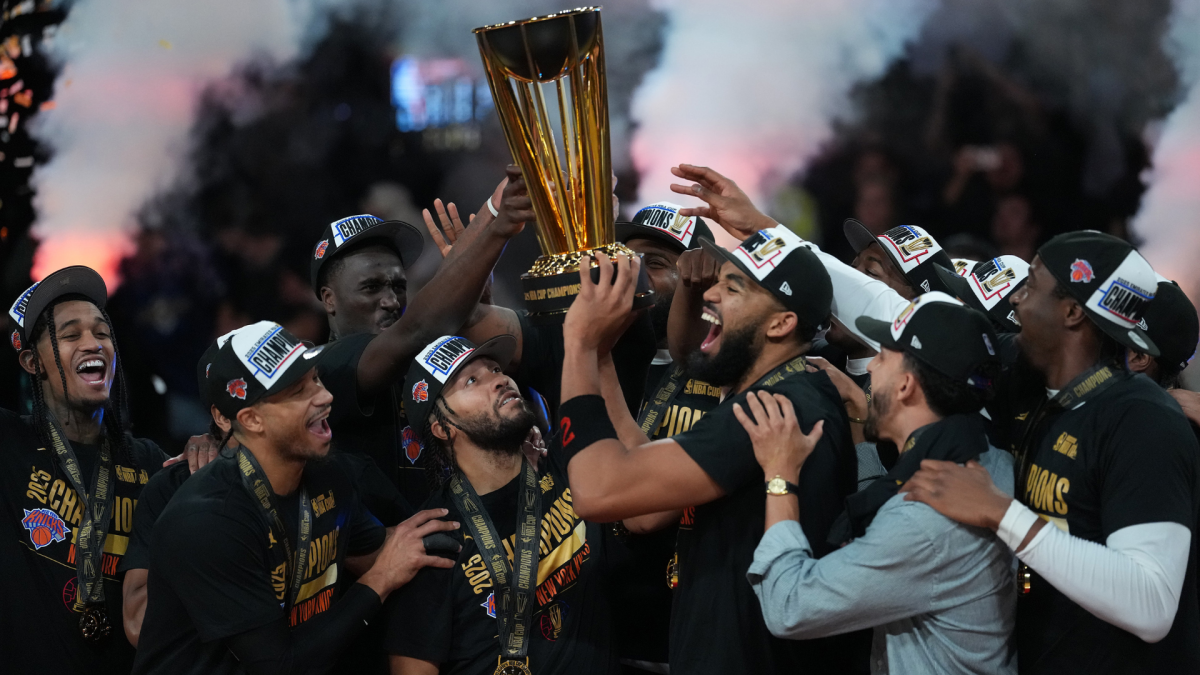
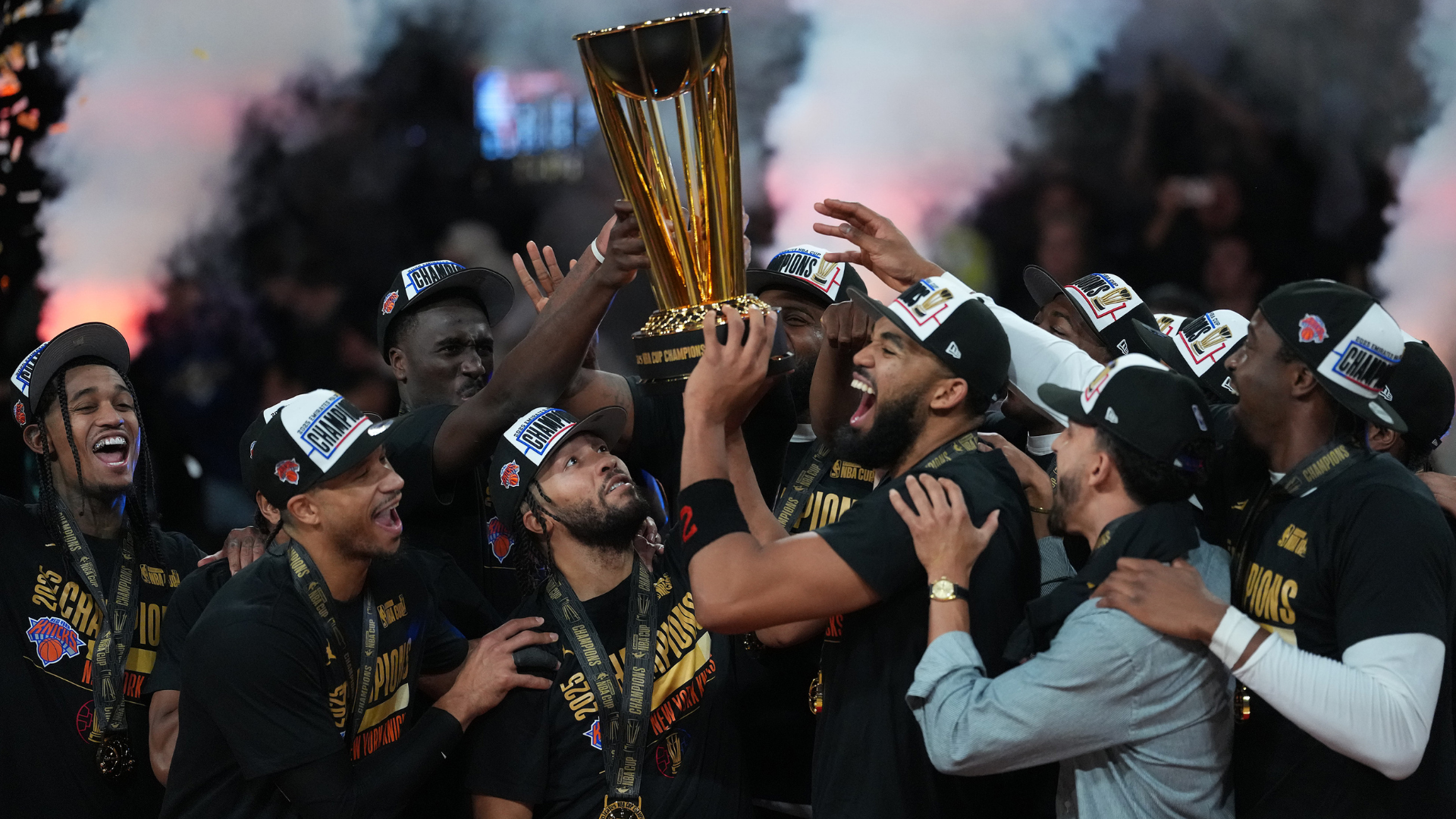
The third NBA Cup has come and gone with Tuesday’s championship game. The New York Knicks have joined the Milwaukee Bucks and Los Angeles Lakers as champions. The San Antonio Spurs fell just short, but still managed to take home more than $200,000 as the second-place finisher. And now, the season moves on as teams turn their attention back to the far more important chase toward June’s championship trophy rather than December’s.
While the NBA Cup will never hold as much sway over teams and fans as the Larry O’Brien Trophy, the purpose of this in-season tournament was to create a secondary event that could energize the early portion of the season enough to at least give teams out of the running in May and June something else to compete for. Has the NBA Cup done so? Let’s go through what’s working and what isn’t three years into the conception of this tournament.
What’s working: The elimination games
It’s a lesson we learn and re-learn every April when the NBA’s Play-In Tournament rolls around. If you put NBA players in any sort of winner-take-all format, regardless of who those players are, the results tend to be positive. Even without stakes that affect the pursuit of the end-of-season championship, these single-elimination games produce high drama year after year after year. What’s more, they do so for unexpected teams.
One of the defining features of the NBA Cup thus far has been its ability to serve as a launching pad for younger teams. The Pacers came out of nowhere to reach the Cup championship game in 2023, but then made the Eastern Conference finals and the NBA Finals in consecutive postseasons. Houston was last year’s breakout team, and now the Rockets are a championship contender. San Antonio’s run this season was the latest example.
The single best thing the NBA Cup does is take young teams without playoff experience and give them a slightly toned-down simulation of what playoff basketball is like. It gives them high-leverage reps that seemingly do translate to the playoffs afterward, and in the process, it introduces more casual fans to teams that they should expect to see quite a bit more of in the years to come. No matter what changes the Cup makes in the coming years, that has to be the heart of the event.
What’s not working: The tournament structure
The way the tournament ends is by and large a positive. Everything that leads up to that ending? Not so much. The group stage, no matter how they’ve tweaked it, has generally been a failure. Nothing about it feels like a familiar tournament structure for fans. Simply telling them that games count differently on different nights doesn’t cut it. It all feels arbitrary. Why are certain teams in certain groups? Why does point-differential matter? There are answers to these questions. They aren’t connecting with the casual viewers the league is trying to attract.
At the very least, the tournament games need to be played consecutively. Somehow, the league needs to carve out a section of its calendar to devote fully to this event, because otherwise, it’s just too much to expect the average fan to know in advance which nights count, especially since that keeps changing. This year, it was Fridays with a Tuesday and Wednesday thrown in during the week of Thanksgiving. In the past, it was Tuesdays and Fridays.
The real solution here is a single-elimination tournament. The problem is numbers. The NBA has 30 teams and it would need 32 for a proper five-round knockout event. The league could sidestep this issue by giving the two reigning NBA finalists first-round byes, advancing 14 other teams and going with a 16-team bracket from there, but as these games need to count in the regular-season standings, everyone probably needs to play the same number of games. Perhaps bringing in foreign teams could work, but expansion is the easiest solution. In an ideal world, 32 teams would compete with loser’s brackets being created after each round. Eventually, every team would place between No. 1 and No. 32, with tournament placement serving as the only postseason tiebreaker.
Hey, speaking of postseason tiebreakers, it is patently absurd that the Cup champion receives no benefit in the standings for winning the final game. The Spurs and Knicks are both near the top of their respective conferences. They had to play an extra game on their schedules, one that the tournament’s early history suggests could hamper them in the coming weeks, when they have to play games that count. To not even give the winning team an extra victory in the standings is frankly a farce. It’s conceivable for a Cup winner to lose a tiebreaker in April to a team that it is not, in fact, tied with in reality. If a team wins a game between opening night and the beginning of the postseason, it has to count. How can you expect fans to take these games seriously when you won’t even award the winner with a win?
What’s working: The money
There were a number of questions before the tournament began about motivation. How do we get the players to care? Should winning teams get another draft pick? A guaranteed playoff slot? Nope. Turns out, the NBA got it right from the start. Players will play hard when they are financially incentivized to do so — for themselves and for their teammates. The level of effort and quality of basketball has stood out even against the backdrop of what has been an excellent regular season thus far.
Even the stars seem invested in winning amounts of money that wouldn’t even represent a full game check for them. Why? Because they understand that many of their teammates, especially rookies and two-way players, aren’t earning as much. That’s been the secret sauce for these payouts. They’ve become a team-bonding issue. The stars want to take care of their less famous teammates, and that’s benefitting everyone even after the tournament ends.
What’s not working: The venue
The pure concept of finishing the tournament in Las Vegas made some sense. It’s an event town, after all, and one the NBA knows quite well thanks to Summer League. They wanted flash for these final games, but they also put an unrealistic burden on fans to create it.
Fans didn’t know whether their teams would make it to Vegas until Tuesday or Wednesday of last week. They played there on Saturday. That’s a shorter turnaround than college basketball fans get from the Elite Eight to the Final Four, which are also far more important games that fans would be much more motivated to travel for.
And then there’s the matter of timing. Christmas is in nine days. Most people with the means to travel already had plans to do so elsewhere later in the month. Asking them to figure out the logistics for an impromptu Vegas trip under those conditions was always going to be a stretch. The atmosphere in the arena has reflected that. The crowds, especially in the early games on Saturday, have been pretty lifeless.
The NBA, to its credit, seems to have recognized that. Next year, the semifinals are set to be played at home venues. The future of the championship game has reportedly not been decided, and it could possibly move out of Vegas as well.
What’s working: The cup on the court
This tournament has one pretty simple aesthetic saving grace: the trophy works. It’s distinct from the Larry O’Brien trophy, and it’s so simple that it works as a design concept all across the court. The center-court logo obviously works, but adding it into the paint is a very nice touch that again helps these games stand out. That’s a concept worth retaining, though considering the slipping issues some of these courts have created, there seems to be more work to be done when it comes to execution.
Imagn Images
What’s not working: Everything else about the courts
The colorful courts were a miss. Even the lighter gold-ish court in Vegas is a bit of a distraction. It was an admirable concept, but fans have certain aesthetic expectations when tuning into a basketball game and a neon green or blood red court just don’t meet them. They’re more distracting than appealing. Keep it simple next year. Retain the trophy. Ditch the colors.