

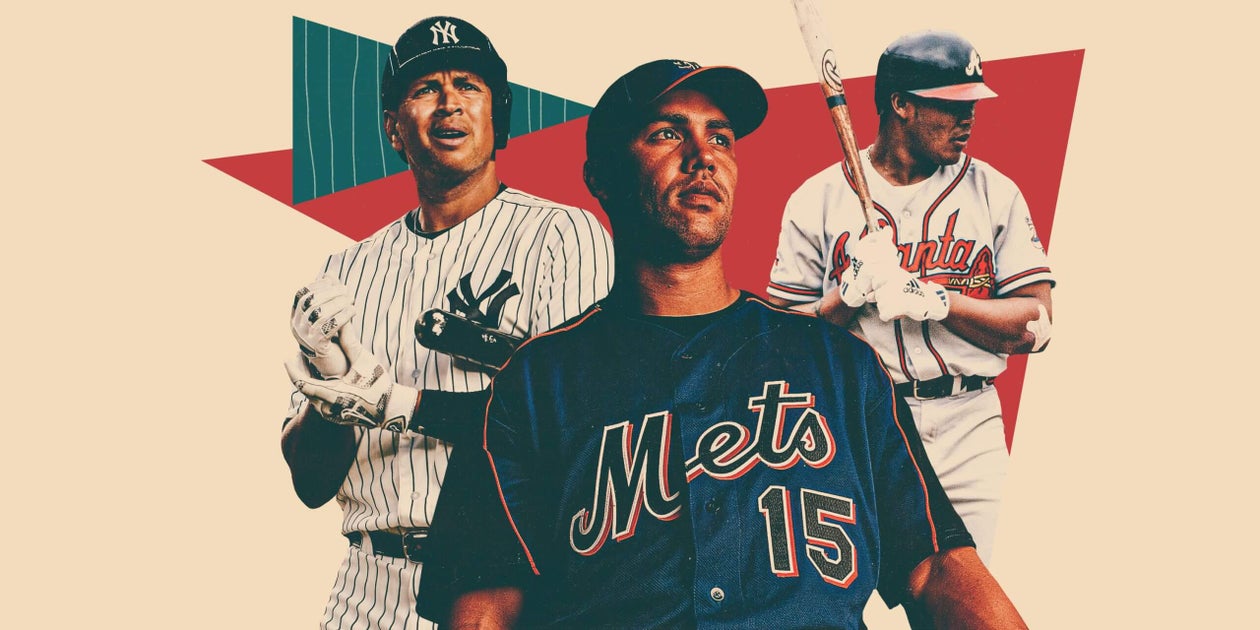
The 2026 Baseball Hall of Fame class will be announced next Tuesday and immortalized, along with Jeff Kent, this summer in Cooperstown.
Twenty-seven players, including 12 newcomers, are on this year’s Hall ballot, which is voted on by over 400 members of the Baseball Writers’ Association of America. Many of The Athletic’s writers have the privilege of voting for the Hall of Fame — and whether they’ve been doing so for decades or cast their first ballot in this election, it’s a meaningful experience for all of them.
Here are the ballots of 12 of The Athletic’s Hall of Fame voters and, in their words, more on their selections.
(Note: Jayson Stark, Ken Rosenthal and Tyler Kepner will reveal their respective ballots in separate columns before next Tuesday’s election.)
Dan Barbarisi
Carlos Beltrán, Andruw Jones, Cole Hamels, Félix Hernández, Andy Pettitte

Cole Hamels was the NLCS MVP and World Series MVP in 2008. (Winslow Townsend-Pool / Getty Images)
I’ll admit, during his playing career, I never really thought of Hamels as a Hall of Famer. He was always just a good pitcher — always there, always performing well, but never the best pitcher in the league, never delivering that blow-you-away season that changes our perception of a player.
But he kept pitching well, kept delivering seasons that kept him among the top 10 pitchers in the league, even top five, over an extended peak from 2008 to 2016. You could count on Hamels for an ERA right around 3.00, 200-plus innings, a strikeout per inning, a 1.20 WHIP. The guy was a metronome, in an era when dependable, consistent starting pitching was already becoming rare, foreshadowing where the game has gone today.
We’re clearly at a crossroads in how we evaluate pitchers, with the standards for what makes a great starting pitcher still catching up to what they’re doing on the field.
Judged against his forebears, Hamels doesn’t measure up. He lacks the counting numbers and the win totals and the long, sustained career of dominance. Compared to pitchers of today, he looks like an absolute horse. For his own era — not that long ago, but clearly already a different time — he should be seen as what he was: one of the best pitchers in the league for a long time, a player whose lack of one or two extreme standout seasons shouldn’t detract from a stellar body of work.
Hamels wasn’t exciting. But he was great for a long time, one of the very best in a period where his kind of production was becoming increasingly hard to find.
Tim Britton
Bobby Abreu, Carlos Beltrán, Félix Hernández, Dustin Pedroia, Andy Pettitte, Chase Utley, David Wright
It is clear from my ballot that I appreciate peak performance, even if it doesn’t come with the type of longevity preferred in Hall of Fame inductees. Hernández, Pedroia, Utley and Wright were among the sport’s very best during their primes, though those tended to end rather abruptly. This makes Andruw Jones’ absence from my ballot more conspicuous.
On the field, Jones would be an easy “yes” for me. Despite the plunge his value took as soon as he was in his 30s, he was a player of immense defensive value who also happened to hit more than 400 home runs.
However, I view Jones’ 2012 arrest for battery against his then-wife, and his subsequent guilty plea to a related disorderly conduct charge, as disqualifying — obviously more so than Beltrán’s involvement with the Astros’ cheating scandal.
I understand and accept that many of you will view this as sanctimonious. I agree that it would be simpler to limit my perspective to only what happened on the field. But induction into the Hall of Fame is the sport’s greatest honor, and the Hall instructs voters to consider a player’s character and integrity when deciding whether to immortalize them with a bronze plaque. By that standard, Jones falls short for me.
Dan Brown
Bobby Abreu, Carlos Beltrán, Mark Buehrle, Félix Hernández, Andruw Jones, Andy Petitte, Manny Ramírez, Álex Rodríguez, Jimmy Rollins, Chase Utley
I held off on Hernández a year ago, but this persuasive analysis by Mike Petriello of MLB.com changed my mind. Petriello made the case that King Félix was the best pitcher in baseball between 2005 and 2014.
Dominating a position for roughly a decade sounds like a Hall of Famer to me, and, indeed, just 19 hurlers since 1950 have emerged as the best pitcher in the sport across a 10-year span. Others on the list include Bob Gibson, Tom Seaver, Pedro Martínez, Randy Johnson and Greg Maddux.
Hernández’s career numbers lump him with a less glittering tier by Baseball Reference similarity scores. (Kevin Appier, Jake Peavy, Frank Viola, et al.) But Félix’s glorious and sustained peak gets him over the top for me, as we struggle to evaluate starters in an era without massive inning totals or 300-game winners.
Voting for Hernández (49.8 career bWAR) made it tough to exclude Pettitte (60.2) and Buehrle (59.0), so I voted for them for the first time. I’ll vote for Hamels (59.0) next year.
As for the guys tainted by performance-enhancing drugs, I just hold my nose and click the box. There are some problematic cases already in the Hall, and the inconsistency grows increasingly unjustifiable.
Steve Buckley
Carlos Beltrán, Andruw Jones, Dustin Pedroia, Andy Pettitte, Jimmy Rollins, Chase Utley, David Wright
Here’s a baseball story I’ve told a couple or a couple of hundred times over the years. It actually takes place inside a football stadium, the old joint where the New England Patriots played before Robert Kraft ponied up millions of dollars in private money to get Gillette Stadium built.
So we’re in the press box at Foxboro Stadium, The Boston Globe’s Bob Ryan and me, sometime in the 1990s, and we’re arguing about the Baseball Hall of Fame. Ryan is making a passionate case as to why longtime Cincinnati Reds shortstop Dave Concepción should be enshrined in Cooperstown. I am making the counterargument that, gee, sorry, Concepción was a fine ballplayer, but he should not be in the Hall of Fame. We keep going back and forth. Think of it as an Aaron Sorkin ping-pong shot. Finally, there comes an announcement in the press box, a request really, for the gentlemen arguing about baseball to please take their discussion to the back room.
The point here? Bob Ryan was, and remains, a passionate, lifelong student of the game. He covered the Red Sox for a few years, but beyond that, he’s famous for scoring every at-bat of every game he’s attended over the past half century-plus, from the World Series to college ball. He even wrote a book that displays his favorite scorecards from over the years, including Red Sox right-hander Reggie Cleveland’s 18-hit, complete-game, 12-5 victory over the Detroit Tigers on Sept. 25, 1977.
And yet as I drove home that night, one question nagged at me: How could Bob Ryan be so wrong about Dave Concepción?
The answer is simple. Everybody’s Hall of Fame ballot sucks. Everybody’s. I know this to be true because the comments, social media posts and emails that are inspired by the annual declaration of my own ballot invariably include a few colorful pronouncements that my voting privileges should be taken away.
It used to be these arguments were generally fun, though often spirited and, yes, occasionally Steel Cage-worthy. Then came the PED era, and for some baseball writers, the Hall of Fame election wasn’t much fun anymore. To vote for any of those steroid guys meant being crushed by angry fans because you were rewarding cheaters who besmirched Baseball’s Sacred Records. If you didn’t vote for them, a posse would be rounded up to chase you down for the purposes of reminding you that this or that guy never failed a test, that there were no real rules in place, that, hey, come on, players from the 1960s popped “greenies,” and so on.
If you were a so-called Big Hall voter, you were dismissed as an overzealous fanperson. If you voted for just one or two players, or Heaven help us submitted a blank ballot, you were mocked as a self-appointed “Protector of the Game” who must keep Cooperstown reserved for Babe Ruth, Henry Aaron, Ted Williams, Satchel Paige and maybe, maybe, a few others.
Everybody’s ballot sucks.
You know what? It’s taken me many years to figure this out, but it’s actually a good thing that everybody’s ballot sucks. It’s liberating. It means you can vote for the maximum 10 players. Or you can vote for no players. You can champion the newfangled WAR7 (a player’s peak performance over seven seasons), or you can hold tight to old-timey counting numbers. (Early Wynn won 300 games! He’s in!)
In the end, none of it makes any difference because everybody’s ballot sucks anyway.
My choices for the Baseball Hall of Fame’s Class of 2026 are noted above.
I think it’s a pretty good ballot. In fact, I think it’s perfect.
What do you think?
Rustin Dodd
Bobby Abreu, Carlos Beltrán, Félix Hernández, Andruw Jones, Andy Pettitte, Manny Ramírez, Álex Rodríguez, Chase Utley

This is Manny Ramírez’s 10th and final year on the writers’ ballot. (Elsa / Getty Images)
When I cast my first Hall of Fame ballot in 2022, I voted for four superstars heavily linked to performance-enhancing drugs: Barry Bonds, Roger Clemens, Manny Ramírez and Álex Rodríguez. The decision, as you’d expect, was polarizing. Dozens of fans online applauded the votes. None other than Keith Olbermann publicly ripped me for ignoring the Hall’s “character clause.” Every year that I’ve cast a ballot, I’ve continued to vote for those linked to PEDs, including Ramírez and Rodríguez, who were caught after MLB officially started testing.
I’ve long wrestled with the ethics of doing so. Am I overlooking a serious breach? Am I enabling cheaters? Clearly, the majority of voters on this year’s Contemporary Baseball Era Committee disagree with my stance because Bonds and Clemens did not come close to getting in. So am I wrong? I’m open to that possibility.
But here’s where I’ve landed: These players are on the ballot. The Hall of Fame could implement protocols or processes to remove so-called “cheaters” from the ballot. They have not.
I believe there are probably players who used PEDs who have been elected to the Hall of Fame. There are players from other eras who used “greenies” (amphetamine pills). Former commissioner Bud Selig is in the Hall of Fame.
The only reasonable thing is to look at the players on the ballot with PED questions and attempt to determine whether their numbers merit inclusion and whether they likely would have been a Hall of Fame-caliber player without using PEDs. This, too, is nearly impossible. I can’t pretend like I know the answer with 100 percent certainty. It could be that I’m punishing players like David Wright and Dustin Pedroia, who theoretically could have stayed healthy and played longer with the help of PEDs.
I’m open to that possibility. But when I use that methodology and consider the careers of Ramírez and Rodríguez, I’m left with the following conclusion: I think they were Hall of Fame players.
Brittany Ghiroli
Carlos Beltrán, Andruw Jones
I’ve waited 17 years to get a Hall of Fame vote because I spent the first decade of my career at MLB.com, which was not considered part of the BBWAA until late 2015, meaning my service clock to get 10 years took much longer. I’ve watched other elections and critiqued voters just like most of you, while wondering what kind of voter I’d be.
Well, after a lot of reading and research, it turns out I’m a Small Hall voter. To me, the sport’s highest honor means the absolute best of the best, and I think the two guys I voted for are a cut above the rest of the candidates.
Don’t get me wrong, there are cases to be made for plenty of players in the Hall of Very Good, but do I put Dustin Pedroia or David Wright in the same category as other Hall of Famers? No. I can’t. Not yet, anyway.
For steroid guys, like Álex Rodríguez and Manny Ramírez, I erred on the side of caution. (I know, I know, the person who presided over the steroid era — Bud Selig — is in. That’s not my doing!)
I do think there’s a case for Chase Utley eventually, thanks to statistics like WAR that show his value exceeds what some of his career numbers suggest. Félix Hernández probably will get in eventually, too.
Look, I’m just one vote of hundreds, and as my colleagues have shown here, certainly in the minority in terms of the numbers I’d like to see in the Hall. There was no slam-dunk first-balloter this year, but I still think Jones and Beltrán are more than worthy.
Chad Jennings
Bobby Abreu, Carlos Beltrán, Cole Hamels, Félix Hernández, Andruw Jones, Dustin Pedroia, Chase Utley, David Wright

David Wright leaps for a ball hit by Dustin Pedroia in 2009. Wright received 8.1 percent of the vote last year, while Pedroia garnered 11.9 percent. (Ezra Shaw / Getty Images)
It took 296 votes for a player to be elected to the Hall of Fame last year, and that level of necessary consensus has always shaped my approach to voting. My role is not to define the Hall of Fame. It’s only to offer my two cents about what makes a Hall of Famer in my eyes.
That’s why I’ve always been a Big Hall voter. It fits my personality, and it’s always felt natural to vote that way. What I’ve wrestled with is my balance between peak and longevity. I’ve come to realize I’m most interested in the great players who burned bright for a relatively short — but still substantial — amount of time.
And so, I vote for Pedroia and Wright, two players about whom most of my coworkers disagree with me. Or, maybe we don’t disagree about the players themselves, but we disagree about whether their career arc — a Hall of Fame track cut short by an injury that just wouldn’t go away — fits within the walls of Cooperstown.
For me, it does. I would have no problem explaining to my kids what made Pedroia and Wright singular players, nor would I feel any shame when explaining why the totality of their careers didn’t measure up to some of the others in the Plaque Gallery. Pedroia and Wright fit my definition of a Hall of Famer, and if nearly 300 of my colleagues agree, they’ll take their place in Cooperstown.
Jen McCaffrey
Bobby Abreu, Carlos Beltrán, Mark Buehrle, Cole Hamels, Félix Hernández, Andruw Jones, Dustin Pedroia, Andy Pettitte, Chase Utley, David Wright
As a first-time voter, I did a lot of research to determine a baseline for such a subjective endeavor. There’s no set criteria for how one should vote for the Hall of Fame, which is the beauty and the curse of the process.
I first determined how I’d vote for players who were suspended for PEDs (Ramírez and Rodríguez) and while I read several opinions on both sides, I opted to leave them out.
For the rest, I considered players’ careers individually, but a big part of the process for me was comparing players to their contemporaries. I think voting should be a mix of statistics and feel for the game on how much a player contributed over the course of his career.
For instance, Hernández dominated for a six-year stretch, winning a Cy Young Award, before tailing off. Buehrle never had as dominant a stretch as Hernández, but he was incredibly consistent for 16 years. Pettitte was a key rotation member on five championship-winning teams. Hamels was consistently among the best in his league and won the NLCS and World Series MVP awards in 2008. WAR isn’t the be-all and end-all, but Hamels and Buehrle posted the same 59 WAR, according to FanGraphs, over the course of their careers, higher than Hernandez (49.8) and a tick below Pettitte (60.2).
The same process applied for infielders Utley, Wright and Pedroia. Pedroia won AL Rookie of the Year and AL MVP in successive years in 2007-08, and helped the Red Sox win two World Series in his prime. Utley and Wright were two of the NL’s best infielders for the better part of 10 seasons. There’s not enough of a difference among the three to not vote for all of them.
The careers of outfielders Beltrán, Jones and Abreu matched in many ways in my mind, too. Abreu didn’t have the 400-homer career of Jones or Beltrán, but his 128 OPS+ topped Beltrán (119 OPS+) and Jones (111 OPS+), and he showed remarkable consistency over 18 years.
None of these decisions was easy and all of it is subjective, but this is what I came up with the first time around.
Zack Meisel
Bobby Abreu, Carlos Beltrán, Félix Hernández, Andruw Jones, Andy Pettitte, Manny Ramírez, Álex Rodríguez, Chase Utley

Bobby Abreu finished with 60.2 bWAR, 2,470 hits, 400 steals and a .291/.395/.475 slash line. (Elsa / Getty Images)
Over six years on the ballot, Abreu has gradually convinced 19.5 percent of the voting body that he’s worth a checkmark. It’s time to turbo-boost that figure. Fear not, Bobby: I’m here to serve as your campaign manager.
Only 12 players have had a season with 20-plus homers, 20-plus steals, 30-plus doubles and 100-plus walks. Abreu had seven such seasons, three more than anyone else. Only six players have had multiple seasons with those numbers: Abreu, Barry Bonds, Jeff Bagwell, Joe Morgan, Paul Goldschmidt and Mike Trout.
Only 10 players have racked up 250 homers, 250 steals and 1,000 walks: Abreu, Bonds, Morgan, Rodríguez, Willie Mays, Gary Sheffield, Beltrán, Rickey Henderson, Craig Biggio and Derek Jeter. That’s essentially a golden ticket to Cooperstown for those without ties to steroids.
Abreu finished with 60.2 bWAR, 2,470 hits, 400 steals and a .291/.395/.475 slash line. His 574 doubles rank 25th all-time, and the only non-Hall of Famers ahead of him are Bonds, Pete Rose, Albert Pujols, Miguel Cabrera, Luis Gonzalez and Rafael Palmeiro. That’s two soon-to-be first-ballot Hall of Famers, plus three guys tied to scandal. His 1,476 walks rank 20th all-time, and the only non-Hall of Famers ahead of him are Bonds, Rose, Eddie Yost and Darrell Evans.
Perhaps his lack of attention-grabbing MVP finishes is what turns off voters.
Consider a couple of 1999 NL MVP cases.
Player A: .319/.441/.633 slash line, 45 homers, 110 RBIs, 25 steals, 126 walks, 6.9 bWAR
Player B: .335/.446/.549 slash line, 20 homers, 93 RBIs, 27 steals, 109 walks, 6.1 bWAR
Player A, Chipper Jones, won the NL MVP. Player B, Abreu, was 23rd. Abreu finished behind a handful of players he bested in just about every category. He greatly outpaced Greg Vaughn in everything but homers (45), yet Vaughn somehow finished 19 spots ahead of him.
There’s also this, from 2004.
Player A: .289/;348/.531, 27 homers, 107 RBIs, seven steals, 49 walks, 3.9 bWAR
Player B: .301/.428/.544, 30 homers, 105 RBIs, 40 steals, 127 walks, 6.6 bWAR
Player A, Jeff Kent, finished 13th. Abreu, again, finished 23rd.
I won’t hold it against Abreu that he never finished higher than 12th in an MVP race, especially when he was so consistent for so long. It’s not his fault my misguided peers didn’t appreciate such a well-rounded, patient hitter.
Stephen J. Nesbitt
Bobby Abreu, Carlos Beltrán, Félix Hernández, Andruw Jones, Dustin Pedroia, Andy Pettitte, Manny Ramírez, Álex Rodríguez, Chase Utley, David Wright
I had three open spots from last year’s ballot. All three went to players who at age 30 you could have described as “future Hall of Famer” without raising hackles, but at 35 were out of the game.
The additions of Hernández, Wright and Pedroia — boxes I checked in that order — are a case for a career interrupted. Five more years of even league-average production would have made their candidacies far less complicated. But these guys didn’t get that twilight tour, as their bodies broke down and their rapidly accumulating stats stopped compiling. Still, they had ceilings some Hall of Famers never touched. Everyone wants longevity, but a sustained peak as one of the best players in the sport is good enough for my vote.
It felt right to put Wright and Pedroia on the ballot at the same time, given the similarities in their careers and their standings in the game. That left Cole Hamels and Mark Buehrle off my ballot — for now. Those lefties currently sit at the top of my list of potential returners to consider next year, just ahead of Ryan Braun. By the numbers alone, I found Braun’s all-around value to be lesser than Wright and Pedroia, though he played longer than them.
C. Trent Rosecrans
Bobby Abreu, Carlos Beltrán, Mark Buehrle, Cole Hamels, Félix Hernández, Andruw Jones, Andy Pettitte, Manny Ramírez, Álex Rodríguez, Chase Utley
For better or worse, I often look at my Hall of Fame voting like a math problem. I have 10 votes available, but I am also part of a large group of people that ultimately decides who is enshrined in Cooperstown. Because of the math, I view myself as a voter, not a selector.
That means my vote doesn’t determine which players go into the Hall, but it is a factor. So I prefer to err on the side of generosity over exclusivity. I’m for inclusion over exclusion.
Like everyone else, there have been Hall election results I don’t agree with and ones that I do. It’s not that those who voted for the people who didn’t meet my standard are wrong or that I’m wrong, it’s that we have different opinions.
One of the reasons players aren’t eligible for the ballot until they’ve been retired for five years, and that they can stick around for 10 elections, is that time offers perspective on how the game has changed over the years.
I’ve been a BBWAA member since 2005. That year, four pitchers won 20 games and 50 pitchers finished with at least 200 innings. In 2025, Max Fried led all pitchers with 19 wins and just three pitchers logged at least 200 innings. To say that the role and expectations for starting pitchers have changed since then is an understatement.
The old benchmarks — 300 wins, 3,000 strikeouts, sub-3.00 ERA — look as anachronistic as a full windup. If those are the standards, no pitcher will be elected for a long time.
I put a check next to four starting pitchers on my ballot this year — Buehrle, Hamels, Hernández and Pettitte — because there wasn’t much separation between them. They’ve had drastically different careers, but there is an argument to put them in any order, depending on the evaluation criteria. I decided they were all in roughly the same neighborhood.
I have used all 10 votes for all but one of the ballots in my career and I’ve yet to see a 10-person class elected. Because our perspective on the past is always evolving, I would rather be more inclusive on my ballot and allow the math and process to play out how it will.
Eno Sarris
Bobby Abreu, Carlos Beltrán, Cole Hamels, Félix Hernández, Andruw Jones, Andy Pettitte, Chase Utley

Félix Hernández celebrates after throwing a perfect game against the Rays in 2012. (Ted S. Warren / Associated Press)
Félix Hernández is the King. Once you compare him to his peers, his numbers shine as Hall-worthy.
It’s true that he won only 169 games, which would be a bottom-10 number among starters in the Hall of Fame. It’s true that his 30s weren’t kind to him. The end wasn’t great.
But things have changed a little since even the days of Greg Maddux. In 1992, Maddux threw 268 innings — and 54 other pitchers had more than 200. Eighty-one pitchers qualified for the ERA title. Twenty-nine pitchers won 15 games.
Last year, three pitchers threw 200-plus innings. Fifty-one qualified for the ERA title. Seven won 15 games. Pitchers just aren’t being used the same way. The innings and wins aren’t piling up like they used to.
In the 2000s, Hernández was a top-ten pitcher by FanGraphs WAR, right between Chris Sale and Randy Johnson. His 169 wins in that span rank 14th, right behind Pettitte. And during his peak, between 2006 and 2016, there was a 10-year period in which Hernández reigned at the top: No. 1 in WAR, No. 3 in wins, No. 7 in ERA (minimum 1,000 innings) and No. 1 in strikeouts.
His 2010 AL Cy Young Award came with a 13-12 record and helped change much of the industry’s minds about the nature of a win. As a team stat, there’s a lot of context that needs to be stripped away.
It would be fitting if Hernández’s Hall of Fame election helped us understand the importance of context once again. Modern starting pitchers need to be compared to their peers, or they’ll fall short of a lot of traditional benchmarks.