

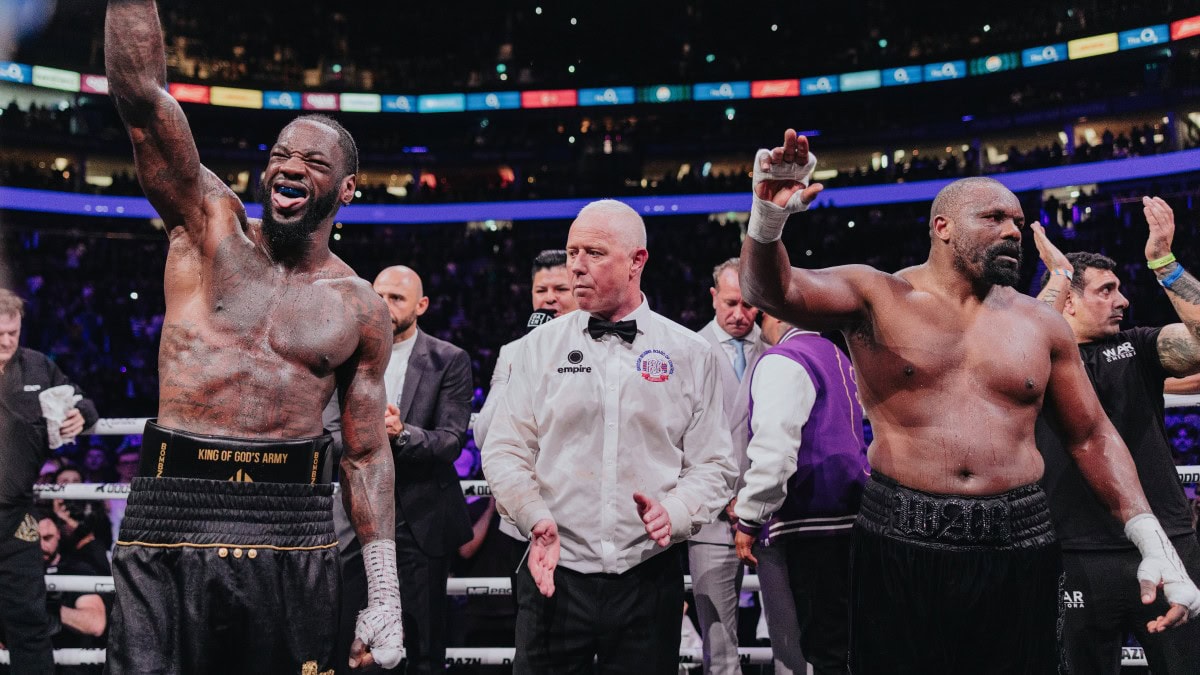
UK boxing officiating came under renewed scrutiny over the weekend as controversy followed both Deontay Wilder’s clash with Derek Chisora and Ellie Scotney’s undisputed title defense.
The fights themselves were very different, but the debate afterward sounded familiar as refereeing decisions and scorecards again became talking points.
Wilder voiced his frustration after edging Chisora at the O2 Arena in London, claiming repeated blows to the back of the head went largely unchecked during the contest.
“It’s crazy. If the ref was fair, you looking at a third round stoppage,” Wilder said at the post-fight press conference. “I got hit in the back of the head at least ten to twelve different times.
“And then when I finally retaliate and hit back, you pointing fingers at me. Deontay, don’t do that. I’m like, man, this man keep hitting me in the back of the head. I’m getting dizzy at times but I’m bouncing back.”
Wilder Unhappy at UK Officiating
Wilder also spoke about the dangers associated with rabbit punches.
“You know how many fighters get hit in the back of the head and don’t wake up tomorrow? That’s why I might not even go to sleep tonight. I feel good externally, but internally something maybe developing inside of me that I can’t see right now.”
The bout was officiated by British referee Mark Bates, whose handling of several moments during the contest quickly became a talking point afterward.
Despite Wilder’s complaints, the result itself was not widely disputed. The scoring, however, became another matter.
World Boxing News scored the fight 116-110 for Wilder, a margin that could reasonably have been wider. Chisora had no real case for victory, which makes the most favorable official card difficult to justify.
Looking back, several moments inside the ropes only added to the questions. Chisora’s corner entered the ring when the fighters became tangled near the ropes, and later appeared to help him back through the strands after he went outside the ring.
Both incidents fall into territory that can lead to disqualification under boxing rules, yet neither brought disciplinary action on the night.
A point deduction against Wilder also drew further scrutiny afterward.
None of those moments changed the winner, but they helped fuel questions about how the fight was handled from start to finish.

Bernstein Criticism
Long-time boxing broadcaster Al Bernstein weighed in shortly after the bout, directly referencing the officiating in Wilder vs. Chisora.
“If I were a fight manager and my fighter had to go to the UK to fight a UK fighter I would not accept the fight if there was a British referee,” Bernstein wrote on social media.
“Tonight Mark Bates added his name to the long list of British refs who have been outrageously biased to try and help British fighters win. Staggering to me that they are not even subtle in their efforts.”
Bernstein later made clear that his criticism was aimed at officiating, not British boxing itself.
“I love Great Britain as a whole. Love the place, love the fans, love other venues–have many good friends there and have wonderful memories of time there. I was first American to do boxing on a British network (Channel 5). So, when I make this negative comment it is very narrowly directed.”
The veteran analyst also acknowledged the problem is not exclusive to one country.
“I pointed out it in the post it happens in US and elsewhere that foreign fighters are treated unfairly. I have criticized US refs for doing it while on the air. But in recent years it has become an epidemic in UK.”

Ellie Scotney Debate
Sunday’s undisputed title fight involving Ellie Scotney produced a different argument, this time centered on the scorecards rather than the referee.
The fight looked competitive at first glance, although Scotney still appeared to produce the cleaner work across most of the rounds and deserved the decision.
The strongest reaction came from a 100-90 card that quickly became a talking point among fans and media.
One fan described it as “The worst card I have ever seen in my entire life,” a view Bernstein answered by calling it “Pretty darn bad.”
That does not mean the fight was scored the wrong way overall. It means Flores deserved more credit than a shutout suggests.
She celebrated at the final bell as though she had won, and while that did not reflect the final outcome, it did signify how involved she was in the contest.
In an undisputed title fight, a 100-90 card will always stand out when the challenger clearly had moments and made her opponent work.
Taken together with the Wilder-Chisora fallout the previous night, it added up to another uncomfortable weekend for UK boxing officiating.
Whether anything is done about it is another story entirely.
About the Author
Phil Jay is the Editor-in-Chief of World Boxing News (WBN) and a veteran boxing reporter with 15+ years of experience. He has interviewed world champions, broken international exclusives, and reported ringside since 2010. Read full bio.